
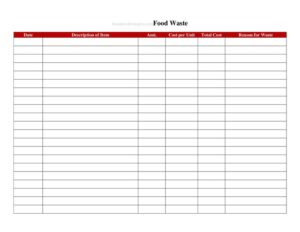
Food Waste Log
Track and reduce kitchen waste with a free Food Waste Log template, recording discarded items, quantities, reasons, and costs. Free download in PDF and DOCX.
PDF
DOCX
26 downloads
0
likes
Download Files
- DOCX
A Food Waste Log is a simple tracking sheet that kitchens use to record what food gets thrown away, how much, and why. Most restaurants reach for one when they want to cut costs, reduce spoilage, and understand where ingredients are slipping through the cracks. You can download this Food Waste Log free in both PDF and DOCX formats — no signup required.
What Is a Food Waste Log?
A Food Waste Log is a record-keeping document used in commercial kitchens, cafes, catering operations, and other food-service settings to capture every instance of discarded food. Each entry typically notes the date, the item wasted, the quantity, the reason it was thrown out, the estimated cost, and the staff member who recorded it. The log is usually filled out by line cooks, prep staff, or shift managers as waste happens, then reviewed by the kitchen manager or owner. Its purpose is straightforward: turn invisible, scattered waste into visible data so the team can spot patterns, trim over-ordering, and protect margins.
When Do You Need a Food Waste Log?
A Food Waste Log earns its place in almost any kitchen that buys and prepares fresh ingredients. Common situations where it helps include:
- Controlling rising food costs — when your cost of goods sold climbs and you need to find out where ingredients are disappearing.
- Reducing spoilage — tracking which produce, dairy, or proteins repeatedly expire before use so you can adjust par levels.
- Identifying prep and portioning errors — catching over-prepping, trim waste, or oversized portions returned on plates.
- Meeting sustainability goals — documenting waste reduction efforts for internal targets, certifications, or local composting and diversion programs.
- Training new kitchen staff — using logged data to coach cooks on knife skills, storage, and rotation habits.
- Menu engineering — flagging dishes whose ingredients are consistently wasted so you can re-cost or retire them.
What a Food Waste Log Should Have
A useful Food Waste Log captures enough detail to act on without becoming a chore to fill in. The core elements are the date and time of disposal, the food item and a quick description, the quantity wasted with a clear unit (pounds, portions, each), the reason for disposal, an estimated cost, the waste category (spoilage, overproduction, trim, plate waste), the staff initials, and a space for notes or corrective action. A header for the kitchen name or station and the reporting week ties the entries together and makes weekly review simple.
How to Fill Out a Food Waste Log
- Header: Write your restaurant or station name, the date or week the sheet covers, and the name of the manager responsible for reviewing it.
- Date and time: Enter when the waste occurred. Logging in real time is far more accurate than reconstructing it later.
- Food item: Name the specific ingredient or dish, such as “diced tomatoes” or “grilled chicken breast,” rather than a vague category.
- Quantity and unit: Record the amount and the unit you measured in — 2 lbs, 6 portions, 1 tray — so totals add up correctly.
- Reason / category: Note why it was discarded: spoilage, expired, overproduction, prep trim, dropped, customer return, or burnt.
- Estimated cost: Multiply the quantity by your known cost per unit to capture the dollar impact.
- Logged by: Add the initials or name of the staff member recording the entry for accountability.
- Notes: Jot any corrective action or context, then total the costs at the end of each shift or week.
Types of Food Waste to Track
Sorting entries by type makes your log far more revealing. Spoilage covers items that went bad before use, usually pointing to over-ordering or poor rotation. Overproduction is food prepped or cooked but never sold, common with buffets and batch cooking. Trim and prep waste includes peels, stems, and offcuts, some of which can be repurposed into stocks or staff meals. Plate waste is what customers leave behind, which can signal portion sizes that are too large. Tagging each entry with one of these categories lets you see at a glance whether your biggest losses come from the walk-in, the prep table, the line, or the dining room.
Turning Log Data Into Savings
A log only saves money if someone acts on it. Review entries at the end of each week and look for repeat offenders — the same ingredient spoiling again and again, or one dish driving most of the plate waste. Use those patterns to adjust ordering pars, reorganize the walk-in for better first-in-first-out rotation, retrain staff on portioning, or rework a menu item. Sharing weekly totals with the team, even posting them in the kitchen, keeps everyone aware. Over a few weeks, the trend line tells you whether your changes are working.
Common Mistakes to Avoid
- Logging after the fact: Trying to remember the day’s waste at closing leads to undercounting; record it as it happens.
- Vague descriptions: Writing “veggies” instead of the specific item makes the data useless for action.
- Inconsistent units: Mixing pounds, portions, and pieces without labeling them breaks your totals.
- Skipping the cost column: Without dollar figures, it is hard to prioritize which waste matters most.
- No follow-up: Collecting data but never reviewing it wastes the effort entirely.
- Blaming staff: Treating the log as a punishment tool discourages honest logging; frame it as a team improvement project.
Frequently Asked Questions
What is a Food Waste Log used for? It is used to record every instance of food thrown away in a kitchen, including the item, quantity, reason, and cost. Restaurants use it to find sources of waste, cut food costs, and support sustainability goals. The data turns scattered losses into clear patterns you can act on.
How do I fill out a Food Waste Log? Record the date, the specific food item, the quantity with its unit, the reason it was discarded, and an estimated cost, then add who logged it. Fill it in as waste happens rather than at the end of the day for accuracy. Total the costs at the end of each shift or week for review.
Who should fill out the log? Any staff member who discards food can make an entry — line cooks, prep cooks, dishwashers, and servers handling returns. A kitchen manager or owner typically reviews the completed log. Making logging quick and blame-free encourages everyone to participate honestly.
How often should I review the log? A weekly review works well for most kitchens, with a quick daily total at closing. Reviewing regularly lets you spot recurring spoilage or overproduction before it adds up. Some operations also do a deeper monthly analysis to track progress against waste-reduction targets.
Is this Food Waste Log free to download? Yes. You can download this Food Waste Log template free in both PDF and DOCX formats with no signup required. The DOCX version is fully editable so you can add your own columns, units, or branding.
Can I customize the template for my kitchen? Absolutely. Open the DOCX file and adjust the columns to match your stations, ingredients, or waste categories, and add a header with your restaurant name. You can also print copies for each prep area or convert it into a spreadsheet for automatic cost totals.
This Food Waste Log template is provided as a general example for informational purposes only and does not constitute legal, financial, tax, or regulatory advice. Health, sanitation, and waste-handling requirements vary by jurisdiction — consult the relevant local authorities or a qualified professional to ensure your practices comply with applicable rules.
Related Forms
- Takeout Menu
- Order Here Sign
- Refrigerator Inventory Log
- Breakfast Menu Casual
- Prix Fixe Menu Options
- Pick Up Here Sign
Browse more in Restaurant.