
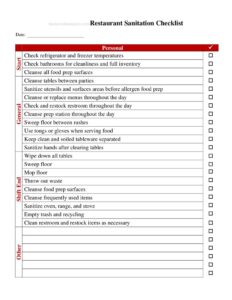
Restaurant Sanitation Checklist
Keep your kitchen clean and inspection-ready with this free Restaurant Sanitation Checklist template, available as a free download in PDF and DOCX.
PDF
DOCX
0
likes
Download Files
- DOCX
A Restaurant Sanitation Checklist is a structured form that kitchen and front-of-house staff use to confirm that every cleaning, food-safety, and hygiene task has been completed during a shift. The most common reason people use it is to stay consistently clean and ready for a surprise health inspection. You can download it free in both PDF and DOCX, with no signup required.
What Is a Restaurant Sanitation Checklist?
A Restaurant Sanitation Checklist is a daily, weekly, and monthly task list that documents the cleaning and food-safety routines a foodservice operation must perform to remain safe and compliant. It is typically issued by the restaurant owner, general manager, or kitchen manager and completed by line cooks, dishwashers, servers, and closing crews. The form records what was cleaned, when, and by whom, creating a paper trail that proves due diligence. It covers everything from sanitizing food-contact surfaces and checking refrigeration temperatures to mopping floors and emptying grease traps. Used correctly, it turns scattered cleaning habits into a repeatable system that protects customers, employees, and the establishment’s reputation.
When Do You Need a Restaurant Sanitation Checklist?
Almost any operation that handles, prepares, or serves food benefits from a written sanitation routine. Common situations include:
- Opening and closing shifts — to verify that surfaces, equipment, and floors are clean before service begins and after it ends.
- Preparing for a health inspection — a documented log demonstrates ongoing compliance rather than a last-minute scramble.
- Training new kitchen or wait staff — the checklist becomes a clear, teachable standard for what “clean” means.
- Managing multiple stations — prep, grill, fry, dish pit, and front counter each need their own verified tasks.
- Running food trucks, cafés, bars, or catering kitchens — smaller operations still need consistent sanitation records.
- Investigating a complaint or illness report — completed logs show whether procedures were followed on a given date.
Types of Sanitation Tasks Covered
Sanitation responsibilities fall into natural time-based groups, and a good checklist separates them so nothing is missed. Daily tasks include wiping and sanitizing prep tables, cleaning slicers and cutting boards, emptying trash, sweeping and mopping floors, and checking cooler and freezer temperatures. Weekly tasks often cover deep-cleaning hood vents, descaling sinks, washing walls and reach-in shelving, and cleaning behind heavy equipment. Monthly or periodic tasks may include calibrating thermometers, servicing grease traps, defrosting freezers, and replacing worn cutting boards. Organizing the form this way keeps everyday work fast while ensuring less-frequent jobs are not forgotten.
What a Restaurant Sanitation Checklist Should Have
To be useful and audit-friendly, a complete checklist should include the restaurant name and location, the date and shift, and the name or initials of the staff member responsible. Each task should have a clear description, a checkbox or status mark, and space to note the time completed. Temperature-related lines should allow a recorded reading rather than a simple check. A strong form also includes a section for corrective actions, a supervisor verification line, and a signature confirming the log was reviewed. Clear groupings by area or frequency make the document easy to scan and hard to skip.
How to Fill Out a Restaurant Sanitation Checklist
- Enter the header details. Write the restaurant name, location or station, the date, and the shift (opening, mid, or closing).
- Add the responsible employee. Record the name or initials of the person completing each section so accountability is clear.
- Work through each area. Move station by station — prep, cook line, dish area, storage, restrooms, and dining room — checking off tasks as they are finished.
- Record temperatures where required. For coolers, freezers, hot-holding, and food-product checks, write the actual reading and the time taken rather than a generic checkmark.
- Note any corrective action. If something is out of range or incomplete, describe the problem and what was done to fix it.
- Initial each completed section. Staff should sign or initial as they finish, not at the end of the day from memory.
- Have a supervisor verify. A manager reviews the log, confirms readings, and signs to certify the shift’s sanitation was completed.
- File the form. Store the completed checklist where it can be retrieved for inspections or internal review.
Tips for Building an Effective Routine
The best sanitation programs make the checklist part of the workflow rather than an afterthought. Post the form at eye level near each station so staff check off tasks in real time. Assign specific employees to specific sections to avoid the “someone else did it” gap. Color-coding by frequency — for example, one tint for daily and another for weekly tasks — helps closing crews see at a glance what is due. Pair the checklist with proper sanitizer concentration testing, since a wiped surface is not necessarily a sanitized one. Finally, review completed logs weekly to spot patterns, such as a cooler that repeatedly runs warm or a task that is consistently skipped.
How It Differs From a Food Safety or HACCP Plan
A sanitation checklist is a practical, task-level tool, while a full food-safety or HACCP plan is a broader written system identifying hazards and critical control points throughout your operation. The checklist supports that larger plan by documenting the routine cleaning and monitoring that keep hazards under control. Many inspectors expect to see both: the plan that explains your standards and the daily logs that prove you follow them. Treat the checklist as the everyday record that backs up your overall food-safety commitments.
Common Mistakes to Avoid
- Filling it out from memory at closing — check off tasks as they happen so the record is accurate.
- Marking temperatures as “OK” instead of recording numbers — actual readings prove compliance and reveal failing equipment.
- Skipping corrective-action notes — an inspector wants to see that problems were caught and fixed.
- Forgetting periodic tasks — weekly and monthly jobs slip when only daily items are tracked.
- Leaving sections unsigned — unverified logs offer little protection and weaken accountability.
- Never reviewing past logs — completed forms are only valuable if managers analyze them for recurring issues.
Frequently Asked Questions
What is a restaurant sanitation checklist used for? It is used to track and verify the cleaning, sanitizing, and food-safety tasks performed during each shift. The form creates a written record that supports compliance with health codes and helps maintain a consistently safe kitchen. It also serves as a training reference for new staff.
How often should the checklist be completed? Daily tasks should be recorded every shift, typically at opening and closing. Weekly and monthly tasks are logged on their scheduled days. Many restaurants keep daily logs in active use and revisit weekly and monthly items on a rotating calendar so nothing is overlooked.
Does a sanitation checklist need to be signed? While a signature is not legally required everywhere, having staff initial their sections and a supervisor verify and sign greatly increases the log’s value. Signatures establish accountability and demonstrate that the record was reviewed, which inspectors and auditors look for.
Is a sanitation checklist required by law? Specific recordkeeping requirements vary by jurisdiction and by the type of establishment. Many local health departments expect documented temperature monitoring and cleaning routines, especially as part of a food-safety plan. Check your local health code to confirm what records your operation must keep.
How long should completed checklists be kept? Retention periods differ by location, but keeping logs for at least several months to a year is a common practice. Storing them makes it possible to respond to inspections, complaints, or internal reviews. Confirm the required retention window with your local regulatory authority.
Is this template really free to download? Yes. The Restaurant Sanitation Checklist is available as a free download in both PDF and DOCX with no signup required. You can use the PDF as-is or open the DOCX to customize stations, tasks, and branding to match your kitchen.
This template is a general example provided for informational purposes only and does not constitute legal, health, or food-safety advice. Sanitation and recordkeeping requirements vary by jurisdiction and establishment type — consult your local health department or a qualified food-safety professional to ensure compliance.
Related Forms
- Bus Your Table Sign
- Refrigerator Temperature Log
- Shift Preferences Log
- Pick Up Here Sign
- Menu Template
- Refrigerator Inventory Log
Browse more in Restaurant.