
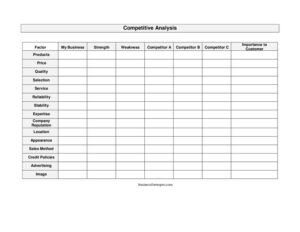
Competitive Analysis
Use this free Competitive Analysis template to compare your business against competitors across price, quality, and service — free PDF and DOCX download.
PDF
DOCX
3 downloads
0
likes
Download Files
- DOCX
A Competitive Analysis is a structured worksheet that lets you compare your business against your direct competitors across the factors that matter most to customers — price, quality, service, reputation, and more. Sales teams and small-business owners most often use it to spot where they win, where they lose, and where to focus their next move. You can download this Competitive Analysis template free in PDF and DOCX, with no signup required.
What Is a Competitive Analysis?
A Competitive Analysis is a side-by-side comparison tool that maps your company’s performance against rival businesses on a defined list of factors. It is typically created by a founder, sales manager, or marketing lead and used internally to guide strategy. Rather than relying on gut feeling, the form forces you to rate yourself and three competitors (Competitor A, B, and C) on concrete attributes such as products, price, quality, selection, service, reliability, and reputation. It also captures your own strengths and weaknesses on each factor and weighs how important each one is to customers. The result is a clear, evidence-based picture of your market position you can act on.
When Do You Need a Competitive Analysis?
This template earns its place any time you need to understand the playing field before making a decision. Common scenarios include:
- Building a business or marketing plan where you must demonstrate how you stack up against rivals.
- Preparing a sales pitch and needing crisp talking points about why your offer beats the alternatives.
- Setting or adjusting pricing after seeing where competitors sit on price versus quality.
- Launching a new product or entering a new location and wanting to map the existing field first.
- Pitching investors or lenders who expect to see a realistic competitive landscape.
- Running a quarterly strategy review to track how your position shifts over time against the same competitors.
Because the factors are repeatable, many teams refresh the same Competitive Analysis every few months to monitor trends rather than treating it as a one-time exercise.
What a Competitive Analysis Should Have
A complete analysis is built around a consistent set of comparison factors evaluated for every player. This template covers the essentials: products, price, quality, selection, service, reliability, stability, expertise, company reputation, location, appearance, sales method, credit policies, advertising, and image. For each factor, you record how your business performs, identify your specific strength and weakness, rate Competitors A, B, and C, and — critically — note the importance to customer. That last column keeps the analysis honest: being slightly weaker on a factor customers barely care about matters far less than being weak where it counts.
How to Fill Out a Competitive Analysis
- List your factors. Use the provided rows — products, price, quality, selection, service, reliability, stability, expertise, company reputation, location, appearance, sales method, credit policies, advertising, and image — or trim them to what’s relevant to your market.
- Rate “my business” on each factor honestly. Use a simple scale (such as 1–5) or short notes.
- Capture strength and weakness. For each factor, write a brief note on what you do well and where you fall short.
- Score Competitor A, Competitor B, and Competitor C on the same factors using the same scale so comparisons are valid.
- Mark importance to customer. Rate how much each factor influences buying decisions in your market.
- Review the patterns. Look for high-importance factors where a competitor outscores you — those are your priorities.
- Summarize and act. Translate the grid into two or three concrete decisions, like adjusting credit policies or sharpening your advertising.
How to Choose the Right Competitors to Analyze
The quality of your Competitive Analysis depends heavily on which three competitors you select. Choose businesses that genuinely compete for the same customers, not just companies in the same industry. A useful mix is your strongest direct rival, a fast-growing newer entrant, and an established alternative customers frequently mention. Avoid loading all three columns with similar firms, because that hides the diversity of threats you face. If a single competitor dominates the market, it is reasonable to give them a column and use the remaining two for smaller players who could disrupt you. Keep the same three competitors over multiple reviews so you can track movement over time.
Turning the Grid Into Action
A filled-out analysis is only valuable if it changes what you do. Scan for three patterns. First, defendable strengths — high-importance factors where you outscore everyone — should become the backbone of your sales messaging and image. Second, urgent gaps — high-importance factors where a competitor beats you — deserve a near-term plan, whether that’s improving service response times or revisiting price. Third, low-value efforts — factors customers barely weigh — may be areas where you’re over-investing. Where a competitor leads on reputation or expertise, consider how to close that perception gap through advertising and proof points. The goal is a short, prioritized list of moves, not a 15-row spreadsheet that sits in a drawer.
Common Mistakes to Avoid
- Rating yourself too generously. Self-flattery defeats the purpose; score as a skeptical customer would.
- Ignoring the importance-to-customer column, which leads you to chase factors buyers don’t actually value.
- Using different scales for different competitors, making the comparisons meaningless.
- Picking weak or irrelevant competitors so your business always looks ahead.
- Relying only on assumptions instead of checking competitor pricing, reviews, and advertising for real data.
- Treating it as a one-time document rather than revisiting it as the market shifts.
Frequently Asked Questions
What is a Competitive Analysis used for? It is used to compare your business against rival companies across the factors customers care about, such as price, quality, service, and reputation. The output helps you identify your competitive advantages and the gaps you need to close. It supports decisions about pricing, marketing, product focus, and sales strategy.
How do I fill out the Competitive Analysis template? List your comparison factors down the left column, then rate your own business and Competitors A, B, and C on each one using a consistent scale. Note your strength and weakness for each factor and how important that factor is to customers. Finish by reviewing the patterns and turning them into a short list of actions.
How many competitors should I include? This template provides three competitor columns, which is enough for most markets. Choose genuine, direct competitors that fight for the same customers rather than every company in your industry. If you have more, run separate sheets or focus on the most significant rivals.
Is a Competitive Analysis a legal document? No. It is an internal strategic worksheet, not a contract or filing, so it carries no legal weight and does not need signing, witnessing, or notarizing. It is meant to inform your planning and decision-making.
How often should I update it? Many businesses refresh their Competitive Analysis quarterly or whenever a notable market change occurs, such as a competitor launching a product or changing prices. Keeping the same factors and competitors over time lets you track shifts in your position.
Is this Competitive Analysis template really free? Yes. You can download the template free in PDF and DOCX formats with no signup or payment required. Edit the factors and ratings to match your business and market.
This Competitive Analysis template is a general example provided for informational purposes only. It is not business, legal, financial, or strategic advice, and the appropriate factors and approach vary by industry and market. Consult a qualified professional for guidance tailored to your situation.
Need to work out sales tax? Use our free Sales Tax Calculator to add or remove sales tax from any amount in seconds.
Official resource: for the rules that apply to your situation, see the U.S. Small Business Administration.
Related Forms
- Exercise Option
- Items to Sell
- Acceptance Of Defective Goods letter
- Small Parts Choking Hazard Warning Tag
- Appraisal Form
- Transmittal Letter
Browse more in Sales.