
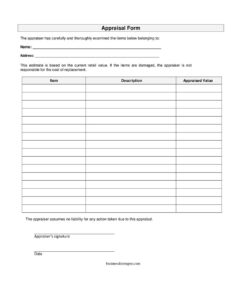
Appraisal Form
Use this free Appraisal Form template to document item descriptions and appraised values clearly; download as PDF or DOCX with no signup.
PDF
DOCX
7 downloads
0
likes
Download Files
- DOCX
An Appraisal Form is a document an appraiser uses to record the estimated value of specific items belonging to a person or business, most often to establish current retail value for sales, insurance, or resale purposes. People reach for it when they need a clean, signed record of what something is worth. You can download this Appraisal Form free in PDF and DOCX, with no signup required.
What Is an Appraisal Form?
An Appraisal Form is a written statement prepared by an appraiser that identifies one or more items, describes them, and assigns an estimated value to each. It is typically issued by a qualified appraiser or evaluator and given to the owner of the items. The form documents that the appraiser examined the items, the basis of the valuation (here, current retail value), and a clear limitation of liability. In a sales context, it helps buyers and sellers agree on a fair price, supports trade-ins, and provides a paper trail. Because it is signed, it carries more weight than a casual verbal estimate and can be referenced later if the value of the items is questioned.
When Do You Need an Appraisal Form?
This form fits any situation where someone needs a documented opinion of value. Common scenarios include:
- Selling or trading goods — a dealer or shop appraises inventory, jewelry, electronics, or equipment before agreeing on a sale price.
- Estate and inheritance matters — heirs need a record of what household items, collectibles, or assets are worth.
- Resale and consignment — a consignment shop documents the retail value of items it accepts.
- Donations — a donor records the value of goods given to a charity or organization.
- Pawn, loan, or collateral evaluations — a lender values items offered against a loan.
- Personal records — an owner simply wants a professional estimate kept on file for high-value possessions.
What an Appraisal Form Should Have
A complete Appraisal Form should clearly identify the owner of the items, including their address, so there is no confusion about whose property is being valued. It should state the basis of valuation — in this template, the current retail value — and include an itemized chart listing each item, a meaningful description, and the appraised value assigned to it. Equally important are the limitation statements: that the appraiser is not responsible for replacement costs if items are damaged, and that the appraiser assumes no liability for actions taken based on the appraisal. Finally, the form needs signature lines so both the appraiser and, where appropriate, the owner can sign and date the document, confirming it was completed and acknowledged.
How to Fill Out an Appraisal Form
- Enter the owner’s name and address. At the top, fill in the name of the person whose items are being examined and their full address. This ties the appraisal to a specific owner.
- Confirm the basis of value. The template states the estimate is based on current retail value. Make sure this matches what you intend; if you are appraising for a different purpose, note that clearly.
- List each item in the chart. In the first column, name the item plainly — for example, “14k gold ring” or “laptop computer.”
- Add a description. In the description column, record identifying details such as condition, brand, model, serial number, dimensions, materials, or distinguishing marks.
- Assign the appraised value. In the value column, write the estimated current retail value for each item, using consistent currency.
- Review the liability statements. Confirm the language noting the appraiser is not responsible for replacement costs of damaged items and assumes no liability for actions taken.
- Sign and date. The appraiser signs on the first line; the owner may sign on the second to acknowledge receipt.
Understanding the Liability Language
This Appraisal Form deliberately includes two protective statements, and it is worth understanding why. The first clarifies that if the items turn out to be damaged, the appraiser is not responsible for the cost of replacement — the appraisal reflects an opinion of value, not a guarantee about condition. The second states that the appraiser assumes no liability for any action taken because of the appraisal, meaning the document is informational and the reader decides how to use it. These clauses are standard practice and protect the appraiser from being held accountable for market shifts, hidden defects, or decisions a buyer or seller makes. If you are the owner, read these statements before relying on the figures, and remember that an appraisal is an estimate at a point in time.
Tips for an Accurate Appraisal
The usefulness of an Appraisal Form depends on the quality of the detail it captures. Photograph each item before completing the chart so the description matches a visual record. Be specific in the description column — “diamond bracelet, 18k, 7 inches, slight wear on clasp” is far more defensible than “bracelet.” Date the appraisal clearly, because retail values change over time and an undated estimate quickly loses meaning. Keep a copy for both parties, and consider attaching receipts, certificates of authenticity, or prior appraisals as supporting documentation. If items are part of a set, note that so the combined value is understood.
Common Mistakes to Avoid
- Leaving descriptions vague — generic entries like “watch” make the form hard to verify later.
- Forgetting to date the form — without a date, the appraised values cannot be tied to a market period.
- Mixing valuation bases — using retail value for some items and a different basis for others without noting it.
- Skipping the signature lines — an unsigned appraisal carries far less weight.
- Omitting the owner’s address — this detail links the document to the right person and property.
- Treating the estimate as a guarantee — ignoring the liability clauses that clearly limit the appraiser’s responsibility.
Frequently Asked Questions
What is an Appraisal Form used for? It is used to document an appraiser’s estimate of the value of specific items belonging to an owner. People use it for sales, trade-ins, estate records, insurance, donations, and collateral evaluations. It provides a signed, written record rather than an informal verbal guess.
How do I fill out an Appraisal Form? Enter the owner’s name and address, then list each item with a clear description and its appraised value in the chart. Confirm the valuation basis and liability statements, then have the appraiser sign and date the form. Adding photos or supporting documents makes the appraisal stronger.
Does an Appraisal Form need to be notarized? Notarization is generally not required for a basic appraisal, since the appraiser’s signature usually suffices. However, some institutions — such as insurers, courts, or lenders — may request a notarized or certified appraisal. Check the requirements of whoever will rely on the document.
Is an Appraisal Form legally binding? An appraisal is an opinion of value, not a contract, so it does not bind either party to a transaction by itself. The liability statements in this template specifically limit the appraiser’s responsibility. It can still serve as useful evidence of value in negotiations, claims, or disputes.
Who should sign the Appraisal Form? The appraiser signs to confirm they examined the items and assigned the values. The owner can sign the second line to acknowledge receipt of the appraisal. Both signatures help establish that the document was completed and accepted.
How much does this Appraisal Form template cost? This template is completely free to download here at Business Forms Pro in both PDF and DOCX formats, with no signup or payment required. You can fill it out digitally or print it. Only a professional appraisal performed by an appraiser may carry a separate service fee.
This Appraisal Form template is provided as a general example for informational purposes only and is not legal, financial, or tax advice. Valuation standards and documentation requirements vary by jurisdiction and by the institution relying on the appraisal. Consult a qualified appraiser or professional for advice specific to your situation.
Need to work out sales tax? Use our free Sales Tax Calculator to add or remove sales tax from any amount in seconds.
Official resource: for the rules that apply to your situation, see the U.S. Small Business Administration.
Related Forms
- New Benefits Announcement
- Rejected Goods Notification
- Order Authorization Form
- Shipment Procedure
- Commission Summary
- New Customer Form
Browse more in Sales.