
Shipment Procedure
Download a free Shipment Procedure letter template to confirm orders, share tracking, and set delivery expectations with customers in PDF or DOCX.
PDF
DOCX
4 downloads
0
likes
Download Files
- DOCX
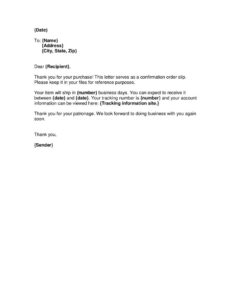
A Shipment Procedure letter is a customer-facing confirmation that tells a buyer their order has been received and explains exactly when and how their item will ship. Businesses use it most often to acknowledge a purchase, set clear delivery expectations, and hand over a tracking number in one tidy message. You can download this Shipment Procedure template for free in PDF and DOCX formats, with no signup required.
What Is a Shipment Procedure Letter?
A Shipment Procedure letter is a written notice sent by a seller, online store, or fulfillment team to a customer after an order is placed. It functions as a confirmation order slip: it documents who the buyer is, restates that the purchase went through, and outlines the shipping timeline. The letter typically includes the number of business days until dispatch, an estimated delivery window, a tracking number, and a link where the customer can view account or shipment status. Its purpose is to reassure the buyer, reduce “where is my order?” inquiries, and create a record both parties can reference. Because it is friendly and informational rather than contractual, it strengthens the customer relationship while keeping logistics transparent.
When Do You Need a Shipment Procedure Letter?
This letter is useful any time you want to formally acknowledge an order and communicate shipping details. Common scenarios include:
- An online retailer confirming a web order and providing the carrier tracking number.
- A small business that processes orders manually and emails or mails a written confirmation slip.
- A wholesaler shipping a bulk order to a business client who needs the delivery window for planning.
- A handmade or print-on-demand seller whose items ship in a set number of business days after production.
- A company replacing or reshipping an item and wanting to restate the new timeline in writing.
- A subscription or recurring-order business sending a per-shipment notice for each fulfillment cycle.
What a Shipment Procedure Letter Should Have
A complete Shipment Procedure letter blends a warm thank-you with the practical facts a customer needs. The essential elements are the date the letter is issued, the recipient’s name and full mailing address, and a clear opening that confirms the purchase. From there, it should state the processing time in business days, an estimated delivery window with a start and end date, the tracking number, and a link to where the customer can monitor their shipment or account. It closes with a courteous sign-off and the sender’s name. Keeping these details accurate and complete turns the letter into a reliable reference document the buyer can keep on file.
How to Fill Out a Shipment Procedure Letter
- Enter the {Date} at the top — the day you send the confirmation.
- In the address block, fill in the customer’s {Name}, {Address}, and {City, State, Zip} so the letter is properly directed.
- Open with the greeting using the {Recipient} field, addressing the buyer by name.
- Keep the thank-you and confirmation line as written so the buyer knows the letter is their order slip.
- Specify the processing time in the {number} field for business days until the item ships.
- Provide the estimated delivery window by entering the start {date} and end {date} the customer should expect their item.
- Add the carrier {number} tracking number so the buyer can follow the package.
- Insert the {Tracking information site.} link where the customer can view shipment and account status.
- Sign off with your name in the {Sender} field, then proofread every date and number before sending.
Tips for a Clear, Effective Shipment Notice
Accuracy is everything in a shipment letter, because every figure sets an expectation. Double-check that the processing days and the delivery window agree with each other — if the item ships in three business days, the start of your delivery window should reflect that head start plus carrier transit. Paste the tracking number directly from your carrier’s system to avoid transcription errors, and confirm the tracking link actually loads before sending. Use a tone that matches your brand: the template’s friendly thank-you works well, but you can adjust wording for a more formal or more casual voice. If you ship internationally, consider noting that customs may affect the delivery window. Sending the letter promptly after dispatch, rather than days later, keeps the information fresh and reduces follow-up questions.
Shipment Procedure Letter vs. Invoice and Packing Slip
It helps to know where this letter sits among related sales documents. An invoice requests or records payment and itemizes costs; a packing slip lists the physical contents of a box and travels inside the package. A Shipment Procedure letter, by contrast, is a communication about timing and tracking — it confirms the order and tells the buyer when to watch for the package. While some businesses combine these, keeping the shipment notice separate makes it easy to send digitally the moment a label is generated, even if the invoice was settled earlier. Think of it as the bridge between “order placed” and “package delivered.”
Common Mistakes to Avoid
- Leaving the tracking number blank or mistyping a digit, which sends the customer to an error page.
- Promising a delivery window that the chosen shipping method cannot realistically meet.
- Forgetting to update the dates when reusing the template for a new order.
- Using “days” instead of “business days,” which confuses weekend and holiday timing.
- Misspelling the recipient’s name or sending to the wrong address block.
- Sending the letter long after dispatch, so the estimated window has already passed.
Frequently Asked Questions
What is a Shipment Procedure letter used for? It is used to confirm a customer’s order and communicate shipping details in writing. It tells the buyer how many business days until the item ships, when to expect delivery, and how to track the package. It also serves as a confirmation slip the customer can keep for their records.
How do I fill out the Shipment Procedure template? Start with the date and the customer’s name and address, then greet them by name. Fill in the processing time in business days, the estimated delivery start and end dates, the tracking number, and the link where they can view their shipment status. Finish by signing your name as the sender and proofreading every detail.
Is a Shipment Procedure letter legally binding? It is primarily an informational and customer-service document rather than a contract. The delivery dates are estimates, so they generally do not create a guaranteed legal obligation unless your stated terms of sale say otherwise. Still, it is good practice to keep your timelines realistic since they shape the customer’s expectations.
Does this letter need to be signed or notarized? No notarization is needed. A simple typed or written signature in the sender field is all that is required, since this is a routine business communication and not a legal instrument that affects rights or obligations.
Can I use this for email instead of a printed letter? Yes. The template works equally well as the body of an order confirmation email or as a printed slip enclosed with documents. Many sellers copy the wording into their email system and fill in the same fields automatically from their order data.
How much does this Shipment Procedure template cost? Nothing — it is completely free to download from Business Forms Pro in both PDF and DOCX formats. There is no signup required, and you can edit the DOCX version to add your logo, brand colors, or custom wording.
This Shipment Procedure template is provided as a general example for informational purposes only and does not constitute legal, financial, or business advice. Shipping obligations, consumer-protection rules, and delivery requirements vary by jurisdiction and by your own terms of sale. Consult a qualified professional to ensure your customer communications meet applicable requirements.
Need to work out sales tax? Use our free Sales Tax Calculator to add or remove sales tax from any amount in seconds.
Official resource: for the rules that apply to your situation, see the U.S. Small Business Administration.
Related Forms
- Daily Sales Log
- Vendor Performance Warning Letter
- Appraisal Form
- Credit Application
- Small Parts Choking Hazard Warning Tag
- New Benefits Announcement
Browse more in Sales.