
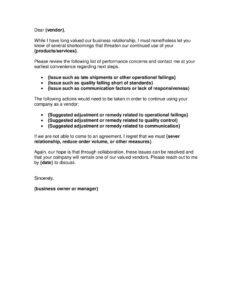
Vendor Performance Warning Letter
Address supplier issues with a Vendor Performance Warning Letter that documents problems and required improvements — free template download in PDF and DOCX.
PDF
DOCX
2 downloads
0
likes
Download Files
- DOCX
A Vendor Performance Warning Letter is a formal written notice a buyer sends to a supplier when delivery, quality, or service standards fall below the agreed terms. Companies most often use it to put a struggling vendor on notice, document the problem in writing, and set clear expectations for improvement before escalating to penalties or termination. You can download this template free in PDF and DOCX with no signup required.
What Is a Vendor Performance Warning Letter?
A Vendor Performance Warning Letter is a business document issued by a purchasing organization to a supplier, contractor, or service provider whose performance is not meeting contractual or quality requirements. It is typically prepared by a procurement manager, vendor relations specialist, or operations lead and addressed to the vendor’s account or relationship manager. The letter documents specific shortcomings — such as late shipments, defective goods, missed service levels, or billing errors — references the relevant agreement, and states what corrective action is expected and by when. It serves as both a professional prompt to fix the issue and a paper trail that protects the buyer if the relationship later needs to be escalated or ended.
When Do You Need a Vendor Performance Warning Letter?
This letter is useful whenever a supplier relationship is slipping but you still want to give the vendor a fair chance to recover. Common scenarios include:
- Chronic late deliveries — a supplier repeatedly misses agreed lead times, disrupting your production or sales schedule.
- Quality failures — incoming goods fail inspection, arrive damaged, or show rising defect rates that violate the spec.
- Missed service-level agreements — a service vendor falls short of contracted response times, uptime, or completion targets.
- Billing and invoicing problems — recurring overcharges, duplicate invoices, or pricing that doesn’t match the contract.
- Poor communication or unresponsiveness — the vendor stops returning calls, ignores escalations, or fails to provide promised reports.
- Compliance or safety lapses — the supplier breaches certification, documentation, or regulatory obligations specified in the agreement.
What a Vendor Performance Warning Letter Should Have
A complete and effective letter does more than express frustration — it builds a clear, factual record. The strongest versions include the date and a unique reference number, full details for both your company and the vendor, and a clear statement that this is a formal performance warning. They identify the specific issues with dates, order numbers, and measurable facts rather than vague complaints, and they cite the relevant contract clause or purchase order. Crucially, the letter spells out the required corrective action, a realistic deadline for improvement, and the consequences if performance does not recover — for example, withheld payment, financial penalties, suspension, or termination. A signature block and a request for written acknowledgment round out the document.
How to Fill Out a Vendor Performance Warning Letter
- Add the date and reference number so the letter can be tracked and tied to your vendor file.
- Enter your company details — legal name, address, and the issuing department or manager’s name and title.
- Enter the vendor’s details — company name, address, and the contact person who manages your account.
- Reference the agreement — list the contract number, purchase order, or service agreement the vendor is failing to meet.
- Describe the performance issues — state each problem with specific dates, order or invoice numbers, quantities, and measurable shortfalls.
- State the impact — explain how the failures affected your operations, costs, customers, or deadlines.
- Define the required corrective action — describe exactly what the vendor must do to return to acceptable performance.
- Set a deadline — give a firm date by which improvement must be demonstrated.
- Outline consequences — note what happens if standards are not met, such as penalties, probation, or termination.
- Sign and request acknowledgment — add the authorized signature, title, and a line asking the vendor to confirm receipt.
Types of Performance Issues This Letter Covers
One letter can address a single incident or a pattern, and tailoring the tone to the situation matters. A first-notice warning for an isolated lapse should be firm but collaborative, inviting the vendor to explain and correct. A repeat-offense warning, sent after earlier informal conversations, should reference those prior discussions and adopt a more serious tone. A final warning makes clear that termination is the next step. Whichever applies, keep the language factual and professional — the goal is to fix the relationship where possible and to create a defensible record where it isn’t.
Keeping a Defensible Record
Because this letter may later support a decision to withhold payment or end a contract, treat it as part of your formal vendor file. Send it through a method that proves delivery, such as email with a read receipt or tracked mail, and keep a copy of the signed acknowledgment. Note in your records any phone calls or meetings that preceded the letter, and follow up after the deadline with a documented assessment of whether the vendor improved. This disciplined trail strengthens your position and demonstrates that you acted in good faith.
Common Mistakes to Avoid
- Being vague — writing “poor service” instead of citing specific dates, orders, and measurable failures weakens your case.
- Skipping the contract reference — failing to tie the issue to a clause or PO makes the warning harder to enforce.
- Setting no deadline — without a clear improvement date, the vendor has no urgency and you have no trigger for next steps.
- Using an emotional or hostile tone — anger undermines professionalism and can damage a salvageable relationship.
- Omitting consequences — if the letter never states what happens next, it reads as a complaint rather than a warning.
- Not keeping proof of delivery — an undocumented letter offers little protection if the dispute escalates.
Frequently Asked Questions
What is a Vendor Performance Warning Letter? It is a formal notice sent by a buyer to a supplier whose delivery, quality, or service performance is below agreed standards. The letter documents the problems, references the contract, and sets out the corrective action and deadline required to avoid further consequences.
How do I fill out a Vendor Performance Warning Letter? Add the date, reference number, and full details for your company and the vendor, then describe each performance issue with specific dates and order numbers. Finish by stating the required corrective action, a clear deadline, the consequences of non-compliance, and your authorized signature.
Is a Vendor Performance Warning Letter legally binding? The letter itself is a notice rather than a contract, but it can carry significant legal weight as evidence that you notified the vendor and gave them a chance to comply. If your underlying agreement allows penalties or termination for poor performance, this letter often becomes a required or supporting step in that process.
Does the letter need to be signed or witnessed? It should be signed by an authorized representative such as a procurement manager, but witnesses or notarization are generally not required. Requesting the vendor’s written acknowledgment of receipt is more valuable than a witness for proving the notice was delivered.
How much does this template cost? Nothing — you can download the Vendor Performance Warning Letter free from Business Forms Pro in both PDF and DOCX formats with no signup. The editable DOCX version lets you customize the company names, issues, deadlines, and consequences for your situation.
What should happen after I send the letter? Monitor the vendor’s performance against the deadline you set and document the results. If they improve, note the recovery in your file; if they don’t, the letter supports your next step, whether that is a final warning, withheld payment, or termination under your contract.
This template is a general example provided for informational purposes only and is not legal, financial, or contractual advice. Procurement rules and contract enforcement requirements vary by jurisdiction and by the terms of your specific agreement, so consult a qualified legal or procurement professional before acting on a vendor dispute.
Need to work out sales tax? Use our free Sales Tax Calculator to add or remove sales tax from any amount in seconds.
Official resource: for the rules that apply to your situation, see the U.S. Small Business Administration.
Related Forms
- Order Authorization Form
- Cancel Stop Payment And Honor Check
- Ebay Auction Worksheet
- Request For Appointment
- Announcing Sales Campaign
- Proposal Form
Browse more in Sales.