
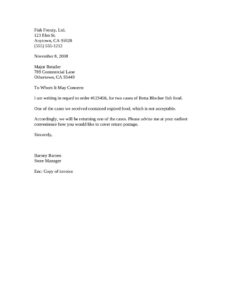
Request To Return Merchandise
Download a free Request to Return Merchandise letter template in PDF and DOCX to notify a supplier of a return and resolve return shipping costs.
DOCX
0
likes
Download Files
- DOCX
A Request to Return Merchandise is a written letter sent by a buyer to a supplier or retailer to formally notify them that goods are being returned and to request instructions on how to proceed. People most often use it when an order arrives damaged, defective, expired, or incorrect and they need a paper trail. You can download this Request to Return Merchandise template for free in PDF and DOCX — no signup required.
What Is a Request to Return Merchandise?
A Request to Return Merchandise is a business letter that documents a buyer’s intention to send products back to a seller. It is typically issued by the receiving business — a store, distributor, or office — and addressed to the supplier or retailer who shipped the order. The letter identifies the specific order, explains why the items are being returned, and asks the seller to confirm next steps such as covering return postage or issuing a replacement. Rather than a phone call that leaves no record, this letter creates clear written evidence of the complaint and the date it was raised, which is useful if a refund, credit, or replacement is later disputed.
When Do You Need a Request to Return Merchandise?
This letter is useful in any situation where you must send goods back and want a documented request on file. Common scenarios include:
- You received expired or spoiled stock, such as the case of Betta Blocker fish food in the sample, that cannot be sold to customers.
- An order arrived damaged in transit with broken packaging or crushed contents.
- The supplier shipped the wrong item, wrong quantity, or wrong size compared with what was ordered.
- Products are defective or not working as described on the invoice.
- You ordered too much inventory and want to return surplus stock under the supplier’s return policy.
- You need a formal record before requesting a refund, store credit, or replacement shipment.
What a Request to Return Merchandise Should Have
A complete return request letter is short but precise. It should include your business name and contact details, the date, and the recipient’s company name and address. The body must clearly reference the original order or invoice number, name the specific product and quantity being returned, and state plainly why the goods are unacceptable. Crucially, it should ask the seller to respond with return instructions — particularly how return postage will be handled — and note any enclosures, such as a copy of the invoice, that support the claim. A polite, factual tone keeps the relationship professional while still protecting your interests.
How to Fill Out a Request to Return Merchandise
- Add your business header. Enter your company name, street address, city, state, ZIP, and phone number at the top, as Fish Frenzy, Ltd. did in the sample.
- Date the letter. Use the date you are sending it so there is a clear timestamp for the complaint.
- Address the recipient. Write the supplier or retailer’s company name and full mailing address, then open with a salutation such as “To Whom It May Concern” if you have no named contact.
- State the order reference. Identify the order or invoice number — for example, order #123456 — and the product and quantity, such as two cases of fish food.
- Explain the problem. Describe the specific issue, like one case containing expired food, and state clearly that you will be returning the affected goods.
- Request next steps. Ask the seller to advise how they want return postage covered, and request a reply at their earliest convenience.
- Sign off. Close with “Sincerely,” your signature, your printed name, and your title (for example, Store Manager).
- List enclosures. Note any attachments, such as “Enc: Copy of invoice,” so the recipient knows what was sent.
How to Handle Return Postage and Replacements
One of the most important purposes of this letter is to settle who pays for return shipping. Many suppliers cover postage when the fault is theirs — expired stock, a packing error, or a defective product — but they often want to issue a prepaid label or a Return Merchandise Authorization (RMA) number first. By asking the seller to advise how they want postage covered, you avoid shipping items back at your own expense and then arguing about reimbursement later. Keep the returned goods in their original packaging where possible, take photos of any damage or expiration dates, and hold onto tracking information once you ship. If the supplier offers a replacement instead of a refund, confirm the arrangement in writing so both sides have a matching record.
Request to Return Merchandise vs. a Refund Demand
This letter is a request and notification, not a formal demand for money. It signals a problem and invites the seller to cooperate on a solution, which usually preserves a good working relationship with a vendor you may keep buying from. A refund demand, by contrast, is more forceful and typically follows after a return request has been ignored or refused. Starting with the polite return request is almost always the smarter first step, because most reputable suppliers want repeat business and will resolve a legitimate complaint quickly. Escalate only if you get no response within a reasonable time.
Common Mistakes to Avoid
- Leaving out the order or invoice number, which makes it hard for the supplier to locate your transaction.
- Being vague about the problem — name the exact product, quantity, and defect rather than a general complaint.
- Forgetting to ask about return postage, so you end up paying shipping you could have avoided.
- Shipping items back before getting authorization, which some suppliers require for a refund or credit.
- Not keeping a copy of the letter and the enclosed invoice for your own records.
- Using an aggressive tone on a first contact when a professional, factual letter usually gets faster results.
Frequently Asked Questions
What is a Request to Return Merchandise used for? It is a letter that formally notifies a supplier or retailer that you are returning goods and asks how they want to handle the return. Businesses use it for expired, damaged, defective, incorrect, or surplus items to create a written record of the complaint and the date it was made.
How do I fill out a Request to Return Merchandise? Add your business header and the date, address the supplier, reference the order or invoice number, describe the product and the problem, and ask how return postage will be covered. Then sign with your name and title and note any enclosures such as a copy of the invoice.
Does this letter need to be notarized or witnessed? No. A return request is ordinary business correspondence, so it does not require notarization or witnesses. A clear signature, your title, and the date are enough; sending it by a trackable method simply adds proof of delivery.
Is a Request to Return Merchandise legally binding? The letter itself is a notification and request rather than a binding contract. Your actual return rights depend on the supplier’s return policy, your purchase agreement, and applicable consumer or commercial laws, so the letter works best alongside those terms.
Should I include a copy of the invoice? Yes, enclosing a copy of the invoice helps the supplier match your request to the correct order and speeds up processing. Note the enclosure at the bottom of the letter, as in “Enc: Copy of invoice,” and keep the original for your files.
How much does this template cost? It is completely free to download from Business Forms Pro in both PDF and DOCX formats, with no signup required. You can edit the DOCX version to match your own company details, order numbers, and the specific reason for your return.
This template is a general example provided for informational purposes only and is not legal, financial, or tax advice. Return rights and supplier obligations vary by jurisdiction and by contract. Consult a qualified professional for guidance on your specific situation.
Need to work out sales tax? Use our free Sales Tax Calculator to add or remove sales tax from any amount in seconds.
Official resource: for the rules that apply to your situation, see the U.S. Small Business Administration.
Related Forms
- Customer Referral Form
- Transmittal Letter
- Rebate Tracker
- Amortization Schedule
- Election To Cancel Contract
- Gift Certificate Log
Browse more in Sales.