
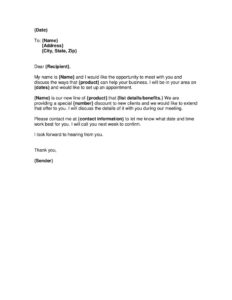
Request For Appointment
Download a free Request for Appointment letter template to set up a sales meeting professionally — free PDF and DOCX download, no signup required.
PDF
DOCX
2 downloads
0
likes
Download Files
- DOCX
A Request for Appointment letter is a short, professional sales message used to ask a prospect for a face-to-face or virtual meeting so you can present your product and discuss how it benefits their business. Salespeople most often use it to open a relationship with a new client and book time during an upcoming visit to the area. You can download this template free in PDF and DOCX, with no signup required.
What Is a Request for Appointment Letter?
A Request for Appointment letter is a brief outreach document sent by a salesperson, account executive, or business owner to a potential customer. It introduces the sender, names the product or service being offered, and politely asks the recipient to set aside time for a meeting. The letter does the groundwork of a cold call in writing: it explains why a conversation would be worthwhile, mentions a specific window of availability, and often dangles an incentive such as a new-client discount. Because it is short and personalized, it tends to land better than a generic mass email and gives the prospect a clear, low-pressure way to respond before the sender follows up by phone.
When Do You Need a Request for Appointment Letter?
This letter fits a range of sales and business-development situations. Common uses include:
- Introducing a new product line to prospects in a territory you plan to visit on specific dates.
- Reaching out to a warm referral who has not yet met you in person.
- Following up after a trade show or networking event to convert interest into a booked meeting.
- Re-engaging a lapsed or dormant account with a fresh offer or discount.
- Pitching to a decision-maker at a target company you have never sold to before.
- Coordinating a regional sales trip where you want several appointments scheduled in advance.
In each case, the goal is the same: secure a confirmed time on the prospect’s calendar so your sales conversation can begin.
What a Request for Appointment Letter Should Have
A strong appointment request stays concise while covering the essentials. It should include the date, the recipient’s name and full mailing address, and a warm but professional greeting. The body needs a clear statement of who you are, what product you are offering, and a specific reason the meeting benefits the reader. Mentioning the dates you will be in the area gives the request urgency and structure. Naming an incentive — such as a new-client discount — adds a reason to say yes. Finally, it must include your contact information, a promise to follow up, and a courteous closing with your signature. Specificity beats vagueness throughout.
How to Fill Out a Request for Appointment Letter
- Enter the {Date} at the top so the recipient knows when the letter was sent.
- Fill the recipient block: {Name}, {Address}, and {City, State, Zip} exactly as they appear on file.
- Open with Dear {Recipient}, using the contact’s correct name and title.
- State your own {Name} and the purpose of the letter in the first sentence.
- Name the {product} you want to discuss and how it can help the reader’s business.
- Insert the {dates} you will be in their area to anchor the meeting window.
- Describe your new line — fill the {list details/benefits} field with two or three concrete advantages.
- Add the {number} for the special new-client discount you are extending.
- Provide your {contact information} — phone, email, or both — and note that you will call to confirm.
- Close with a thank-you and sign as the {Sender}.
Tips for Writing an Appointment Request That Gets a Yes
Keep the letter to a single page; busy prospects skim. Lead with the benefit to them, not a catalog of your features — replace the {list details/benefits} placeholder with outcomes the reader cares about, such as time saved or costs reduced. Personalize the greeting and reference something specific about their company when possible, so the note does not read as a template. Offering a clear discount tied to a deadline (your travel {dates}) creates a natural reason to act now. Always state exactly how and when you will follow up; the line “I will call you next week to confirm” sets expectations and keeps momentum. Proofread names and addresses carefully, since a misspelled recipient name undermines an otherwise polished pitch.
Following Up After You Send It
The letter is only the first touch. Plan to call during the week you promised, and have two or three proposed time slots ready so the prospect can choose quickly rather than open-endedly. If you reach voicemail, leave a short message referencing the letter and the discount, then try again a few days later. When the meeting is booked, send a brief confirmation email restating the date, time, location, and what you will cover. Tracking each request in a simple spreadsheet or CRM helps you stay organized when you are sending several letters ahead of a regional visit.
Common Mistakes to Avoid
- Making it all about you. Prospects respond to benefits for their business, not a list of your accomplishments.
- Leaving the dates vague. “Sometime soon” gives no reason to commit; specific travel {dates} create urgency.
- Forgetting your contact information, which makes it impossible for an interested reader to respond.
- Overstuffing the {list details/benefits} field with jargon instead of two or three clear, concrete points.
- Not following up. If you promise to call next week, calling builds credibility; failing to call kills the lead.
- Sending it without proofreading the recipient’s name, address, and discount figure.
Frequently Asked Questions
What is a Request for Appointment letter used for? It is a sales outreach tool that asks a prospect to set up a meeting to discuss your product or service. It introduces you, explains the benefit of meeting, and proposes a time window, often with an incentive like a new-client discount.
How do I fill out the Request for Appointment template? Add the date and the recipient’s name and address, then personalize the greeting and body with your name, the product, your travel dates, the benefits, and the discount amount. Finish with your contact information and signature, and proofread before sending.
Should I send this letter by mail or email? Either works depending on your relationship and industry. A printed letter can stand out for higher-value B2B prospects, while email is faster and easier to follow up on; the template adapts to both formats.
Does a Request for Appointment letter need to be signed or notarized? No. It is an informal business communication, not a legal contract, so it requires no notarization or witnesses. A simple signature or sign-off as the sender is all that is needed.
How long should the letter be? Keep it to a single, scannable page. A few short paragraphs covering who you are, the product benefit, your availability, the offer, and a follow-up promise is enough to prompt a response without overwhelming the reader.
Is this Request for Appointment template free to download? Yes. You can download it free in PDF and DOCX formats with no signup required, then customize every field for your own product, prospect, and travel schedule.
This template is a general example provided for informational purposes only and does not constitute legal, financial, or business advice. Sales practices and communication requirements vary by industry and jurisdiction — consult a qualified professional for guidance specific to your situation.
Need to work out sales tax? Use our free Sales Tax Calculator to add or remove sales tax from any amount in seconds.
Official resource: for the rules that apply to your situation, see the U.S. Small Business Administration.
Related Forms
- Items to Sell
- Sales Report By Location
- Competitive Analysis
- New Customer Form
- Order Authorization Form
- Request To Return Merchandise
Browse more in Sales.