
Elevator Maintenance
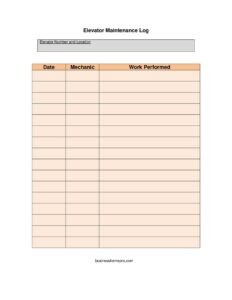
Track inspections and repairs with our free Elevator Maintenance Log template, recording mechanic, date, and work performed—free download in PDF and DOCX.
PDF
DOCX
4 downloads
0
likes
Download Files
- DOCX
An Elevator Maintenance Log is a record-keeping sheet used to document every inspection, service visit, and repair performed on an elevator, capturing the elevator number, date, mechanic, and work performed. Building managers and service companies use it most often to prove that an elevator has been regularly maintained and to keep a clear history of who did what and when. It is free to download here in both PDF and DOCX formats, with no signup required.
What Is an Elevator Maintenance Log?
An Elevator Maintenance Log is a chronological document that tracks the upkeep of one or more elevators within a building. It is typically maintained by property managers, facilities teams, or the elevator service contractor who performs the work. Each entry records which elevator was serviced, the date of the visit, the name of the mechanic or technician, and a description of the work performed—whether that was a routine inspection, a lubrication, a parts replacement, or an emergency repair. The log serves as an ongoing maintenance history that demonstrates due diligence, supports safety compliance, and helps the next technician understand what has already been addressed.
When Do You Need an Elevator Maintenance Log?
This log is useful any time an elevator is inspected, serviced, or repaired. Common scenarios include:
- Routine preventive maintenance — recording scheduled monthly or quarterly service visits by your elevator contractor.
- Annual or periodic inspections — documenting safety checks performed to satisfy local building or fire-code requirements.
- Emergency repairs — logging breakdowns, stuck-car incidents, or door malfunctions and the corrective work done.
- Parts replacement — noting when cables, rollers, controllers, or other components are repaired or swapped out.
- Ownership or management transfer — providing a new owner or property manager with a complete service history.
- Insurance or audit reviews — showing an insurer, inspector, or auditor that the equipment has been consistently maintained.
Whether you manage a single residential building, a commercial tower with multiple cars, or a portfolio of properties, keeping a consistent log creates an accountable paper trail for every elevator under your care.
What an Elevator Maintenance Log Should Have
A complete and useful log keeps each entry simple but specific. At minimum it should capture the elevator number and location so multiple cars in the same building can be told apart, the date each service occurred, the name of the mechanic or technician responsible, and a clear note of the work performed. Beyond those core fields, a strong log is filled in consistently, written legibly, and kept in a central, accessible place—often near the elevator machine room or in a facilities binder. Entries should be made at the time of service rather than reconstructed later, and the log should never have gaps where visits go unrecorded.
How to Fill Out an Elevator Maintenance Log
- Identify the elevator number and location. Enter the unit’s designation—such as “Elevator 2, North Tower” or “Service Lift, Loading Dock”—so anyone reading the log knows exactly which car was serviced. In single-elevator buildings, list the building name or address.
- Record the date. Write the full date of the service visit, including the year. Use a consistent format throughout the log so entries sort cleanly and dates are never ambiguous.
- Enter the mechanic’s name. Write the full name of the technician or mechanic who performed the work. Including the service company name alongside it makes the record easier to verify later.
- Describe the work performed. Note exactly what was done—for example, “Lubricated guide rails and inspected door operator,” “Replaced worn hoist cable,” or “Monthly inspection, no issues found.” Be specific enough that a future technician understands what was checked or repaired.
- Add follow-up notes if needed. If a part is on order or a return visit is required, note it so it is not forgotten.
- Review and store the log. Confirm the entry is legible and complete, then return the log to its designated location for the next visit.
Tips for Keeping an Accurate Service History
Consistency is what turns a maintenance log into a genuinely valuable record. Make entries the moment work is completed so details are fresh and accurate. Encourage every technician who touches the equipment to sign in, even for a five-minute visual check, because a complete record is more credible than a selective one. If you manage several elevators, consider keeping a separate log for each car or clearly labeling entries by elevator number so histories never get mixed. Periodically scan or photograph the pages to create a digital backup—paper logs can be damaged, lost, or left behind during a management change.
How It Differs From an Inspection Certificate
An Elevator Maintenance Log is not the same as an official inspection certificate. The log is an internal, ongoing record of every service action, while a certificate is a formal document issued by a licensed inspector or authority confirming the elevator passed a required inspection on a given date. The two work together: the log shows your day-to-day diligence between inspections, and the certificate satisfies regulatory requirements. Keeping both helps demonstrate a continuous record of care. Always confirm what your local jurisdiction requires, since inspection rules and posting requirements vary by location.
Common Mistakes to Avoid
- Leaving gaps in the record. Skipping entries for minor visits creates an incomplete history that looks neglected during an audit.
- Vague work descriptions. Writing only “serviced” or “checked” provides no useful information for the next technician.
- Forgetting to identify the elevator. In multi-car buildings, an entry with no elevator number is impossible to attribute correctly.
- Illegible handwriting. A log no one can read defeats its purpose; print clearly or use the DOCX version digitally.
- Missing the technician’s name. Without accountability, you cannot follow up on questions about past work.
- Storing it where it can be lost. Keep the log in a consistent, protected location and back it up regularly.
Frequently Asked Questions
What is an Elevator Maintenance Log used for? It is used to document every inspection, service, and repair performed on an elevator over time. The log records the elevator number and location, the date, the mechanic, and the work performed, creating a continuous history that supports safety, accountability, and compliance reviews.
Who fills out the Elevator Maintenance Log? Typically the mechanic or technician who performs the work completes the entry, often with oversight from the building’s facilities team or property manager. In some buildings the property manager records visits on behalf of the service company. The key is that whoever does the work is identified in the entry.
How often should an elevator be logged? Every service visit should be logged, including routine preventive maintenance, scheduled inspections, and emergency repairs. Many buildings schedule regular maintenance monthly or quarterly, but you should follow your service contract and local code. Logging even brief visits keeps the history complete.
Is an Elevator Maintenance Log legally required? Requirements vary by jurisdiction, and many areas require regular inspections and recordkeeping for elevators. Even where a specific log format is not mandated, maintaining one is strongly recommended to demonstrate due diligence. Check your local building and safety codes to confirm what your area requires.
Does the log replace an official inspection? No. The maintenance log is an internal record of service activity, while official inspections and certificates are performed by licensed inspectors or authorities. The log complements inspections by showing the ongoing care performed between them, but it does not satisfy any required inspection on its own.
Is this Elevator Maintenance Log template free? Yes. You can download this template for free in both PDF and DOCX formats with no signup required. Use the PDF for printing and binder storage, or edit the DOCX version to add your building details, logo, or extra columns.
This Elevator Maintenance Log template is provided as a general example for informational purposes only and does not constitute legal, safety, or regulatory advice. Elevator maintenance and inspection requirements vary by jurisdiction and equipment type—consult a qualified elevator service professional and your local authority to ensure compliance.
Related Forms
- Restaurant Reservation Request
- Gifts Received List
- Football Sponsorship Form
- Restaurant Reservation List
- Meeting Room Reservation Request
- Employee Sign In Sheet
Browse more in Sign In / Sign Up Sheets.