
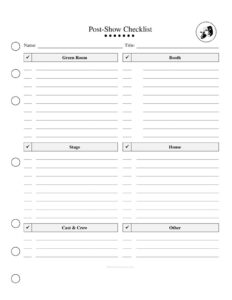
Post-Show Checklist
Use our free Post-Show Checklist template to close out every theater production cleanly, return props, and capture notes — free download in PDF and DOCX.
PDF
DOC
5 downloads
0
likes
Download Files
- DOC
A Post-Show Checklist is a structured task list that a theater team works through after a performance or production run ends, ensuring nothing is forgotten during strike, cleanup, and wrap-up. The most common reason people use one is to standardize the chaotic hours after the final curtain so equipment, costumes, and the venue are all returned to proper condition. This template is free to download in PDF and DOCX, with no signup required.
What Is a Post-Show Checklist?
A Post-Show Checklist is a working document used by stage managers, production teams, and venue staff to track every task that must happen once a show closes. It documents the breakdown of the set, the return of borrowed or rented items, the safe storage of costumes and props, the powering-down of technical systems, and any notes needed for the next production. Whether it is issued by a community theater, a school drama department, or a professional touring company, the checklist serves as both a guide during strike and a record afterward. It keeps a busy crew aligned, prevents missed steps in the rush to clear the space, and creates accountability for who handled what.
When Do You Need a Post-Show Checklist?
This form is useful any time a production wraps and the team needs to reset, return, or close out resources in an orderly way. Common scenarios include:
- Closing a multi-night run and striking the set in a single evening with a large volunteer crew.
- A school or college production that must vacate a shared auditorium by a deadline so the next group can load in.
- A touring company breaking down equipment for transport to the next venue.
- Returning rented lighting, sound gear, costumes, or props to vendors before late fees accrue.
- Handing a venue back to its owner or manager in the same condition it was received, to protect a deposit.
- Capturing production notes and lessons learned while details are still fresh for the next show’s planning.
What a Post-Show Checklist Should Have
A complete Post-Show Checklist covers every functional area of a production so nothing slips through the cracks. Strong checklists typically include sections for set and scenery strike, props inventory and return, costume and wardrobe handling, lighting and sound teardown, the dressing rooms and backstage areas, the front-of-house and lobby, and general venue cleanup. It should also identify the production name and performance date, the person responsible for each task or area, and space for sign-off when a section is complete. Finally, a notes or follow-up field lets the team flag damaged items, outstanding returns, or improvements for next time. The best checklists pair specific line items with checkboxes so progress is visible at a glance.
How to Fill Out a Post-Show Checklist
Because this is a flexible template, customize it to match your production, then work through it methodically during strike:
- Identify the production: Enter the show title, the closing date, and the venue at the top so the completed checklist becomes a dated record.
- Assign responsibility: Note the stage manager or crew lead overseeing the close-out, and assign each section to a specific person or team.
- Strike the set: Check off dismantling scenery, removing fasteners and hardware, and clearing the stage of all built elements.
- Account for props: Inventory every prop, return rentals, and store reusable items in their labeled bins or storage location.
- Handle costumes: List laundering, repairs, returns, and storage of wardrobe pieces and accessories.
- Power down tech: Confirm lighting, sound, and projection equipment are turned off, coiled, packed, or returned.
- Clean spaces: Tick off dressing rooms, backstage, the booth, and the lobby being cleared and tidied.
- Record notes and sign off: Capture damaged items, outstanding tasks, and follow-ups, then have leads sign each completed section.
Organizing an Efficient Strike
A checklist only helps if the team uses it under pressure. Print enough copies to assign one to each area lead, or share a single master copy that the stage manager updates as sections report complete. Sequence tasks logically — for example, strike heavy set pieces and clear the deck before crews bring in tools that obstruct walkways, and pack rented gear early so it is ready for pickup or return the next morning. Designate a staging zone near the loading area for items leaving the building, separated from items returning to storage. Assign someone to photograph the venue once cleanup is done; those photos protect you in any dispute over deposits or damage. A well-run strike that follows the list can turn a stressful late night into a predictable, hour-by-hour process.
Protecting Returns, Rentals, and the Venue
Many of the most expensive post-show problems involve items that were never returned or were returned damaged. Keep your original rental agreements and the venue contract handy while you work the checklist, and reconcile each borrowed item against its paperwork before the crew disperses. If something is broken, missing, or stained, document it immediately with notes and photos rather than discovering it weeks later. For shared or rented venues, walk the space with the facility manager if possible, using the cleanup section of your checklist as the agenda. This habit preserves relationships with vendors and venue owners, supports your refund of any deposit, and gives the producer an accurate accounting of what the production cost and what condition assets are in for future use.
Common Mistakes to Avoid
- Starting strike with no assigned roles, so multiple people tackle the same task while others go undone.
- Failing to inventory props and costumes against a list, leading to lost or misplaced items.
- Returning rented equipment late, dirty, or with cables tangled and components missing.
- Skipping the backstage and dressing-room cleanup, which risks losing a venue deposit.
- Not recording damage or follow-up items while the team is present and details are fresh.
- Treating the checklist as optional once the crew is tired, then forgetting safety steps like powering down equipment.
Frequently Asked Questions
What is a Post-Show Checklist used for? It is used to organize and track every task that happens after a theater production closes, from striking the set to returning rentals and cleaning the venue. It ensures the team works through close-out steps in a consistent order and creates a record of who completed each task. This reduces forgotten items and protects relationships with vendors and venue owners.
Who should fill out the Post-Show Checklist? Typically the stage manager or production manager owns the master checklist, while individual area leads — such as the props master, costume lead, or technical director — complete and sign off their sections. Spreading responsibility this way keeps a large strike moving in parallel and makes accountability clear.
How do I customize this template for my production? Add or remove line items so each section reflects your actual set, props, costumes, and equipment, and enter your show title, closing date, and venue at the top. You can edit the DOCX version freely or print the PDF and write in handwritten additions during strike.
Is a Post-Show Checklist a legal document? No, it is an internal operational tool rather than a contract, so it is not legally binding on its own. However, the notes and photos you capture using it can serve as helpful supporting documentation if a dispute arises over rented equipment or a venue deposit.
When should the checklist be completed? Most teams begin working through it immediately after the final performance during strike, and complete the remaining items — such as returning rentals and laundering costumes — over the following day or two. Capturing notes while the crew is still present and the details are fresh produces the most accurate record.
How much does this Post-Show Checklist cost? Nothing — it is completely free to download here in both PDF and DOCX formats with no signup required. You can reuse and adapt it for every production your group puts on.
This Post-Show Checklist template is a general example provided for informational purposes only and does not constitute legal, financial, or professional advice. Production needs, venue contracts, and rental terms vary, so review your own agreements and consult a qualified professional where appropriate.
Related Forms
- Focus Chart
- Bio Form
- Preliminary Props List
- Stage Choreography Numbers
- Lighting Cues Sheet
- Contact Sheet Cast
Browse more in Theater.