
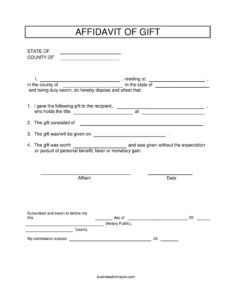
Affidavit Of Gift
Download a free Affidavit of Gift template in PDF or DOCX to document a no-cost transfer of property, vehicles, or money with a sworn statement.
PDF
DOCX
8 downloads
0
likes
Download Files
- DOCX
An Affidavit of Gift is a sworn, notarized statement in which one person (the affiant) declares that they have voluntarily given property, money, or another asset to someone else with no payment expected in return. People most often use it to prove that a car, cash, or valuable item was a genuine gift rather than a sale — which matters for taxes, titles, and registration. You can download this Affidavit of Gift free in both PDF and DOCX formats, with no signup required.
What Is an Affidavit of Gift?
An Affidavit of Gift is a legal document in which the giver formally swears, under oath before a notary public, that a transfer of property was made freely and without compensation. It identifies who gave the gift, what was given, and to whom, and is signed and acknowledged so it can be relied upon by third parties. Government agencies, banks, and insurers often request one because a gift can be treated differently from a purchase for purposes of sales tax, gift tax, lending, and ownership records. Because it is sworn before a notary, the statement carries the weight of a formal affidavit and can be used as evidence that the transaction was truly gratuitous.
When Do You Need an Affidavit of Gift?
This affidavit is useful any time you must prove that something changed hands as a gift rather than a sale. Common situations include:
- Gifting a vehicle to a family member, where the DMV needs proof that no money was exchanged before transferring the title and waiving sales tax.
- Giving a large sum of cash toward a relative’s home down payment, where a mortgage lender requires a gift letter or affidavit confirming the funds are not a loan.
- Transferring jewelry, collectibles, or equipment between family members and documenting that no payment was involved.
- Gifting real estate or an interest in property, where the recipient or a title company wants a sworn record of the donor’s intent.
- Estate planning or lifetime transfers, where a parent gives assets to children and wants written evidence to avoid future disputes among heirs.
- Charitable or in-kind donations, where an organization needs documentation describing the donated item and confirming it was freely given.
What an Affidavit of Gift Should Have
To be complete and credible, an Affidavit of Gift should clearly identify the state and county where it is sworn, the full legal name and address of the affiant (the donor), and a precise description of the gift. The body of the affidavit — the sworn statement itself — should state who is receiving the gift, describe the property in enough detail to identify it (for a vehicle, that means year, make, model, and VIN; for cash, the dollar amount), and affirm that the transfer was voluntary with no payment, loan, or expectation of repayment. Finally, it must include the affiant’s signature and a notary acknowledgment block with the date, the notary’s signature, the county, and the commission expiration date.
How to Fill Out an Affidavit of Gift
- State and County: At the top, enter the state and county where you are signing and being sworn. This establishes the jurisdiction of the affidavit.
- Affiant identity: In the “I, ____” line, print your full legal name as the person making the gift.
- Residence: Fill in your street address, then the county and state of your residence in the lines provided. This confirms who the affiant is.
- The sworn statement: In the large “do hereby depose and attest that” section, write the substance of the gift. Identify the recipient by full name and relationship, describe exactly what is being given, state its approximate value, and affirm that it is a gift made freely with no money or consideration exchanged.
- Affiant signature: Sign on the AFFIANT line — but only in the notary’s presence, not beforehand.
- Notary block: Leave the “Subscribed and sworn” section for the notary. They will fill in the day, month, and year, sign as Notary Public, add their county, and note their commission expiration date.
Notarization and Filing
An Affidavit of Gift is designed to be notarized, which is why the form ends with a jurat — the “subscribed and sworn to before me” language. Do not sign until you are in front of a notary public, who will verify your identity, watch you sign, and complete the acknowledgment. Bring valid photo identification. Some recipients or agencies may also want a copy of the title, bill of sale, or supporting paperwork attached. Once notarized, keep the original in a safe place and give signed copies to the recipient and to any agency, lender, or insurer that requested it. For vehicle gifts, the affidavit usually accompanies the title transfer paperwork submitted to your state motor vehicle department.
How It Differs From a Bill of Sale
A bill of sale records a transaction in which money or other value was exchanged, while an Affidavit of Gift documents the opposite — that no payment was made. Confusing the two can create tax problems, because a purported “sale” may trigger sales tax or capital gains questions that a properly documented gift might avoid. If you are giving something away, an affidavit of gift is generally the correct instrument; if you are selling it, use a bill of sale instead. When in doubt about gift tax thresholds or reporting, consult a tax professional, since the giver may have reporting obligations on larger gifts.
Common Mistakes to Avoid
- Signing before the notary: The affidavit must be signed in the notary’s presence, or it will not be valid.
- Vague property descriptions: Failing to include identifying details like a VIN, serial number, or exact dollar amount can make the affidavit useless as proof.
- Omitting the relationship: Many agencies want to see how the donor and recipient are related, especially for tax-exempt family transfers.
- Leaving the jurisdiction blank: Forgetting to fill in the state and county undermines the document’s formality.
- Implying a sale: Mentioning any payment, trade, or future repayment contradicts the gift and defeats the purpose.
- Losing the original: Keep the notarized original safe; you may need it again for registration or audits.
Frequently Asked Questions
What is an Affidavit of Gift used for? It is used to formally prove that property, money, or an asset was transferred as a gift with no payment in return. People most often use it for gifting vehicles, documenting cash gifts for mortgage lenders, and recording family transfers of valuable items.
Does an Affidavit of Gift need to be notarized? Yes. This template is built around a notary acknowledgment, so the affiant must sign in front of a notary public who completes the sworn statement. Without notarization, it is just an unverified letter and may not be accepted by agencies or lenders.
Is an Affidavit of Gift legally binding? Once properly signed and notarized, it is a sworn statement that the facts within it are true, and making a false statement under oath can carry legal consequences. While it documents a completed gift, it is the act of transfer plus this sworn record that gives it legal weight.
Who signs the Affidavit of Gift, the giver or the receiver? The giver — called the affiant — signs and swears to the affidavit, since they are the one attesting that the gift was made freely. The recipient generally does not need to sign, though some agencies may request their information in the body.
Do I have to pay anything to use this form? No. You can download the Affidavit of Gift here completely free in PDF or DOCX format with no signup. The only typical cost is a small notary fee, which is often free at banks for account holders.
Can I use this affidavit to gift a car to a family member? Yes, it is one of the most common uses. Include the vehicle’s year, make, model, and VIN in the sworn statement, then submit the notarized affidavit with your title transfer paperwork to your state’s motor vehicle department to support a tax-exempt gift transfer.
This Affidavit of Gift template is a general example provided for informational purposes only and is not legal, financial, or tax advice. Requirements for gifts, notarization, and reporting vary by state and situation — consult a qualified attorney or tax professional before relying on this document.
Related Forms
- Affidavit Of Heirship
- Affidavit Of Consent
- Affidavit Of Marriage
- Non-Cash Contribution Letter
- Affidavit Of Correction
- Affidavit Of One And The Same
Browse more in Affidavits.