
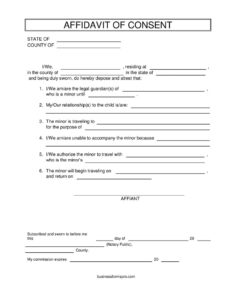
Affidavit Of Consent
Download a free Affidavit of Consent template in PDF or DOCX to legally document sworn permission — no signup required, free download today.
PDF
DOCX
6 downloads
1
likes
Download Files
- DOCX
An Affidavit of Consent is a sworn written statement in which a person formally declares their permission for a specific action, decision, or arrangement. People most often use it to put consent on the record in a way that can be relied upon by courts, agencies, schools, or other institutions. You can download this Affidavit of Consent free in PDF and DOCX formats, with no signup required.
What Is an Affidavit of Consent?
An Affidavit of Consent is a legal document, signed under oath before a notary public, in which the person making it (the affiant) voluntarily grants permission for something to happen. Unlike a casual note or verbal agreement, it carries the weight of a sworn statement, meaning the affiant attests that the contents are true to the best of their knowledge. It is typically issued by a parent, guardian, spouse, property owner, or any individual whose approval is legally or practically required. The document records who is giving consent, what they are consenting to, and confirms that the consent is given freely. Because it is notarized, it serves as credible, dated evidence that permission was granted.
When Do You Need an Affidavit of Consent?
This affidavit appears in a wide range of situations where one party needs documented, sworn permission from another. Common scenarios include:
- Travel consent for a minor — a parent or guardian authorizing a child to travel with the other parent, a relative, or a group.
- Name changes — a spouse, parent, or other interested party consenting to a legal name change.
- Use of property or premises — a property owner consenting to a tenant, business, or organization using an address or space for a specific purpose.
- Medical or guardianship decisions — granting another adult permission to make certain decisions or care for a dependent.
- Immigration or government filings — providing sworn consent in support of an application or petition.
- Marriage of a minor or other family matters — where a parent’s documented consent is required by local rules.
Types of Consent an Affidavit Can Cover
The flexible wording of this template lets you tailor it to many circumstances. A single affiant may sign alone, or two parties (shown by the “I/We” option) may consent jointly, such as two parents authorizing the same matter. The consent may be broad or narrowly limited to one event or transaction. Because the operative consent language is written into the body, the same form can serve travel, property, financial, educational, or personal-decision purposes — as long as the statement of what is being consented to is clear and specific.
What an Affidavit of Consent Should Have
To be complete and credible, the affidavit should clearly identify the state and county where it is executed, the full legal name and address of the affiant, and a precise statement of exactly what is being consented to. It must include language indicating the affiant was duly sworn, the date of signing, and the affiant’s signature. Finally, it requires the notary’s section: the jurat (“subscribed and sworn to before me”), the notary’s signature, county, and commission expiration date. Vague or incomplete consent language is the most common reason such documents are questioned.
How to Fill Out an Affidavit of Consent
- State and County: At the top, enter the State of and County of where you will sign the affidavit — this establishes the jurisdiction.
- Affiant name: After “I/We,” write the full legal name of the person (or persons) giving consent. Use names exactly as they appear on official identification.
- Residence: Fill in the affiant’s full street address after “residing at,” then confirm the county and state of residence in the spaces provided.
- Consent statement: In the body following “do hereby depose and attest that,” write a clear, specific statement of what you are consenting to — name the people involved, the action, and any relevant dates or conditions.
- Signature: Do not sign until you are in front of the notary, who must witness your signature.
- Jurat: The notary completes “subscribed and sworn to before me this ___ day of ___, 20__,” then signs, enters their county, and records the date their commission expires.
Notarization and Filing Notes
Because this is a sworn affidavit, notarization is central to its validity. Bring valid government-issued photo identification to your appointment, and leave the affiant signature blank until the notary instructs you to sign. The notary administers an oath or affirmation, witnesses the signature, and completes the jurat at the bottom. Where two people are consenting jointly, both should appear and sign before the notary. After notarization, keep the original in a safe place and provide copies to whoever requested the consent — a school, court clerk, embassy, agency, or other party. Some institutions require the original or a certified copy, so confirm their preference before submitting. Requirements for how the affidavit must be worded or filed can vary by jurisdiction.
Affidavit of Consent vs. a Consent Letter
A simple consent letter is an informal, signed note granting permission, while an Affidavit of Consent is sworn under oath before a notary. The notarized affidavit carries greater evidentiary weight and is more likely to be accepted by courts, government offices, and international authorities. If an organization specifically asks for a “sworn” or “notarized” consent, a plain letter usually will not satisfy the requirement — use this affidavit instead.
Common Mistakes to Avoid
- Signing before the notary: The signature must be witnessed; signing in advance can void the affidavit.
- Vague consent language: Failing to clearly state what, who, and when leaves the consent open to dispute.
- Mismatched names: Using a nickname or maiden name that differs from your ID can cause rejection.
- Leaving blanks empty: Incomplete state, county, or date fields make the document look unfinished or invalid.
- Forgetting the notary block: Without the jurat, signature, county, and commission expiration, the affidavit is not properly executed.
- Not confirming the recipient’s format: Some offices need the original; submitting only a copy can delay your matter.
Frequently Asked Questions
What is an Affidavit of Consent used for? It is used to formally document, under oath, that a person grants permission for a specific action — such as a minor’s travel, a name change, the use of property, or a government filing. Because it is sworn and notarized, it provides reliable proof that consent was given on a particular date.
Does an Affidavit of Consent need to be notarized? Yes. The template includes a jurat stating the affidavit was “subscribed and sworn to” before a notary public, so it must be signed in the notary’s presence. The notary verifies your identity, administers the oath, and completes their portion of the form.
Can two people sign the same affidavit? Yes. The form’s “I/We” wording allows one or more affiants, which is useful when two parents or co-owners are giving the same consent. In that case, both individuals should appear before the notary and sign.
Is an Affidavit of Consent legally binding? A properly completed and notarized affidavit is a sworn legal statement, and making false statements in it can carry serious consequences. Whether it is sufficient for your particular purpose depends on the requirements of the court or agency receiving it.
How much does this template cost? Nothing. You can download the Affidavit of Consent free from Business Forms Pro in both PDF and DOCX formats, with no signup or account required. You only pay any standard notary fee charged separately.
Can I edit the template to fit my situation? Yes. The DOCX version is fully editable, so you can write your specific consent language and adjust the details before printing. Keep the sworn statement and notary block intact so the affidavit remains valid.
This Affidavit of Consent template is a general example provided for informational purposes only and is not legal advice. Requirements for sworn statements, consent, and notarization vary by jurisdiction. Consult a qualified attorney or notary to confirm the document meets your needs.
Related Forms
- Affidavit Of Non-Military Service
- Affidavit Of One And The Same
- Affidavit Of Non Collusion
- Affidavit Of Loss
- Affidavit Of Residence
- Affidavit Of Title
Browse more in Affidavits.