
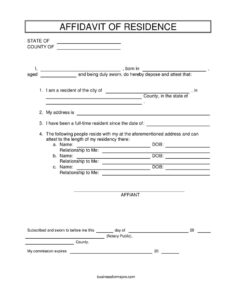
Affidavit Of Residence
Download a free Affidavit of Residence template in PDF and DOCX to legally verify where you live for schools, banks, and government agencies—free download.
PDF
DOCX
3 downloads
0
likes
Download Files
- DOCX
An Affidavit of Residence is a sworn written statement in which a person formally declares where they live, signed under oath before a notary public. People most often use it to prove their address when a utility bill or lease isn’t available—for school enrollment, bank accounts, or government services. You can download this template free in PDF and DOCX with no signup required.
What Is an Affidavit of Residence?
An Affidavit of Residence is a legal document in which an individual (the affiant) swears under oath that they reside at a particular address. It is signed in the presence of a notary public, who verifies the affiant’s identity and administers the oath. The document is commonly accepted as official proof of residency by schools, courts, banks, motor vehicle departments, and other agencies. Because it is sworn testimony, making a false statement on an affidavit can carry legal penalties for perjury. The form records the state and county where it is executed, identifies the affiant, states the residency facts being attested, and is completed with the notary’s certification and commission details.
When Do You Need an Affidavit of Residence?
This affidavit is requested whenever someone must verify where they live but lacks the usual paperwork, or when a third party needs sworn confirmation. Common situations include:
- Enrolling a child in school—districts often require proof that a student lives within their boundaries.
- Opening a bank or credit union account when standard address documents are missing or in another person’s name.
- Applying for in-state tuition at a college or university that requires evidence of state residency.
- Obtaining or renewing a driver’s license or state ID when an applicant cannot supply a typical utility bill.
- Establishing residency for a will, estate, or probate matter, or to settle questions of domicile.
- Confirming the address of a relative or tenant who lives with you, where you swear to their place of residence.
What an Affidavit of Residence Should Have
A complete and acceptable affidavit includes several essential elements. It should clearly name the state and county where it is being sworn, since notary authority is jurisdictional. It must identify the affiant by full legal name and basic identifying details, contain a clear statement of the facts being attested—typically the residential address and how long the person has lived there—and include language showing the statement was made under oath. Finally, it requires the affiant’s signature and a notary block with the date, the notary’s signature, their county, and commission expiration. Missing any of these can cause an agency to reject the document.
How to Fill Out an Affidavit of Residence
- State of: Enter the state where you are signing the affidavit—this is where the notary is commissioned.
- County of: Write the county within that state where the document is being executed.
- Affiant name (“I, ___”): Print your full legal name as the person swearing to the facts.
- Born in: Enter your place of birth (city, state, or country) as requested.
- Aged: Fill in your current age in years.
- Statement (“do hereby depose and attest that”): Write the residency facts in clear sentences—for example, your complete residential address and how long you have lived there. Be precise and truthful, since you are swearing under oath.
- Affiant signature: Sign on the AFFIANT line, but only in front of the notary.
- Notary section: Leave the “subscribed and sworn” date, day, month, and year for the notary, who will complete their signature, county, and commission expiration date.
Notarization and Why It Matters
The defining feature of an affidavit is that it is sworn before a notary public. Do not sign the document in advance—the notary must witness your signature and administer the oath in person. Bring a valid government-issued photo ID so the notary can verify your identity. The notary then completes the certification block, recording the date the affidavit was “subscribed and sworn to,” their own signature, the county where they are commissioned, and the date their commission expires. Notaries are available at banks, shipping stores, libraries, law offices, and many other locations, often for a small fee. Without proper notarization, most agencies will not accept the affidavit as valid proof.
Tips for a Smooth Process
Before you visit the notary, confirm exactly what the requesting agency expects. Some schools or banks have their own residency affidavit form, in which case this template may serve as a useful guide or backup. Write the residency statement plainly and avoid abbreviations in your address. If you are swearing to someone else’s residence—such as a child or a tenant—state your relationship to that person and how you know where they live. Make a photocopy of the completed, notarized affidavit for your records before submitting the original.
Common Mistakes to Avoid
- Signing before you reach the notary—the oath must be administered as you sign, or the notarization is invalid.
- Leaving the state or county blank, which undermines the document’s jurisdictional validity.
- Writing a vague address without a street number, unit, city, and ZIP code.
- Stating facts you cannot honestly swear to—a false affidavit can expose you to perjury penalties.
- Forgetting to bring photo ID, which prevents the notary from verifying your identity.
- Not checking the agency’s specific requirements, such as supporting documents or a particular form they require.
Frequently Asked Questions
What is an Affidavit of Residence used for? It is a sworn statement used to prove where a person lives when standard documents like a lease or utility bill are unavailable. Schools, banks, colleges, and government offices commonly accept it as official proof of address. It can also confirm the residence of another person, such as a child or relative living in your home.
Does an Affidavit of Residence need to be notarized? Yes—an affidavit is, by definition, sworn before a notary public. You must sign it in the notary’s presence after they administer the oath and verify your identity. Without notarization, most agencies will not treat it as valid.
Is this affidavit legally binding? Yes. Because you sign it under oath, the statements you make are legally enforceable, and knowingly providing false information can result in perjury charges. Always make sure every fact you attest to is accurate and truthful.
Can I write an Affidavit of Residence for someone else? Yes, you can swear to another person’s residence if you have personal knowledge of where they live, such as a parent confirming a child’s address. State your relationship to that person and the basis of your knowledge in the statement section. You remain the affiant signing under oath.
How much does this template cost? Nothing—you can download the Affidavit of Residence template for free in PDF and DOCX formats, with no signup required. You may only need to pay a small fee to the notary who witnesses your signature.
What should I bring to the notary? Bring the completed but unsigned affidavit and a valid government-issued photo ID, such as a driver’s license or passport. The notary will confirm your identity, watch you sign, administer the oath, and complete their certification block. Some notaries prefer you fill in the residency details ahead of time and leave only the signature for the appointment.
This Affidavit of Residence template is a general example provided for informational purposes only and is not legal advice. Notarization rules and residency-proof requirements vary by state and by the agency requesting the document. Consult a qualified attorney or the requesting institution to confirm your specific requirements before signing.
Related Forms
- Affidavit Of Title
- Affidavit Of Consent
- Affidavit Of Identity
- Affidavit Of Marriage
- Affidavit Of Domicile
- Affidavit Of Lost Note
Browse more in Affidavits.