
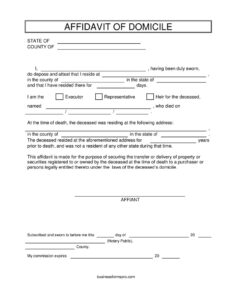
Affidavit Of Domicile
Free Affidavit of Domicile template to certify a deceased person's legal residence and transfer securities, available as a free download in PDF and DOCX.
PDF
DOCX
8 downloads
0
likes
Download Files
- DOCX
An Affidavit of Domicile is a sworn legal statement used to confirm the state and county where a deceased person legally resided at the time of death. It is most commonly required by transfer agents and brokerage firms before securities, stocks, or registered property can be transferred to an estate’s heirs or a purchaser. You can download this form for free in both PDF and DOCX formats — no signup required.
What Is an Affidavit of Domicile?
An Affidavit of Domicile is a notarized document signed by an executor, estate representative, or heir attesting to the deceased’s primary legal residence (domicile) at the time of death. “Domicile” refers to the place a person considered their permanent home — not merely where they happened to be living temporarily. The affidavit establishes which state’s laws govern the transfer of the deceased’s assets and confirms the person was not a resident of any other state during the relevant period. Transfer agents, banks, and financial institutions rely on this affidavit to release stocks, bonds, mutual fund shares, and other registered property to the rightful parties without the risk of competing claims from another jurisdiction.
When Do You Need an Affidavit of Domicile?
This form comes into play whenever a financial institution needs proof of a decedent’s legal residence before releasing assets. Common situations include:
- Transferring stocks, bonds, or other securities held in the deceased’s name to heirs or an estate account.
- Re-registering mutual fund shares or brokerage holdings after the owner’s death.
- Settling an estate where a transfer agent requires confirmation of domicile before processing a request.
- Closing or transferring an investment account that was solely in the decedent’s name.
- Selling securities owned by the deceased to a third-party purchaser who needs assurance of clear title.
- Probate or estate administration where the executor must document the decedent’s residence for the court or financial firms.
What an Affidavit of Domicile Should Have
To be accepted, the affidavit must clearly identify the affiant, their relationship to the deceased, and the decedent’s confirmed legal residence. A complete Affidavit of Domicile includes the state and county where it is executed, the affiant’s own residence and how long they have lived there, the deceased’s full name and date of death, the deceased’s last legal address with county and state, and the number of years the deceased resided there. It must also state the purpose — securing the transfer of property or securities — and be signed by the affiant before a notary public who completes the jurat and seal.
How to Fill Out an Affidavit of Domicile
- Enter the State and County where you are signing the affidavit at the top of the form.
- Write your full legal name as the affiant after “I, ____.”
- Provide your own residence address, along with the county and state where you reside, and the number of days you have lived there.
- Indicate your role by selecting Executor, Representative, or Heir for the deceased.
- Enter the deceased person’s full name and their date of death.
- Record the deceased’s last legal address at the time of death, including the county and state.
- State the number of years the deceased resided at that address, confirming they were not a resident of any other state during that time.
- Review the purpose statement, then sign on the Affiant line — but do not sign until you are in front of the notary.
- The notary completes the date, county, signature, and commission expiration in the jurat section.
Notarization and Submission
An Affidavit of Domicile must be sworn before a notary public to be valid — the affiant signs only in the notary’s presence, and the notary then completes the “Subscribed and sworn to” jurat, adds their seal, names their county, and lists their commission expiration date. Once notarized, the affidavit is usually submitted to the transfer agent, brokerage firm, or financial institution handling the deceased’s assets, often alongside other estate documents such as a certified death certificate, stock certificates, and a stock power or letters testamentary. Many institutions require the original notarized affidavit rather than a copy, and some may have a Medallion Signature Guarantee requirement for the accompanying transfer paperwork. Always confirm the specific institution’s checklist before mailing documents.
How It Differs From Related Documents
An Affidavit of Domicile is sometimes confused with other estate forms, but each serves a distinct role. It is not a death certificate — that is an official record issued by a government vital records office confirming the fact and date of death. It is also not letters testamentary or letters of administration, which the probate court issues to grant an executor authority to act. The Affidavit of Domicile specifically answers one question: where did the deceased legally reside? It works in concert with these other documents during estate settlement rather than replacing any of them.
Common Mistakes to Avoid
- Signing the affidavit before appearing in front of the notary, which invalidates the jurat.
- Confusing a temporary or seasonal residence with the decedent’s true legal domicile.
- Leaving the county fields blank — both the affiant’s and the deceased’s counties are required.
- Entering an incorrect or estimated date of death rather than matching the death certificate.
- Submitting a photocopy when the institution requires the original notarized document.
- Failing to indicate your role (executor, representative, or heir) by leaving all three boxes unchecked.
Frequently Asked Questions
What is an Affidavit of Domicile used for? It is used to certify the state and county where a deceased person legally resided at the time of death. Financial institutions and transfer agents require it before releasing stocks, bonds, and other registered securities to heirs or a purchaser, confirming which jurisdiction’s laws apply to the transfer.
Does an Affidavit of Domicile need to be notarized? Yes. The affiant must sign the document in the presence of a notary public, who then completes the jurat, applies their seal, and records their commission expiration. Without notarization, transfer agents and brokerages will not accept the affidavit.
Who can sign an Affidavit of Domicile? Typically the executor, the estate’s legal representative, or an heir of the deceased signs as the affiant. The form lets you check the box that matches your role, and you must have direct knowledge of the deceased’s residence to attest truthfully.
Is an Affidavit of Domicile legally binding? It is a sworn statement made under oath, so providing false information can carry legal consequences such as perjury. While it is not a court order, financial institutions treat a properly notarized affidavit as reliable evidence of domicile.
What does “domicile” mean on this form? Domicile refers to the deceased’s permanent legal home — the place they intended to return to and considered their primary residence — not a temporary, vacation, or secondary address. The affidavit also confirms the person was not a resident of another state during the stated period.
How much does this Affidavit of Domicile template cost? Nothing. You can download the template here for free in both PDF and DOCX formats, with no account or signup required. You only need to cover any notary fee charged when you have it sworn.
This Affidavit of Domicile template is provided as a general example for informational purposes only and is not legal, financial, or tax advice. Requirements for transferring securities and documenting domicile vary by state and by institution — consult a qualified attorney or estate professional before relying on this document.
Related Forms
- Affidavit Of Non Collusion
- Non-Cash Contribution Letter
- Affidavit Of Financial Support
- Affidavit Of Title
- Affidavit Of Loss
- Affidavit Of Survivorship
Browse more in Affidavits.