
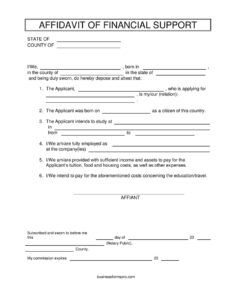
Affidavit Of Financial Support
Download a free Affidavit of Financial Support template in PDF and DOCX to certify you will financially support another person — free download, no signup.
PDF
DOCX
5 downloads
0
likes
Download Files
- DOCX
An Affidavit of Financial Support is a sworn, notarized statement in which one person (the affiant) promises to provide financial support to another individual. People most often use it to prove to a school, embassy, or government agency that someone has a reliable source of funds. You can download this template free in PDF and DOCX formats — no signup required.
What Is an Affidavit of Financial Support?
An Affidavit of Financial Support is a legal document in which an individual or married couple formally swears, under oath and before a notary public, that they will be financially responsible for another person. The person making the statement is called the affiant, and they typically attest to their ability and willingness to cover expenses such as tuition, living costs, or general maintenance. Because it is sworn and notarized, the affidavit carries legal weight and can be used as official evidence of support. Institutions and agencies rely on it to confirm that the person being supported will not become a financial burden, making the document a common requirement in immigration, education, and sponsorship situations.
When Do You Need an Affidavit of Financial Support?
This affidavit appears in many situations where a third party must verify that someone has financial backing. Common scenarios include:
- Student visas and admissions: A parent or relative confirms they will pay tuition and living expenses for an international or out-of-state student.
- Immigration and visa applications: A sponsor demonstrates to an embassy or consulate that a visiting relative will be supported during their stay.
- University enrollment: Schools often require proof of funding before issuing acceptance or enrollment documents.
- Sponsoring a family member: A grandparent, sibling, or other relative formally commits to covering a dependent’s costs.
- Court or benefits matters: Demonstrating that an individual receives outside financial support relevant to a legal or administrative proceeding.
- Housing or rental applications: A guarantor attests they will cover rent or related expenses for a tenant who lacks income.
What an Affidavit of Financial Support Should Have
To be accepted as valid, the affidavit must clearly identify all parties and contain a sworn declaration. Key elements include the state and county where it is executed, the full legal name of the affiant (or both spouses if filing jointly), the affiant’s place and date of birth, and a detailed statement of the support being promised. The heart of the document is the sworn attestation — the specific commitment the affiant makes. Finally, it requires the affiant’s signature, a notary’s acknowledgment with the date, the notary’s signature and county, and the date the notary’s commission expires. Without the notarization block completed, the document is generally not considered properly sworn.
How to Fill Out an Affidavit of Financial Support
- State and County: At the top, enter the state and county where you are signing the affidavit. This establishes the jurisdiction in which the oath is administered.
- Affiant name: In the “I/We” line, write your full legal name. If a married couple is providing support jointly, include both names.
- Place of birth: Fill in the city or town where you were born, then the county and state of birth in the spaces provided. These details help confirm your identity.
- The sworn statement: In the main body, write out exactly what you are attesting to — for example, the name of the person you support, the relationship, the amount or type of support, and the period it covers.
- Affiant signature: Sign on the AFFIANT line. Do not sign until you are in front of the notary, since the signature must be witnessed.
- Notary block: The notary completes the “Subscribed and sworn” line with the day, month, and year, signs as Notary Public, fills in the county, and records when their commission expires.
Notarization and Filing
This affidavit is designed to be notarized, which is what transforms a simple written statement into a sworn legal declaration. Bring the unsigned document and a valid government-issued photo ID to a notary public — available at banks, shipping stores, libraries, and law offices. The notary will verify your identity, watch you sign, administer the oath, and complete the notarization block. Once notarized, deliver the affidavit to the institution that requested it, such as a school’s admissions office, an embassy, or an immigration authority. Many agencies also ask for supporting evidence alongside the affidavit, including bank statements, pay stubs, tax returns, or an employment letter, to substantiate the financial claims you have sworn to.
Affidavit of Support vs. Letter of Support
People sometimes confuse this affidavit with an informal letter of support. A letter of support is simply a written statement expressing intent and is not sworn before a notary. An Affidavit of Financial Support, by contrast, is a formal oath with legal consequences — knowingly providing false information in a sworn affidavit can constitute perjury. Because of this distinction, agencies that need binding assurance almost always require the notarized affidavit rather than a casual letter. Choose the affidavit when an official body demands verified, enforceable proof of financial backing.
Common Mistakes to Avoid
- Signing before the notary: The signature must be witnessed; signing in advance invalidates the notarization.
- Vague support statements: Leaving the sworn paragraph general (“I will help financially”) instead of stating amounts, duration, and the supported person’s name.
- Missing supporting documents: Submitting the affidavit alone when the institution also expects bank statements or income proof.
- Incorrect jurisdiction: Listing a state or county that does not match where the notary is commissioned.
- Incomplete notary block: Forgetting the commission expiration date or the notary’s county.
- Outdated information: Using stale financial figures that no longer reflect your current ability to provide support.
Frequently Asked Questions
What is an Affidavit of Financial Support used for? It is used to formally swear that you will financially support another person, typically for a student visa, university enrollment, immigration sponsorship, or a housing guarantee. Institutions accept it as official proof that the supported individual has reliable funding.
Does an Affidavit of Financial Support need to be notarized? Yes. The template includes a notarization block where a notary public administers an oath and witnesses your signature. Notarization is what makes the document a legally sworn affidavit rather than an informal statement.
Can a married couple sign one affidavit together? Yes. The form uses “I/We,” which allows two people — such as a married couple sponsoring jointly — to provide support together. Both should be named and both should sign in front of the notary.
Is an Affidavit of Financial Support legally binding? Once sworn and notarized, the affidavit is a legal declaration made under oath. Providing false information can carry serious consequences, including penalties for perjury, so only state what you can genuinely fulfill.
What documents should I attach to it? Most agencies want supporting evidence such as recent bank statements, pay stubs, tax returns, or an employment verification letter. These documents back up the financial promises made in your sworn statement.
How much does this template cost? Nothing — you can download the Affidavit of Financial Support free in both PDF and DOCX formats with no signup. You only need to pay a small fee to a notary public when you have it notarized.
This template is provided as a general example for informational purposes only and is not legal, financial, or immigration advice. Requirements for affidavits and notarization vary by jurisdiction and by the institution requesting the document. Consult a qualified attorney or licensed professional to ensure your affidavit meets all applicable requirements.
Related Forms
- Affidavit Of Marriage
- Affidavit Of Gift
- Affidavit Of Non-Military Service
- Affidavit Of Non Collusion
- Affidavit Of Survivorship
- Affidavit Of Correction
Browse more in Affidavits.