
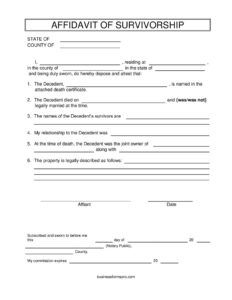
Affidavit Of Survivorship
Use our free Affidavit of Survivorship template to claim jointly owned property after a co-owner's death, with a free PDF and DOCX download.
PDF
DOCX
11 downloads
0
likes
Download Files
- DOCX
An Affidavit of Survivorship is a sworn statement used to confirm that one co-owner of jointly held property has died and that the surviving co-owner is now the rightful owner. People most commonly use it to clear the deceased person’s name from the title of real estate, a vehicle, or a bank account held in joint tenancy. You can download this Affidavit of Survivorship free in PDF and DOCX formats, with no signup required.
What Is an Affidavit of Survivorship?
An Affidavit of Survivorship is a notarized legal document in which a surviving owner (the affiant) swears, under oath, that a co-owner has passed away and that ownership of the jointly held property now belongs to the survivor by right of survivorship. It is typically used when property was held in joint tenancy with right of survivorship or as tenants by the entirety. Rather than going through probate, the survivor records this affidavit — often alongside a certified death certificate — to update public records and prove clear title. It is signed before a notary public and may be filed with a county recorder, the DMV, or presented to a financial institution.
When Do You Need an Affidavit of Survivorship?
This affidavit becomes useful whenever a co-owner dies and the surviving owner needs to formally document the transfer of full ownership. Common situations include:
- Removing a deceased spouse’s or co-owner’s name from a real estate deed held in joint tenancy.
- Transferring title to a jointly owned vehicle into the surviving owner’s name at the DMV.
- Releasing funds from a joint bank or investment account to the surviving account holder.
- Updating county land records so future sales or refinancing can proceed without probate.
- Proving sole ownership to an insurance company, mortgage lender, or utility provider.
- Clearing title on property held by tenants by the entirety after one spouse passes away.
In each scenario, the affidavit serves as the survivor’s sworn confirmation that the co-owner has died and that survivorship rights have taken effect.
What an Affidavit of Survivorship Should Have
To be accepted and recorded, the affidavit needs several essential elements. It must identify the state and county where it is sworn, name the affiant (the surviving owner) and their address, and contain a clear sworn statement describing the deceased co-owner, the date of death, and the property being claimed. Most recorders also expect a legal description of real estate, the title or VIN for a vehicle, or the account number for financial assets. Finally, the document requires the affiant’s signature and a notary public’s acknowledgment, including the date sworn and the notary’s commission expiration. A certified copy of the death certificate is almost always attached.
How to Fill Out an Affidavit of Survivorship
- At the top, enter the State and County where you are signing the affidavit — this establishes the jurisdiction for the notarization.
- In the opening line beginning “I, ____,” write your full legal name as the affiant (the surviving owner).
- Complete the residing at field with your current street address.
- Fill in the county and state of your residence in the spaces provided.
- In the main statement area, depose and attest to the relevant facts: name the deceased co-owner, their date of death, how the property was jointly held, and a description of the property (legal description, VIN, or account number).
- Sign on the AFFIANT line — but only in the presence of the notary public.
- Leave the Subscribed and sworn section for the notary, who fills in the day, month, and year you swore the affidavit.
- The notary completes their signature, the County in which they are commissioned, and their commission expiration date.
Filing and Recording the Affidavit
Where you submit the completed affidavit depends on the asset. For real estate, you typically record the affidavit with the county recorder or land records office in the county where the property sits; recording fees vary by location. For a vehicle, you present it to the motor vehicle agency along with the title. For bank or investment accounts, the financial institution receives the affidavit directly. In nearly all cases you must attach a certified copy of the death certificate — a plain photocopy is usually not accepted. Keep at least one signed original for your records and request certified copies if multiple agencies need them.
How It Differs From Other Documents
An Affidavit of Survivorship is not the same as a will, a deed, or a probate filing. It does not transfer ownership by itself; rather, it documents and confirms a transfer that already occurred automatically through the right of survivorship when the co-owner died. A will directs how property passes through probate, while this affidavit avoids probate for assets that were already jointly titled. If the property was not held with survivorship rights, this form generally will not apply, and the estate may need to go through probate instead.
Common Mistakes to Avoid
- Signing the affidavit before meeting the notary — your signature must be witnessed by the notary.
- Forgetting to attach a certified copy of the death certificate, which most recorders and institutions require.
- Using a vague property description; real estate usually needs the full legal description, not just the street address.
- Leaving the state, county, or commission-expiration fields blank, which can cause the document to be rejected.
- Assuming this affidavit applies when the property was not actually held in joint tenancy with survivorship rights.
- Misspelling the deceased co-owner’s name so it doesn’t match the title or deed on record.
Frequently Asked Questions
What is an Affidavit of Survivorship used for? It is used to confirm that a co-owner has died and that the surviving owner now holds full title to jointly owned property. It clears the deceased person’s name from records for real estate, vehicles, or accounts held with right of survivorship. This often allows the survivor to avoid probate for that asset.
Does an Affidavit of Survivorship need to be notarized? Yes. Because it is a sworn statement, the affiant must sign it in front of a notary public, who completes the acknowledgment and records the date and their commission expiration. Sign only when the notary is present so the oath is valid.
Do I need to attach a death certificate? Almost always. Recorders, the DMV, and financial institutions typically require a certified copy of the death certificate to verify the co-owner’s passing. Request several certified copies if multiple agencies will need one.
Is an Affidavit of Survivorship legally binding? When properly completed, sworn, and recorded, it serves as an official record confirming the survivor’s ownership. Its acceptance depends on the property having been held with survivorship rights and on meeting local recording requirements, which vary by jurisdiction.
How much does this form cost? The template is free to download here in PDF and DOCX with no signup. You may, however, pay a notary fee and a county recording fee when you file the completed affidavit, and those amounts vary by location.
Can I use this affidavit if there was no joint ownership? Generally no. The affidavit relies on a right of survivorship that exists in joint tenancy or tenancy by the entirety. If the property was owned solely by the deceased or as tenants in common, the estate may need to go through probate instead.
This Affidavit of Survivorship template is provided as a general example for informational purposes only and is not legal, financial, or tax advice. Requirements for survivorship affidavits, recording, and property transfer vary by jurisdiction, so consult a qualified attorney or other professional before relying on this document.
Related Forms
- Affidavit Of Marriage
- Affidavit Of Domicile
- Affidavit Of Non Collusion
- Affidavit Of Loss
- Affidavit Of Title
- Affidavit Of Gift
Browse more in Affidavits.