
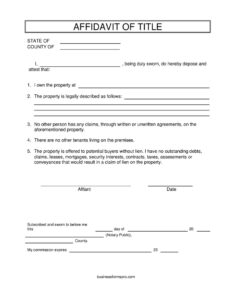
Affidavit Of Title
Download a free Affidavit of Title template in PDF and DOCX to verify property ownership and disclose liens during a sale or closing — free download.
PDF
DOCX
6 downloads
0
likes
Download Files
- DOCX
An Affidavit of Title is a sworn statement in which a property owner (the affiant) confirms they hold clear title to a piece of real estate and discloses any known liens, claims, or defects. People most often use it during a real estate closing to reassure the buyer and title company that there are no hidden ownership problems. You can download this Affidavit of Title free in PDF and DOCX formats, with no signup required.
What Is an Affidavit of Title?
An Affidavit of Title is a legal document signed under oath by the seller or owner of real property, typically as part of a sale or refinance. In it, the affiant attests to facts about the property’s ownership — that they are the rightful owner, that they know of no undisclosed liens or judgments, and that no other party has a competing claim. The document is sworn before a notary public, which adds a layer of accountability because making false statements in a notarized affidavit can carry legal consequences. Title companies frequently require this affidavit before issuing title insurance, and lenders rely on it to confirm the security behind a mortgage.
When Do You Need an Affidavit of Title?
This affidavit shows up in many situations where someone needs assurance about who owns a property and whether it is encumbered. Common scenarios include:
- Selling real estate — the seller provides it at closing to confirm clear title and the absence of new liens since the title search.
- Refinancing a mortgage — lenders may request it to verify the borrower’s ownership and lien status.
- Obtaining title insurance — title companies use the affidavit to support coverage and to fill gaps between the title search date and closing.
- Transferring property between family members — to document that the transferor holds undisputed ownership.
- Resolving a boundary or possession question — to attest there are no unrecorded easements, tenants, or disputes.
- Settling an estate — an executor or heir may sign to confirm title before distributing or selling inherited property.
What an Affidavit of Title Should Have
A complete Affidavit of Title clearly identifies the people, place, and facts involved so it can stand on its own as evidence. The essential elements include the state and county where it is sworn, the full legal name of the affiant, and a clear statement of the facts being attested — such as ownership, marital status where relevant, the absence of unpaid taxes or liens, and that no bankruptcy or judgment affects the property. It should reference the property in enough detail to identify it, often by address and legal description. Finally, it needs the affiant’s signature, the notary’s acknowledgment, the date sworn, the notary’s county, and the notary commission expiration date.
How to Fill Out an Affidavit of Title
Follow these steps, matching each entry to the fields on this template:
- State and County: At the top, enter the State of and County of where you are signing and being sworn — usually where the notary is commissioned, not necessarily where the property sits.
- Affiant name: In the line beginning “I, ____,” write your full legal name as the person making the sworn statement.
- Statement of facts: In the large open section after “do hereby depose and attest that,” set out each sworn fact. Describe the property, confirm you are the owner, and state the absence of liens, judgments, unpaid taxes, leases, or undisclosed claims. Use clear, numbered sentences for each point.
- Affiant signature: Sign on the Affiant line — but only in the notary’s presence, never beforehand.
- Notarization block: The notary completes the “Subscribed and sworn to before me this ___ day of ___ 20 ___” line with the date.
- Notary details: The notary signs, prints the county on the County line, and fills in the commission expiration date.
Notarization and Recording
Because an Affidavit of Title is sworn under oath, the notary’s role is central. Do not sign until you are in front of the notary, who will verify your identity, watch you sign, and then complete the acknowledgment block. Bring a valid government-issued photo ID. In a typical closing, the affidavit is delivered to the title company or closing agent rather than filed with a public office, though some parties keep it with the deed and other recorded documents. Keep a copy for your own records in case a question about the property’s history arises later.
Affidavit of Title vs. Warranty Deed
These two documents are easy to confuse but serve different purposes. A warranty deed actually transfers ownership of the property from seller to buyer and contains promises about title that run with the land. An Affidavit of Title, by contrast, transfers nothing — it is a sworn statement of facts confirming the current state of ownership and disclosing encumbrances. The affidavit supports the transaction; the deed accomplishes it. Both are commonly part of the same closing package.
Common Mistakes to Avoid
- Signing before the notary — the affidavit must be signed in the notary’s presence, or the acknowledgment is invalid.
- Vague property identification — failing to include a clear address or legal description weakens the document’s usefulness.
- Omitting known liens — leaving out a mortgage, tax lien, or judgment can constitute a false sworn statement.
- Using a nickname instead of the legal name — names should match the deed and your identification.
- Leaving the notary block incomplete — missing the date, county, or commission expiration can render the affidavit unusable.
- Mixing up the state/county of signing with the property’s location — the heading reflects where you swear the oath.
Frequently Asked Questions
What is an Affidavit of Title used for? It is used to swear that you are the legal owner of a property and that there are no undisclosed liens, claims, or defects affecting the title. It is most common at real estate closings, refinances, and when issuing title insurance, where buyers and lenders need assurance about ownership.
Does an Affidavit of Title need to be notarized? Yes. The document is a sworn statement, so it must be signed in front of a notary public who completes the acknowledgment block, records the date, their county, and their commission expiration. Without proper notarization, the affidavit generally will not be accepted.
Is an Affidavit of Title legally binding? The affidavit itself does not transfer property, but the statements in it are made under oath. Knowingly providing false information can expose the affiant to legal liability, so every fact you attest to should be accurate and complete.
Who signs the Affidavit of Title? The affiant — typically the current property owner or seller — signs it. If a property is jointly owned, each owner may need to sign, and an executor or trustee may sign for an estate or trust.
How much does this template cost? This Affidavit of Title template is free to download from Business Forms Pro in both PDF and DOCX formats, with no signup or payment required. You will, however, need to pay any standard notary fee when you have it sworn.
Can I edit the template to fit my situation? Yes. The DOCX version is fully editable, so you can add a legal description, list specific liens or exceptions, and tailor the sworn statements to your transaction before printing and signing.
This Affidavit of Title template is a general example provided for informational purposes only and is not legal, financial, or tax advice. Requirements for affidavits, notarization, and real estate documents vary by jurisdiction — consult a qualified attorney or title professional to ensure your document meets local rules.
Related Forms
- Affidavit Of Identity
- Affidavit Of Domicile
- Affidavit Of Residence
- Non-Cash Contribution Letter
- Affidavit Of Correction
- Affidavit Of Lost Note
Browse more in Affidavits.