
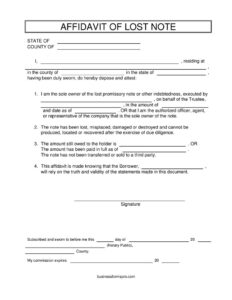
Affidavit Of Lost Note
Download a free Affidavit of Lost Note template in PDF or DOCX to formally declare a promissory note lost or destroyed — no signup, free download.
PDF
DOCX
7 downloads
0
likes
Download Files
- DOCX
An Affidavit of Lost Note is a sworn statement used to formally declare that an original promissory note has been lost, misplaced, stolen, or destroyed. People most often use it when a lender or note holder cannot produce the physical document needed to enforce, transfer, or release a debt. You can download this Affidavit of Lost Note free in both PDF and DOCX formats, with no signup required.
What Is an Affidavit of Lost Note?
An Affidavit of Lost Note is a notarized legal document in which a person — called the affiant — swears under oath that an original promissory note is no longer in their possession and cannot be located. It is typically signed by the lender, the note holder, or an authorized officer of a lending institution. The affidavit documents the circumstances of the loss, confirms the note has not been assigned or transferred to anyone else, and often includes a promise to indemnify other parties against claims arising from the missing instrument. It allows a debt or transaction to move forward even though the original signed note cannot be physically produced.
When Do You Need an Affidavit of Lost Note?
This affidavit becomes important whenever an original signed note is required but cannot be found. Common situations include:
- Mortgage payoff or loan satisfaction — when a lender must release a lien but the original promissory note has gone missing from the file.
- Selling or assigning a loan — when a note is transferred between lenders or investors and the original instrument cannot be located.
- Enforcing repayment — when a creditor seeks to collect on a debt but the signed note has been lost or destroyed.
- Estate administration — when an executor discovers a note owed to a deceased person but the original document is missing.
- Refinancing or restructuring — when a new loan replaces an existing one and the original note is needed to close the file.
- Fire, flood, or office relocation — when business records, including a note, were destroyed or lost during a disruptive event.
What an Affidavit of Lost Note Should Have
To be credible and useful, an Affidavit of Lost Note should clearly identify the affiant and their relationship to the note, describe the note itself (the parties, the original amount, and the date if known), and state plainly that the original cannot be found despite a diligent search. It should explain how the note was lost and confirm that the affiant has not sold, pledged, or assigned it to a third party. Strong affidavits also include an indemnification statement protecting other parties from future claims. Finally, the document must be signed under oath and acknowledged before a notary public, who completes the jurat section confirming the affiant was sworn.
How to Fill Out an Affidavit of Lost Note
- State and County: At the top, enter the state and county where the affidavit is being signed. This establishes the jurisdiction for the notarial act.
- Affiant name: Write your full legal name in the “I, ____” line as the person making the sworn statement.
- Residence address: Provide your complete street address where indicated, then fill in your county and state of residence in the corresponding blanks.
- Statement of facts: In the main “depose and attest” section, describe the note in detail — the parties, original principal amount, date executed, and the circumstances of its loss. Affirm that a diligent search was made and that the note has not been assigned or transferred.
- Affiant signature: Sign on the “AFFIANT” line, ideally in the notary’s presence.
- Notary block: Leave the “Subscribed and sworn” section, the day, month, and year, the notary signature, county, and commission expiration date for the notary to complete.
Notarization and Recording
An Affidavit of Lost Note is almost always notarized, because its value comes from being a sworn statement. The notary administers an oath, witnesses your signature, and completes the jurat — the “subscribed and sworn to before me” language — along with their commission details. Bring valid government-issued photo identification and do not sign the document until the notary instructs you to do so. In some transactions, such as releasing a mortgage lien, the affidavit may also need to be recorded with the county recorder or land records office. Recording requirements and any associated fees vary by jurisdiction, so confirm with the relevant office or closing agent before filing.
Indemnification and the Lost Instrument
Because a promissory note is a negotiable instrument, the party relying on a lost-note affidavit usually wants protection in case the original document later surfaces in someone else’s hands. For this reason, many affidavits include an indemnification clause in which the affiant agrees to hold the other party harmless from any loss or claim connected to the missing note. Some lenders or title companies may also require a separate lost note bond. Read any indemnity language carefully so you understand the obligations you are accepting before you sign and swear to the affidavit.
Common Mistakes to Avoid
- Leaving out note details — failing to identify the original amount, parties, and date makes the affidavit hard to rely on.
- Signing before the notary — the signature must be witnessed, so never sign in advance.
- Overstating the search — only attest that you made a diligent search if you genuinely did; you are swearing under oath.
- Omitting the no-assignment statement — confirming you never transferred the note is often essential to the other party.
- Blank notary fields — an incomplete jurat, missing commission date, or unsigned notary block can invalidate the document.
- Skipping recording when required — some lien releases need the affidavit on file with the county to be effective.
Frequently Asked Questions
What is an Affidavit of Lost Note used for? It is used to formally swear that an original promissory note has been lost, destroyed, or stolen and cannot be produced. This allows a loan to be paid off, transferred, enforced, or released even without the physical original document.
Does an Affidavit of Lost Note need to be notarized? Yes, in almost all cases. The document is a sworn statement, so a notary public must administer an oath, witness your signature, and complete the jurat section confirming the affidavit was subscribed and sworn before them.
Who signs the Affidavit of Lost Note? The affiant signs it — typically the lender, current note holder, or an authorized representative such as a loan officer or estate executor who has personal knowledge that the note is missing.
Is an Affidavit of Lost Note legally binding? When properly completed, signed under oath, and notarized, it is a binding sworn statement, and making false statements in it can carry serious legal consequences. Whether it satisfies a specific transaction depends on the requirements of the lender, court, or recording office involved.
Do I need to record the affidavit anywhere? Sometimes. If the note is tied to a mortgage or other recorded lien, you may need to file the affidavit with the county recorder. Recording rules and fees vary by jurisdiction, so confirm locally before filing.
How much does this Affidavit of Lost Note template cost? The template is completely free to download here in PDF and DOCX formats with no signup required. You may pay a small fee to the notary for the notarial act and, in some cases, a recording fee to the county office.
This Affidavit of Lost Note template is provided as a general example for informational purposes only and is not legal, financial, or tax advice. Requirements for sworn statements, notarization, and recording vary by jurisdiction. Consult a qualified attorney before using this document for your specific situation.
Related Forms
- Non-Cash Contribution Letter
- Affidavit Of Loss
- Affidavit Of Identity
- Affidavit Of One And The Same
- Affidavit Of Domicile
- Affidavit Of Financial Support
Browse more in Affidavits.