
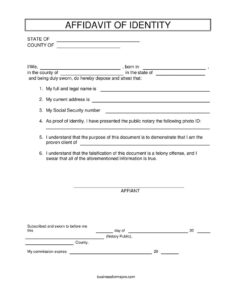
Affidavit Of Identity
Download a free Affidavit of Identity template in PDF and DOCX to legally confirm your identity under oath — no signup, instant free download.
PDF
DOCX
6 downloads
0
likes
Download Files
- DOCX
An Affidavit of Identity is a sworn written statement in which a person (the affiant) confirms, under oath and before a notary public, that they are who they claim to be. People most often use it to verify their identity when documents, records, or signatures are questioned or when no standard photo ID can be presented. You can download this Affidavit of Identity template free here in both PDF and DOCX formats, with no signup required.
What Is an Affidavit of Identity?
An Affidavit of Identity is a legal document used to formally declare and verify a person’s identity. It is signed by the affiant — the individual making the statement — and sworn before a notary public who administers an oath and witnesses the signature. The affidavit typically records the affiant’s name, place and details of birth, and the specific facts they are attesting to regarding their identity. Banks, courts, government agencies, schools, and businesses request these affidavits when they need a notarized, on-the-record confirmation that a person is genuinely the individual named in another document. Because it is sworn under penalty of perjury, the statement carries legal weight beyond an informal letter.
When Do You Need an Affidavit of Identity?
This affidavit comes up in many practical situations where a name or identity must be confirmed in writing. Common scenarios include:
- Proving you are the same person named on a document when records show different name spellings or variations.
- Verifying identity to a bank or financial institution when opening accounts or accessing funds and a photo ID alone is insufficient.
- Confirming identity to a court, school, or government office that requires a notarized declaration.
- Supporting a name-change, passport, or estate matter where someone must swear to who they are.
- Establishing identity when an original ID has been lost, stolen, or is otherwise unavailable.
- Confirming the identity of a signer in connection with a deed, contract, or legal filing.
What an Affidavit of Identity Should Have
For the document to serve its purpose, it must clearly identify the affiant and be properly executed. A complete Affidavit of Identity should include the state and county where it is sworn, the full legal name of the affiant, identifying details such as place and date of birth, and a clear statement of the facts being attested to. It must contain the affiant’s signature and a notary acknowledgment block showing the date, the notary’s signature, the county, and the date the notary’s commission expires. Without the notarial section completed, the affidavit is generally just an unsworn statement and may not be accepted by the institution requesting it.
How to Fill Out an Affidavit of Identity
Work through the template field by field, printing clearly or typing where possible:
- At the top, enter the State and County where you are signing the affidavit.
- Write your full legal name in the “I/We” line so the affiant is clearly identified.
- Fill in your place of birth in the “born in” field — the city, town, or country where you were born.
- Enter the county and state associated with your birth or identity details as prompted.
- In the main statement area following “do hereby depose and attest that,” write the specific facts about your identity you are confirming — for example, that you are the same individual named on a particular document.
- Sign on the AFFIANT line, but only in the presence of the notary.
- Leave the notary section blank: the notary completes the day, month, and year, signs as Notary Public, lists the county, and notes when the commission expires.
Getting the Affidavit Notarized
The defining feature of this document is that it is “subscribed and sworn to” before a notary public. Do not sign in advance. Instead, bring the unsigned affidavit and acceptable identification to a notary — many banks, shipping stores, libraries, and law offices offer notary services. The notary will verify your identity to the extent they can, administer an oath, watch you sign, and then complete the acknowledgment block with the date, their signature, the county, and their commission expiration. The notary does not vouch for the truth of your statements; they confirm that you appeared, swore to the contents, and signed. Some online or remote notarization options may also be available depending on your state’s rules.
Affidavit of Identity vs. a Photo ID
A photo ID is government-issued proof you carry, while an Affidavit of Identity is a sworn statement you create and have notarized. The affidavit does not replace a driver’s license or passport in most everyday situations; rather, it supplements or supports them when an institution needs an extra, on-the-record declaration. Because you are swearing under oath, knowingly making false statements can expose you to penalties for perjury. Always make sure the facts you write are accurate and complete before signing.
Common Mistakes to Avoid
- Signing before you reach the notary — the signature must be witnessed, so wait until you are in front of the notary public.
- Leaving the state or county fields blank, which can make the venue of the affidavit unclear.
- Using a nickname or partial name instead of your full legal name.
- Writing a vague statement in the attestation section instead of clearly stating the identity facts you are confirming.
- Forgetting to have the notary block completed, leaving you with an unsworn, unusable document.
- Not checking whether the receiving institution has its own required wording or format before you sign.
Frequently Asked Questions
What is an Affidavit of Identity used for? It is used to formally confirm, under oath, that you are the person you claim to be. People rely on it when banks, courts, schools, or agencies need a notarized declaration of identity, often to resolve name discrepancies or when standard ID is missing.
Does an Affidavit of Identity need to be notarized? Yes. The document is designed to be “subscribed and sworn to before a notary public,” so a notary must administer an oath, witness your signature, and complete the acknowledgment block. Without notarization it is generally treated as an informal, unsworn statement.
Is an Affidavit of Identity legally binding? Once properly sworn and notarized, it is a legal document made under oath, and false statements can carry penalties for perjury. However, whether a particular institution accepts it depends on their own requirements and your jurisdiction’s rules.
How much does this Affidavit of Identity template cost? The template on this page is completely free to download in PDF and DOCX with no signup. You may still need to pay a small fee to a notary public for the notarization itself, which varies by location.
Can I write my own statement in the affidavit? Yes. The section after “do hereby depose and attest that” is where you state the specific identity facts you are confirming. Keep it clear, factual, and limited to information you know to be true.
Who is the affiant on this form? The affiant is you — the person making and signing the sworn statement. Your full legal name should appear in the “I/We” line and again as your signature on the AFFIANT line.
This Affidavit of Identity template is provided as a general example for informational purposes only and is not legal advice. Requirements for affidavits and notarization vary by state and jurisdiction, and acceptance depends on the institution requesting it. Consult a qualified attorney or notary for guidance on your specific situation.
Related Forms
- Affidavit Of Heirship
- Affidavit Of Gift
- Affidavit Of Non Collusion
- Non-Cash Contribution Letter
- Affidavit Of One And The Same
- Affidavit Of Marriage
Browse more in Affidavits.