
Apartment Manager Ledger
Download a free Apartment Manager Ledger template to track tenant rent payments, balances, and unit activity in PDF and DOCX, no signup required.
PDF
DOCX
0
likes
Download Files
- DOCX
An Apartment Manager Ledger is a record-keeping document property managers use to track rent payments, outstanding balances, and unit activity across a building or portfolio. The most common reason people use it is to keep a clean, organized account of who has paid, who owes, and how much, so rent collection never relies on memory or scattered notes. It is free to download here in both PDF and DOCX formats with no signup required.
What Is an Apartment Manager Ledger?
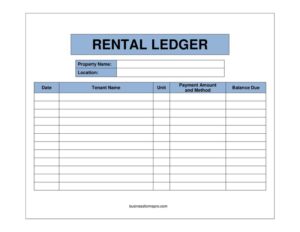
An Apartment Manager Ledger is a running financial record kept by an apartment manager, property management company, or landlord to document tenant payments and running balances unit by unit. It typically lists the property name, its location, each transaction date, the tenant, the unit number, the payment received, and the resulting balance. The ledger serves as a single source of truth for rent collection, helping managers reconcile income, spot late or partial payments, and prepare reports for owners. Unlike a one-off receipt, the ledger captures the full history of an account over time, making it valuable for monthly accounting, dispute resolution, and end-of-year financial summaries.
When Do You Need an Apartment Manager Ledger?
A ledger becomes essential any time more than a single payment needs to be tracked and reconciled. Common situations include:
- Monthly rent collection — logging each tenant’s rent as it comes in and confirming whether the unit is current or behind.
- Managing multiple units or properties — keeping organized records across several apartments where balances vary from tenant to tenant.
- Tracking partial or late payments — recording a $500 payment against $900 owed so the remaining balance is clearly visible.
- Reporting to property owners — giving an owner a transparent month-by-month account of collections for their building.
- Resolving payment disputes — providing a dated history when a tenant claims a payment was made or missed.
- Year-end accounting and tax prep — totaling rental income per unit for bookkeeping or handing off to an accountant.
What an Apartment Manager Ledger Should Have
A complete and useful ledger keeps every entry consistent and easy to audit. Each row should identify the property and its location so records from multiple buildings never get mixed up. Every transaction needs a date, the tenant’s name, and the unit number to tie the payment to a specific account. The payment column records the amount received, and the balance column shows what remains owed after that payment is applied. The strength of a ledger lies in its running balance: each new entry updates the prior figure, so the most recent row always reflects the current account status. Clear column headers, chronological ordering, and legible amounts make the document trustworthy and far easier to reconcile at month-end.
How to Fill Out an Apartment Manager Ledger
- Property name: Enter the name of the building or community the ledger covers, such as “Maple Court Apartments,” so the record is clearly identified.
- Location: Add the property’s address or general location to distinguish it from other buildings you manage.
- Date: Record the date each payment is received or each transaction occurs. Keep entries in chronological order.
- Tenant name: Write the full name of the tenant making the payment, matching the name on the lease.
- Unit: Enter the apartment or unit number associated with that tenant, for example “Unit 4B.”
- Payment: Log the exact amount received for that transaction. If it is a partial payment, enter only what was actually paid.
- Balance: Calculate and record the remaining amount owed after applying the payment. Carry this figure forward so the next entry starts from the correct balance.
Repeat a new row for each payment or charge, and review the running balance regularly to confirm it matches your bank deposits and accounting software.
Ledger Versus Rent Receipt
It helps to understand how a ledger differs from a rent receipt. A receipt confirms a single payment and is usually given to the tenant as proof for one transaction. A ledger, by contrast, is the manager’s ongoing internal record that strings every transaction together to show a cumulative balance. You might issue a receipt to a tenant and simultaneously log that same payment in your ledger. Keeping both is good practice: the receipt protects the tenant, and the ledger protects you by preserving the complete payment history for the unit, the property, and your owner reports.
Tips for Keeping Accurate Records
Consistency is what makes a ledger reliable. Update it the same day payments arrive rather than batching them later, when details are easy to forget. Use the same date format throughout, and never overwrite an old entry — add a correcting line instead so the history stays intact. Reconcile the ledger against your bank statements at the end of every month to catch missing or duplicated entries early. If you manage several buildings, keep a separate ledger per property to avoid confusion, and back up your digital copies. A tidy ledger saves hours during tax season and removes guesswork when an owner asks how a particular unit is performing.
Common Mistakes to Avoid
- Forgetting to update the balance — entering a payment but leaving the running balance unchanged makes the whole ledger unreliable.
- Skipping the date — undated entries make it impossible to prove when a payment was received during a dispute.
- Mixing properties on one sheet — combining multiple buildings without clear labels leads to misapplied payments.
- Logging partial payments as full — always record the exact amount received, not the amount that was due.
- Using inconsistent tenant or unit labels — “4B” in one row and “Apt 4” in another can cause entries to be misread.
- Failing to reconcile — never comparing the ledger to actual deposits allows errors to accumulate unnoticed.
Frequently Asked Questions
What is an Apartment Manager Ledger used for? It is used to track rent payments and running balances for tenants across one or more units. Managers rely on it to see who has paid, who owes, and how much, and to produce accurate reports for property owners and accountants.
How do I fill out the ledger? Start by entering the property name and location, then add a row for each transaction with the date, tenant name, unit number, payment amount, and updated balance. Keep entries in chronological order and carry the balance forward so the latest row always shows the current account status.
Is an Apartment Manager Ledger a legal document? It is primarily an internal record-keeping tool rather than a contract, but it can serve as supporting evidence of payment history in a dispute or audit. Its value depends on being accurate, consistent, and contemporaneous with the transactions it records.
Does the ledger need to be notarized or witnessed? No. A management ledger is an accounting record and does not require notarization or witnesses. Accuracy, dating, and consistency are what make it credible and useful.
Can I use one ledger for multiple properties? You can, but it is usually cleaner to keep a separate ledger per property to prevent payments from being misapplied. If you do combine them, clearly label the property name and location on every entry.
How much does this template cost? Nothing — the Apartment Manager Ledger template is completely free to download here in PDF and DOCX formats, with no signup required. You can print it or edit the digital version to match your own properties and units.
This Apartment Manager Ledger template is a general example provided for informational purposes only and is not legal, financial, or tax advice. Record-keeping and landlord-tenant requirements vary by jurisdiction, so consult a qualified professional for guidance specific to your situation.
Official resource: for the rules that apply to your situation, see HUD.
Related Forms
- Rental Appliance Condition Record
- Noise Complaint Letter
- Rental Agreement Violation
- Rent Demand Letter
- Move In Letter
- Landlord Checklist
Browse more in Landlord Documents.