
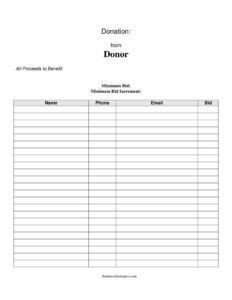
Auction Bid Sheet
Download a free Auction Bid Sheet template to track silent auction bids, donors, and winners with ease — print-ready PDF and DOCX, free download.
PDF
DOCX
4 downloads
0
likes
Download Files
- DOCX
An Auction Bid Sheet is a printable form placed beside an item at a silent auction so guests can write down their offers, with each bid topping the last by a set amount. People most often use it to run a smooth silent auction at a fundraiser, where the highest written bid at closing time wins the item. You can download this Auction Bid Sheet free in both PDF and DOCX formats, with no signup required.
What Is an Auction Bid Sheet?
An Auction Bid Sheet is a single-item tracking document used during silent auctions, charity galas, school fundraisers, and community events. It is typically created by the event organizer or auction committee and placed on a table next to each donated item. The sheet identifies the item, names the donor, states the cause the proceeds support, and sets a minimum opening bid and a required increase between offers. Below that, attendees record their name, contact details, and bid amount in sequence. When the auction closes, the last and highest valid entry on the sheet identifies the winner and the final selling price, making it the central record for both the transaction and follow-up.
When Do You Need an Auction Bid Sheet?
This form is useful any time bids are collected silently and in writing rather than called out to a live auctioneer. Common situations include:
- School and PTA fundraisers where parents bid on classroom baskets, experiences, or donated services.
- Charity galas and nonprofit benefit nights raising money for a specific program or cause.
- Church, club, or community group events auctioning donated goods to support a building fund or outreach effort.
- Corporate giving events where employees bid on prizes with proceeds going to a chosen charity.
- Sports team or booster club fundraisers featuring signed memorabilia and gift packages.
- Small estate or yard-style auctions where you want a written, orderly record of competing offers.
In each case, the bid sheet keeps the bidding transparent, prevents disputes about who offered what, and gives volunteers a clear way to total proceeds at the end of the night.
What an Auction Bid Sheet Should Have
A complete bid sheet does more than collect numbers — it sets the rules of the contest at a glance. The essential elements are a clear description of the donation (the item), the name of the donor who contributed it, and a line noting which cause the proceeds benefit. Equally important are the minimum bid that opens the bidding and the minimum bid increment that each new offer must exceed the previous one by. Finally, the sheet needs ordered rows for each bidder’s name, phone, email, and bid amount, plus space at the bottom to circle or mark the winning entry once bidding closes.
How to Fill Out an Auction Bid Sheet
- Describe the donation: Write a clear, appealing name and short description of the item or experience being auctioned in the donation field.
- Credit the donor: Enter the donor who provided the item so they can be thanked publicly and on the sheet.
- State the cause: Fill in the proceeds to benefit line so bidders know exactly what their generosity supports.
- Set the opening price: Enter the minimum bid, the lowest amount you will accept to start.
- Set the step: Write the minimum bid increment — the smallest amount each new bid must raise the price by, such as $5 or $10.
- Leave the bid rows blank: Guests complete each row themselves, writing their name, phone, and email next to their bid.
- Close and confirm: At the announced cutoff time, draw a line under the last entry and mark the highest valid bid as the winner.
Volunteers should then transfer the winning name, contact details, and amount to a master tally for checkout.
Tips for Running a Successful Silent Auction
Set a minimum bid that reflects an item’s value but stays inviting — too high and the sheet stays empty, too low and you leave money on the table. Choose a bid increment that matches the price range: small increments encourage frequent bidding on lower-value items, while larger increments speed up competition on premium packages. Display each sheet on a sturdy table with a pen attached, and keep sheets uncluttered so guests can see the current high bid at a glance. Announce closing times clearly, and consider adding a “buy it now” price on popular items to capture guaranteed revenue. After closing, having phone and email on every winning row makes checkout and pickup far easier.
After the Auction: Collecting and Recording
Once bidding ends, the bid sheet becomes your payment and pickup record. Use the winner’s name to call them to checkout, the bid amount to charge the correct total, and the phone and email fields to follow up if a winner has already left. Keep completed sheets as documentation of how much each item raised and which donor it came from — this is invaluable for thank-you notes, tax-acknowledgment letters to donors, and planning next year’s event. Totaling the winning bids across all sheets gives you the gross proceeds for the cause.
Common Mistakes to Avoid
- Forgetting the bid increment: Without a stated minimum increase, bidders may raise by a penny and slow the contest to a crawl.
- Vague item descriptions: A thin description in the donation field undersells the item and depresses bids.
- No contact info: Skipping the phone and email columns makes it hard to reach winners who leave early.
- Unclear closing time: If guests don’t know when bidding ends, you’ll face disputes over last-second offers.
- Illegible writing: Bids crammed together or written sloppily can void an entry — keep rows generously spaced.
- Losing track of the donor: Failing to record who donated each item complicates thank-yous and recordkeeping.
Frequently Asked Questions
What is an Auction Bid Sheet used for? It is used to collect and track written bids on a single item during a silent auction. Guests record their name, contact details, and offer in sequence, and the highest entry at closing wins the item.
How do I set the minimum bid and increment? Base the minimum bid on a fraction of the item’s estimated value so it feels approachable, and set the increment to keep bidding lively — commonly $5 to $25 depending on the item’s price range. Both values go at the top of the sheet before bidding opens.
Do bidders have to use the same sheet? Yes. Each item should have its own dedicated bid sheet so all competing offers for that item are recorded in one place, making it easy to identify the winning bid and final price.
What happens if two people write the same amount? Because each new bid must exceed the previous one by the stated increment, identical amounts shouldn’t qualify. If they do, the earlier entry or the one that meets the increment rule generally prevails — clarify your tie rule before the event.
Is this Auction Bid Sheet free to download? Yes. You can download this template completely free in PDF and DOCX formats, with no signup or payment required, and print as many copies as your event needs.
Can I customize the sheet for my event? Absolutely. The DOCX version lets you add your organization’s name, logo, a “buy it now” price, more bid rows, or extra item details so the sheet fits your specific auction.
This Auction Bid Sheet template is provided as a general example for informational purposes only and is not legal, financial, or tax advice. Rules for charitable auctions, donor acknowledgments, and sales tax vary by jurisdiction — consult a qualified professional or your event’s organizing authority to ensure compliance.
Related Forms
- Security Shift Activity
- Testimonial Form
- Driving Directions With Map
- Accident Claim Worksheet
- Blank Memo
- Raffle Ticket White
Browse more in Miscellaneous.