
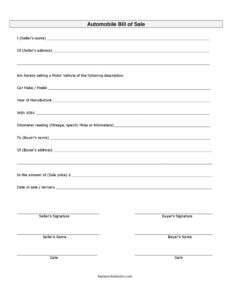
Auto Bill Of Sale
Download a free Auto Bill of Sale template to document a private car sale, record the price, mileage, and parties involved — free PDF and DOCX download.
PDF
DOCX
3 downloads
0
likes
Download Files
- DOCX
An Auto Bill of Sale is a simple written record that documents the sale of a motor vehicle from one person to another, capturing the seller, the buyer, the vehicle, the price, and the date of the transaction. Most people use it to prove ownership changed hands in a private car sale and to protect both parties after the keys are handed over. You can download this Auto Bill of Sale free in PDF and DOCX formats — no signup required.
What Is an Auto Bill of Sale?
An Auto Bill of Sale is a short legal document that records the transfer of a motor vehicle from a seller to a buyer. It is typically created and signed by both parties at the time of sale, and it states who sold the vehicle, who bought it, a description of the car, the agreed price, and the date the sale and delivery took place. The document serves as written proof that the transaction occurred and that ownership has moved from one person to the other. Buyers often use it when registering or titling the vehicle, while sellers keep a copy to show they no longer own — and are no longer responsible for — the car.
When Do You Need an Auto Bill of Sale?
This form is useful any time a vehicle changes hands outside of a dealership transaction. Common situations include:
- Private car sales — selling a used vehicle to a private buyer who found your listing online or through word of mouth.
- Buying from an individual — protecting yourself as a buyer with a written record of what you paid and the vehicle’s condition.
- Gifting or family transfers — documenting a transfer between relatives, even when the sale price is nominal.
- Registration and titling — many motor vehicle agencies request a bill of sale to register the car in the new owner’s name.
- Tax purposes — recording the sale price so the correct amount of sales or use tax can be calculated.
- Proof of release of liability — giving the seller evidence of the date ownership transferred in case of later tickets, tolls, or accidents.
What an Auto Bill of Sale Should Have
To be complete and useful, an Auto Bill of Sale should clearly identify everyone and everything involved in the deal. At minimum it should include the seller’s full name and address, the buyer’s full name and address, a description of the vehicle (make and model, and ideally the VIN), the odometer reading with the unit of measurement, the agreed sale price, and the date of sale or delivery. Signatures from both parties turn the document into a stronger record of mutual agreement. Many people also add language stating the vehicle is sold “as-is” so expectations about condition are clear from the start.
How to Fill Out an Auto Bill of Sale
This template uses plain fill-in-the-blank language. Work through it field by field:
- Seller’s Name: Enter the full legal name of the person selling the vehicle, exactly as it appears on the title.
- Seller’s address: Write the seller’s current residential or business address for identification and records.
- Car make/model: Describe the vehicle, such as “Toyota Camry” — adding the year, color, and VIN strengthens the record even though they aren’t preprinted fields.
- Odometer reading: Record the exact mileage shown on the dashboard and clearly note whether the figure is in miles or kilometers.
- Buyer’s Name: Enter the full legal name of the person purchasing the vehicle.
- Buyer’s address: Write the buyer’s complete address.
- Sale price: State the agreed amount in numbers and, ideally, words to avoid confusion.
- Date of sale/delivery: Fill in the date ownership and possession transfer, then have both parties sign on the lines provided.
As-Is Sales and the Odometer Statement
Most private vehicle sales are made “as-is,” meaning the buyer accepts the car in its current condition without any warranty from the seller. Stating this clearly on the bill of sale helps prevent disputes if a problem appears after the sale. The odometer reading included on this form is also important: recording accurate mileage at the time of transfer creates a snapshot of the vehicle’s use and supports an honest transaction. Always note whether the reading is in miles or kilometers, since the same number means very different things depending on the unit. If the odometer is broken or has rolled over, note that plainly rather than guessing at a figure.
After the Sale: Keep Copies and Notify the Authorities
Once both parties have signed, each should keep a copy. The buyer typically uses their copy to register and title the vehicle in their name, while the seller keeps theirs as proof they no longer own the car. In many places the seller is expected to notify the motor vehicle authority that the vehicle was sold, and the buyer must transfer the title and update insurance promptly. Handling these steps quickly protects the seller from being held responsible for tolls, tickets, or incidents involving a car they no longer own. Check your local agency’s requirements, since the exact paperwork and deadlines vary.
Common Mistakes to Avoid
- Leaving out the VIN: Make and model alone may not uniquely identify the vehicle — add the VIN whenever possible.
- Skipping the odometer unit: Failing to specify miles or kilometers can create confusion about the vehicle’s true mileage.
- Misstating the sale price: An inaccurate price can cause tax problems or look like an attempt to underreport.
- Forgetting signatures or the date: An unsigned or undated bill of sale is far weaker as proof of the transaction.
- Using nicknames instead of legal names: Always use full legal names that match the title and ID.
- Not keeping a copy: Both parties should retain a signed copy for their own records.
Frequently Asked Questions
What is an Auto Bill of Sale used for? It documents the sale of a vehicle between a seller and buyer, recording who sold it, who bought it, the price, the mileage, and the date. Buyers often use it to register and title the car, and sellers keep it as proof they transferred ownership.
Is an Auto Bill of Sale legally binding? When both parties complete and sign it honestly, it serves as a binding record of the transaction. Its legal weight and the exact requirements vary by location, so check what your local motor vehicle authority expects.
Does an Auto Bill of Sale need to be notarized? Many private vehicle sales do not require notarization, but some states or transactions do. Confirm the rules where you live, since notarization can add an extra layer of verification even when it isn’t mandatory.
Do I still need a title if I have a bill of sale? Yes. A bill of sale records the transaction, but the vehicle title is the official ownership document and is usually required to register the car in the buyer’s name.
How much does this Auto Bill of Sale template cost? Nothing — it is completely free to download in PDF and DOCX formats from Business Forms Pro, with no signup required. You can fill it out by hand or type directly into the document.
What should I write for the odometer reading? Record the exact number shown on the dashboard at the time of sale and clearly indicate whether it is in miles or kilometers. If the odometer is inaccurate or has rolled over, note that on the form instead of estimating.
This Auto Bill of Sale template is a general example provided for informational purposes only and is not legal, financial, or tax advice. Vehicle sale and titling requirements vary by jurisdiction, so consult your local motor vehicle authority or a qualified professional before relying on this document.
Official resource: for the rules that apply to your situation, see your state DMV.
Related Forms
- Vehicle Deal Jacket
- Used Vehicle Appraisal
- Motorcycle Bill of Sale
- Used Car Comparison
- Used Car Mechanic Checklist
- Auto Transport Bill of Lading
Browse more in Auto Sales.