
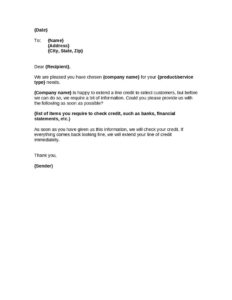
Business Credit Line Information
Request the documents you need to approve a customer credit line with this free Business Credit Line Information letter template — free download in PDF and DOCX.
DOCX
3 downloads
0
likes
Download Files
- DOCX
A Business Credit Line Information letter is a short, professional request a company sends to a customer asking for the financial details it needs before extending a line of credit. Businesses most often use it after a customer expresses interest in buying on credit but before any account terms are approved. You can download this template free in PDF and DOCX formats — no signup required.
What Is a Business Credit Line Information Letter?
A Business Credit Line Information letter is a formal communication issued by a seller, supplier, or service provider to a prospective or existing customer who wants to purchase on credit. It welcomes the customer, confirms the company is willing to consider extending a credit line, and lists the specific information required to evaluate the applicant’s creditworthiness — such as bank references, financial statements, and trade references. The letter documents the start of the credit-review process and sets clear expectations: once the requested items are received and the credit check comes back acceptable, the line of credit will be extended. It serves as both a courteous touchpoint and a record of due diligence.
When Do You Need a Business Credit Line Information Letter?
This letter fits any situation where a company wants to gather financial information before approving customer credit. Common scenarios include:
- A new wholesale customer asks to place orders on net-30 terms instead of paying upfront.
- A supplier wants to formalize the documentation step before opening a trade account.
- A service provider is considering monthly billing rather than prepayment for a recurring client.
- An existing cash customer requests a credit line so they can scale up purchasing.
- A distributor needs bank and trade references on file before shipping larger orders.
- A company is standardizing its onboarding so every credit applicant receives the same request.
What a Credit Line Information Letter Should Have
To do its job, the letter should be clear, polite, and specific about what you need back. A complete version includes the recipient’s full name and mailing address, a warm opening that thanks the customer for choosing your company, and a plain statement that you extend credit to select customers. Most important is an itemized list of the exact documents or references you require — vague requests slow everything down. The letter should also explain the next step (you will run a credit check) and the outcome (prompt approval if everything checks out). Close with a thank-you and the sender’s name so the customer knows who to contact with questions.
How to Fill Out a Business Credit Line Information Letter
- In the To block, enter the recipient’s Name, Address, and City, State, Zip exactly as they should appear on the envelope.
- Complete the greeting by replacing Recipient with the contact’s name — for example, “Dear Ms. Alvarez.”
- Insert your company name in the opening line thanking the customer for choosing you.
- Fill in the product/service type so the customer sees the letter relates to their specific needs (for example, “office supply” or “landscaping”).
- Repeat your company name in the sentence explaining you extend credit to select customers.
- In the list of items you require, spell out everything you need — bank references, recent financial statements, trade references, a completed credit application, or a tax ID. Use a bulleted list for clarity.
- Review the closing paragraph confirming you will check credit and extend the line once everything is in order.
- Sign off by entering the Sender name and your title, then add direct contact details so the customer can respond quickly.
What Information to Request
The most valuable part of this letter is the list of items you ask for, so tailor it to your risk tolerance and the size of the credit line. Typical requests include the names and contact details of the customer’s primary bank, two or three trade references from other suppliers, recent financial statements or a balance sheet, the business’s legal name and structure, and a federal tax identification number. For larger lines you might also ask for a personal guarantee or a completed standard credit application. Requesting too little leaves you exposed; requesting too much can stall the relationship — aim for the minimum that lets you make a confident decision.
What Happens After You Send It
Once the customer returns the requested information, the seller verifies bank and trade references, reviews any financial statements, and may pull a commercial credit report. If the results are acceptable, you can move directly to a credit approval letter that states the credit limit, payment terms, and any conditions. If the file raises concerns, you might offer a smaller line, require prepayment for an initial period, or politely decline. Keeping a copy of this information request, the customer’s response, and your decision creates a clean audit trail that protects both sides if a dispute arises later.
Common Mistakes to Avoid
- Vague requests: writing “please send your information” instead of naming exact documents leads to back-and-forth delays.
- Forgetting placeholders: sending a letter that still says “{company name}” or “{Recipient}” looks careless and unprofessional.
- No response deadline: omitting a clear timeframe leaves the application sitting in limbo.
- Promising approval: stating you “will” extend credit before the check is complete; keep it conditional.
- No contact path: failing to include who the customer should call or email with questions.
- Skipping recordkeeping: not saving a dated copy of the letter and the customer’s reply for your files.
Frequently Asked Questions
What is a Business Credit Line Information letter used for? It is used to request the financial details a company needs before deciding whether to extend a line of credit to a customer. The letter thanks the customer, confirms interest in offering credit, and lists the documents or references required. It marks the formal beginning of the credit-review process.
How do I fill out this template? Replace each placeholder — recipient name and address, your company name, the product or service type, and the list of items you need — with your own details. Add a clear list of documents, a response deadline, and your name and contact information at the close. Proofread to make sure no brackets remain before sending.
What information should I ask the customer to provide? Common requests include bank references, two or three trade references, recent financial statements, the legal business name and structure, and a tax identification number. For larger credit lines you may also ask for a personal guarantee or a completed credit application. Request only what you genuinely need to make a sound decision.
Is this letter legally binding? No. The letter is an information request and an expression of willingness to consider credit — it does not by itself create a credit agreement. Credit terms become binding only when both parties agree to a separate approval or contract specifying limits, rates, and payment terms.
Does it need to be notarized or witnessed? No. A credit information request is routine business correspondence and does not require notarization or witnesses. A signature from an authorized representative and accurate company details are all that is typically expected.
Is this template really free? Yes. You can download the Business Credit Line Information letter free in PDF and DOCX from Business Forms Pro with no signup required. Edit it freely to match your company’s onboarding process and credit policy.
This template is a general example provided for informational purposes only and is not legal, financial, or credit-policy advice. Credit practices and disclosure requirements vary by jurisdiction and industry — consult a qualified professional before relying on this document for your business.
Related Forms
- Warranty Claim on a Product
- Quote Invitation
- New Product Announcement
- Employee Termination For Drug Use
- Landlord Eviction For Renovation
- Notice of Impending Action
Browse more in Business Letters.