
Employee Termination For Drug Use
Download a free Employee Termination for Drug Use letter template in PDF and DOCX to document a clear, professional, policy-based separation.
DOCX
0
likes
Download Files
- DOCX
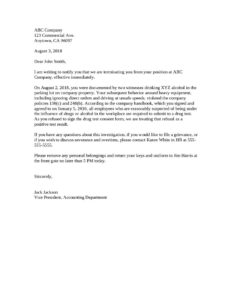
An Employee Termination for Drug Use letter is a formal document an employer issues to end the employment of a worker for violating the company’s drug and substance policy. People most often use it to clearly communicate the decision, the policy basis, and the effective date while creating a written record of the separation. It’s free to download here in both PDF and DOCX formats, with no signup required.
What Is an Employee Termination for Drug Use Letter?
An Employee Termination for Drug Use letter is a written notice from an employer—usually HR, a manager, or a business owner—informing an employee that their employment is ending because of a confirmed violation of the organization’s drug-free workplace or substance abuse policy. It documents the reason for termination, references the relevant policy, and states the effective date. The letter serves both a communication and a recordkeeping function: it gives the employee a clear, professional explanation and gives the employer a dated paper trail in case the decision is later questioned. It is typically delivered in person or in a brief meeting, then placed in the employee’s personnel file.
When Do You Need an Employee Termination for Drug Use Letter?
This letter is appropriate after an investigation or test has confirmed a policy violation and the decision to terminate has been finalized. Common situations include:
- An employee fails a workplace drug test required under a documented drug-free workplace policy.
- A worker is found using, possessing, or distributing illegal substances on company premises.
- An employee reports to work visibly impaired and a reasonable-suspicion test confirms drug use.
- A safety-sensitive worker (driver, machine operator, medical staff) violates substance rules that put others at risk.
- An employee refuses a lawfully required drug test in violation of company policy.
- A repeat offense occurs after a prior warning, last-chance agreement, or completed treatment program.
What an Employee Termination Letter Should Have
A complete and professional termination letter for drug use should clearly identify all parties and the basis for the action. Strong letters include the company name and contact details, the employee’s name and position, the date of the letter, and the effective date of termination. They reference the specific policy or section the employee violated, briefly state the factual basis (such as a failed test or confirmed incident) without unnecessary detail, and explain next steps for final pay, benefits, and return of company property. A respectful, factual tone matters—avoid accusatory or emotional language. The letter should end with a signature line for the authorized representative and, where appropriate, a place for the employee to acknowledge receipt.
How to Fill Out an Employee Termination for Drug Use Letter
- Enter your company name, address, and date at the top so the letter is properly identified and timestamped.
- Add the employee’s full name, job title, and department in the recipient block.
- Open with a clear statement that the employee’s employment is being terminated and provide the effective date.
- State the reason: a violation of the company’s drug and substance policy, and reference the specific policy name or section number.
- Briefly describe the factual basis—for example, the date of a failed drug test or the incident—keeping it concise and objective.
- Explain final logistics: last paycheck, accrued benefits, COBRA or insurance information, and return of company property such as keys, badges, or equipment.
- Provide a contact person for questions about final pay or benefits.
- Close with the signature, name, and title of the authorized manager or HR representative, and include an acknowledgment line for the employee if used.
Documentation and Confidentiality
Because this letter touches on a sensitive medical and legal area, supporting documentation matters. Keep the underlying drug test results, the signed acknowledgment of the company drug policy, any warnings or last-chance agreements, and incident reports together in a secure file. Limit access to those with a legitimate business need. Drug test results and related medical information are often treated as confidential under privacy and employment rules, so avoid sharing details beyond what is necessary. The letter itself should reference the policy violation rather than reproduce clinical test data in full.
How This Differs From a General Termination Letter
A standard termination letter may cite layoffs, performance, or restructuring, and often includes neutral language. A termination for drug use is a for-cause separation tied to a specific policy violation, which can affect eligibility for unemployment benefits and severance in some jurisdictions. Because of this, the letter should be especially precise about the policy referenced and the date of the violation. Many employers coordinate with HR or counsel before sending a for-cause letter to ensure consistency with the employee handbook and applicable laws.
Common Mistakes to Avoid
- Vague reasoning—failing to name the specific policy or section the employee violated.
- Including too much clinical detail—reproducing full test results rather than referencing the violation.
- Emotional or accusatory language that could be read as defamatory; keep it factual.
- Skipping documentation—sending the letter without retaining test results, warnings, or signed policy acknowledgments.
- Forgetting final-pay and property details, which leaves loose ends and can create disputes.
- Inconsistent enforcement—treating similar violations differently across employees, which undermines the policy.
Frequently Asked Questions
What is an Employee Termination for Drug Use letter? It is a formal written notice from an employer ending an employee’s job because of a confirmed violation of the company’s drug and substance policy. It states the reason, references the policy, and gives the effective date. It also serves as a permanent record in the employee’s file.
How do I fill out this termination letter? Start with your company information and the date, then identify the employee and their position. State clearly that employment is ending, the effective date, the policy violated, and the factual basis, followed by final-pay and property-return details. Finish with an authorized signature and, if desired, an employee acknowledgment line.
Does this letter need to be notarized or witnessed? Notarization is generally not required for an employment termination letter. Some employers ask the employee or a witness to sign an acknowledgment of receipt for their records. Check your internal HR procedures and any applicable local rules.
Is a termination for drug use letter legally binding? The letter documents and communicates a decision rather than forming a contract, but it can carry legal weight as evidence of why and when the termination occurred. Its enforceability depends on whether the underlying action complies with employment laws, your handbook, and any contracts. Consistent policy enforcement and proper documentation strengthen it.
Should I reference the drug policy and test in the letter? Yes—reference the specific policy or section that was violated and the date of the confirmed violation or failed test. Keep clinical details brief and factual, and store full test results separately and confidentially. This balances clarity with privacy.
How much does this template cost? This Employee Termination for Drug Use letter template is completely free to download from Business Forms Pro in both PDF and DOCX formats, with no signup required. You can edit it to match your company’s policy and branding. Reuse it whenever you need a clear, professional for-cause termination letter.
This template is a general example provided for informational purposes only and does not constitute legal, HR, or medical advice. Employment, drug-testing, and privacy requirements vary by jurisdiction and by individual circumstances. Consult a qualified employment attorney or HR professional before terminating an employee or relying on this document.
Related Forms
- Reference Request
- Very Late Reply to Customer
- Employee Termination For Absenteeism
- Project Delay Letter
- Copyrighted Material Request
- Landlord Eviction For Renovation
Browse more in Business Letters.