
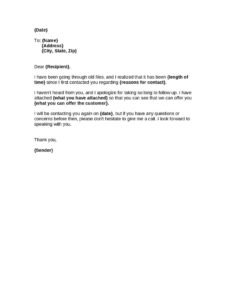
Very Late Reply to Customer
Use this free Very Late Reply to Customer letter template to apologize, re-engage a prospect, and reopen the conversation — free PDF and DOCX download.
DOCX
1 downloads
0
likes
Download Files
- DOCX
A Very Late Reply to Customer letter is a short, courteous business message used to reconnect with a customer or prospect after an unusually long gap in communication. The most common reason people use it is to revive a stalled lead or follow up on a forgotten inquiry without seeming to ignore the delay. You can download this letter free in PDF and DOCX, with no signup required.
What Is a Very Late Reply to Customer Letter?
A Very Late Reply to Customer letter is a professional correspondence that acknowledges a significant delay in following up with someone you previously contacted. It is typically written by a salesperson, account manager, business owner, or customer-facing representative who discovers an old inquiry or unfinished conversation. The letter documents that you reached out, briefly apologizes for the slow response, restates what you can offer, and proposes a clear next step. Its purpose is twofold: to repair any impression of neglect and to reopen a viable opportunity. Rather than pretending the gap never happened, this letter addresses it head-on with a friendly, accountable tone, which often disarms the recipient and makes them more receptive to continuing the discussion.
When Do You Need a Very Late Reply to Customer Letter?
This letter fits many situations where time slipped away and you want to re-establish contact gracefully. Consider sending it when:
- You are cleaning out old files or a CRM and find a prospect you never followed up with after the first contact.
- A quote or proposal went out months ago and you never circled back to see if the customer was still interested.
- A staff transition left an inquiry unanswered, and you are now picking up the account.
- A customer requested information that got buried, and you want to deliver it with a genuine apology.
- You are reviving a dormant lead pipeline and want a warm, honest way to restart conversations.
- A seasonal or budget cycle has come back around, making an old offer relevant again.
In each case, the goal is the same: acknowledge the lapse, provide value, and give the recipient an easy way to respond.
What a Very Late Reply Letter Should Have
A complete and effective version of this letter includes a few essential elements. It should open with the current date and the recipient’s full name and mailing address so the correspondence is properly addressed and on the record. It needs a clear acknowledgment of how long it has been and what the original contact concerned. Most importantly, it should include a sincere but brief apology — long enough to show accountability, short enough to keep the focus on moving forward. Add a description of any attachment you are sending and a concise statement of what you can offer the customer. Finally, propose a specific follow-up date and invite the recipient to reach out with questions, then close with a polite sign-off and your name.
How to Fill Out a Very Late Reply to Customer Letter
- Enter the {Date} you are sending the letter at the top.
- In the address block, fill in the recipient’s {Name}, {Address}, and {City, State, Zip} exactly as they should appear on an envelope.
- Write the greeting using {Recipient} — use the person’s name, for example “Dear Ms. Carter,” to keep it personal.
- State the {length of time} since you first made contact, such as “six months” or “nearly a year,” so the apology feels genuine and specific.
- Describe the {reasons for contact} — the product, service, quote, or question that started the conversation, refreshing the reader’s memory.
- Specify {what you have attached}, such as an updated brochure, revised quote, or product sheet.
- Explain {what you can offer the customer} — the benefit, pricing, or solution you want them to consider.
- Provide the {date} you will follow up again so the next step is concrete and not open-ended.
- Sign off with your name in the {Sender} field, and add your phone number or title if helpful.
Tips for Striking the Right Tone
Because the central challenge of this letter is the delay itself, tone matters more than length. Apologize once, sincerely, and then pivot quickly to value — dwelling on the lapse only highlights it. Frame the message around what is in it for the recipient: a renewed offer, fresh information, or a problem you can still solve. Keep the language warm and conversational rather than stiff. A specific follow-up date signals reliability and reassures the reader that you will not disappear again. If the original opportunity has changed, update the offer to reflect current pricing or availability so the customer is not surprised later.
How This Differs From a Standard Follow-Up
A routine follow-up assumes the conversation is recent and ongoing, so it rarely needs an apology. A very late reply, by contrast, openly addresses a long silence. This distinction shapes the structure: you lead with acknowledgment, take responsibility briefly, and then re-anchor the relationship with renewed value and a clear next action. Treating it like an ordinary follow-up — as if no time had passed — can feel tone-deaf to a recipient who remembers being left hanging.
Common Mistakes to Avoid
- Over-apologizing or repeating the apology in every paragraph, which makes the letter feel anxious instead of confident.
- Failing to remind the recipient what the original contact was about, leaving them confused about who you are.
- Leaving the follow-up date blank or vague, which gives the recipient no reason to expect another touch.
- Sending an outdated offer without updating prices, terms, or availability.
- Forgetting to actually include the attachment you reference in the letter.
- Using an impersonal greeting like “Dear Customer” when you have the recipient’s name on file.
Frequently Asked Questions
What is a Very Late Reply to Customer letter used for? It is used to reconnect with a customer or prospect after a long gap in communication. The letter acknowledges the delay, apologizes briefly, restates your offer, and proposes a clear follow-up date so you can revive the opportunity professionally.
How do I fill out this letter? Start with the date and the recipient’s name and address, then personalize the greeting. Fill in how long it has been, what the original contact concerned, what you have attached, and what you can offer, then set a specific follow-up date and sign with your name.
Should I apologize for the delay or skip it? A brief, sincere apology is usually best because it shows accountability and often makes the recipient more receptive. Keep it to one sentence and move quickly to the value you are offering so the letter stays positive and forward-looking.
Is this letter legally binding? No, it is a courtesy business communication and not a contract. It does not create binding obligations on its own, although any specific offer you state should be accurate and honored in good faith.
How much does this template cost? Nothing — it is completely free to download from Business Forms Pro in both PDF and DOCX formats, with no signup or account required. You can edit the DOCX version to match your branding and message.
Can I use this letter as an email instead of a printed letter? Yes. The same wording works as an email; simply move the recipient details into the address line and subject, keep the personalized greeting, and adjust the sign-off to suit your email format.
This template is a general example provided for informational purposes only and is not legal, financial, or business advice. Communication norms and any offer terms vary by situation and jurisdiction, so consult a qualified professional before relying on this letter for important matters.
Related Forms
- Disputed Invoice
- Cease and Desist Libel
- Request for Shipping Information
- Furlough Letter
- Offer To Settle Disputed Account
- New Product Announcement
Browse more in Business Letters.