
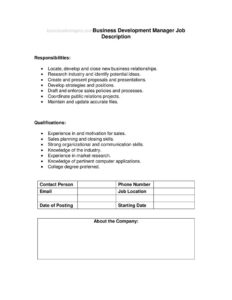
Business Development Manager Job Description
Download a free Business Development Manager job description template in PDF and DOCX to attract qualified candidates and define the role clearly.
PDF
DOCX
2 downloads
0
likes
Download Files
- DOCX
A Business Development Manager job description is a structured document that outlines the responsibilities, qualifications, and expectations for a role focused on growing a company’s revenue, partnerships, and market presence. Employers most often use it to write a clear, attractive job posting and to set measurable expectations once someone is hired. You can download this template free in PDF and DOCX formats — no signup required.
What Is a Business Development Manager Job Description?
A Business Development Manager job description is a written summary of a sales-and-growth leadership role, typically issued by an HR team, hiring manager, or business owner. It documents the core duties the position involves — identifying new clients, building strategic partnerships, and driving revenue — alongside the skills, education, and experience a candidate needs to succeed. The document serves several purposes at once: it powers the recruitment advertisement, gives recruiters a yardstick for screening applicants, anchors interview questions, and later becomes a reference point for performance reviews. Because it sets shared expectations between the company and the new hire, a well-written description reduces confusion about scope, ownership, and goals from day one.
When Do You Need a Business Development Manager Job Description?
This template is useful any time the role needs to be defined, advertised, or clarified. Common situations include:
- Hiring for growth: You are creating a new business development position and need a polished posting for job boards and your careers page.
- Replacing a departing employee: Someone is leaving and you want to capture the role accurately before recruiting a successor.
- Restructuring a sales team: You are splitting account management from new-business hunting and need to formalize the distinction.
- Setting performance benchmarks: An existing manager lacks documented goals, and you want measurable responsibilities to review against.
- Working with a recruiter or agency: External partners need a precise brief on the role, seniority, and must-have qualifications.
- Aligning internal stakeholders: Leadership, HR, and the hiring manager need to agree on scope and compensation banding before the search begins.
What a Business Development Manager Job Description Should Have
A complete job description balances aspiration with clarity. It should include a short role summary that frames the mission of the position, a detailed list of responsibilities that reflects day-to-day and strategic work, and a qualifications section that separates required skills from preferred ones. Strong descriptions also note reporting lines, key performance indicators such as revenue or pipeline targets, the collaboration expected with marketing and product teams, and any travel or territory requirements. Including the work arrangement (on-site, hybrid, or remote) and a brief company overview helps candidates self-select. Keeping language specific and measurable — rather than relying on vague phrases like “team player” — makes the role more credible and easier to evaluate against.
How to Fill Out a Business Development Manager Job Description
This template centers on two core sections, Responsibilities and Qualifications. Use the steps below to complete it thoroughly:
- Add a job title and a one-to-two sentence summary describing the role’s purpose and how it supports company growth.
- Under Responsibilities, list 6–10 bullet points covering prospecting new clients, qualifying leads, negotiating and closing deals, building strategic partnerships, and maintaining a sales pipeline in your CRM.
- Add cross-functional duties to Responsibilities, such as collaborating with marketing on campaigns, working with product teams on client feedback, and reporting forecasts to leadership.
- Include any measurable targets — for example, quarterly revenue quotas or a number of new accounts — so expectations are concrete.
- Under Qualifications, list required items first: years of B2B sales experience, a relevant degree, CRM proficiency, and a track record of hitting targets.
- Add preferred qualifications separately, such as industry knowledge, an existing network, or experience selling into specific markets.
- Finish with logistics: reporting line, location or remote policy, travel expectations, and compensation structure if you choose to disclose it.
Responsibilities vs. Qualifications: Getting the Balance Right
The two sections in this template do different jobs, and conflating them is a common error. The Responsibilities section describes what the person will do — actions, ownership, and outcomes. Use action verbs like “develop,” “negotiate,” “forecast,” and “build” so each bullet reads as a clear duty. The Qualifications section describes what the person must have to do those things well — experience, skills, certifications, and traits. A useful test: every required qualification should map back to at least one responsibility. If you require five years of enterprise sales experience, the responsibilities should reflect enterprise-scale deal-making. Keeping the sections distinct helps candidates understand both the work and whether they are a fit, and it gives interviewers a logical structure to probe during conversations.
Tips for Writing a Description That Attracts Strong Candidates
Top business development talent is selective, so the description doubles as a recruiting pitch. Lead with what makes the opportunity compelling — growth stage, market, autonomy, or earning potential. Be honest about quotas and travel rather than burying them, since transparency builds trust and reduces early turnover. Trim the qualifications list to genuine must-haves; long wish-lists discourage qualified applicants, particularly those from underrepresented groups who tend to apply only when they meet most criteria. Use inclusive, jargon-light language, and where possible quantify success so candidates can picture winning in the role. Finally, keep the whole document scannable with short bullets and clear section headers.
Common Mistakes to Avoid
- Mixing duties and requirements: Listing experience under Responsibilities or tasks under Qualifications confuses applicants and screeners.
- Vague, unmeasurable language: Phrases like “drive results” without context give candidates nothing concrete to assess.
- An endless qualifications list: Demanding too many “required” skills shrinks your applicant pool unnecessarily.
- Hiding key details: Omitting travel, territory, or quota expectations leads to mismatched hires and early departures.
- Copy-pasting a generic template: Failing to tailor the role to your industry and sales motion produces a posting that feels impersonal.
- Ignoring growth and culture: Skipping the company story or advancement path makes a competitive role harder to fill.
Frequently Asked Questions
What does a Business Development Manager actually do? A Business Development Manager identifies and pursues new revenue opportunities — including new clients, partnerships, and markets — while nurturing a sales pipeline from prospecting through closing. The role blends strategic planning with hands-on selling and often collaborates closely with marketing and product teams. The exact mix depends on your company size, industry, and sales model.
How is this different from a sales manager job description? A sales manager typically leads and coaches a team of salespeople toward quota, focusing on performance and process. A Business Development Manager is usually more outward-facing, focused on opening new accounts, channels, and partnerships rather than managing reps. Some roles overlap, so the description should clarify whether the position carries people-management responsibility.
What qualifications should I require? Common requirements include several years of B2B or relevant sales experience, a proven record of meeting revenue targets, CRM familiarity, and strong negotiation and communication skills. Many employers prefer a bachelor’s degree and industry-specific knowledge, but these can be “preferred” rather than “required.” Tailor the list to your market and the seniority of the role.
Should I include salary in the job description? Including a salary range or earning structure often increases application quality and is required by law in some jurisdictions. For a business development role, candidates especially want to understand the base-plus-commission split and any quota. Transparency here can speed up your hiring process and reduce mismatched expectations.
Can I edit this template for my company? Yes. The template is fully editable in DOCX and ready to print or share as a PDF. Adjust the Responsibilities and Qualifications sections, add your company overview and logistics, and adapt the tone to match your brand. It is designed to be a starting framework, not a finished posting.
Is this Business Development Manager job description template free? Yes, it is completely free to download in both PDF and DOCX formats with no signup or payment required. You can reuse and customize it for as many roles and openings as you need. There are no watermarks or usage limits on the template.
This template is a general example provided for informational purposes only and does not constitute legal, HR, or employment advice. Employment and job-posting requirements vary by jurisdiction and may change over time, so consult a qualified HR or legal professional before finalizing or publishing a job description.
Official resource: for the rules that apply to your situation, see the U.S. Department of Labor.
Related Forms
- Flash Animator Job Description
- Accountant Job Description
- Attorney Job Description
- Technical Writer Job Description
- Server Job Description
- Account Development Manager Job Description
Browse more in Job Descriptions.