
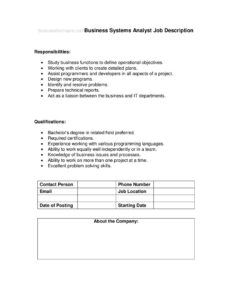
Business Systems Analyst Job Description
Download a free Business Systems Analyst job description template in PDF and DOCX to attract qualified candidates and streamline hiring—free download.
PDF
DOCX
1 downloads
0
likes
Download Files
- DOCX
A Business Systems Analyst job description is a structured document that outlines the duties, required skills, and qualifications for a professional who bridges the gap between business needs and technology solutions. Companies most often use it to advertise an open role and screen candidates consistently. You can download it free in PDF and DOCX formats with no signup required.
What Is a Business Systems Analyst Job Description?
A Business Systems Analyst job description is a hiring and role-definition document that explains what a business systems analyst does day to day, what business outcomes they are responsible for, and what background a candidate needs to succeed. It is typically written by a hiring manager, HR recruiter, or IT director and is used in job postings, internal role planning, and performance expectations. The document captures two core areas—Responsibilities and Qualifications—so that both the employer and the applicant share a clear understanding of the position. Because the business systems analyst role sits between operations, stakeholders, and software development teams, the description must communicate both analytical and communication expectations.
When Do You Need a Business Systems Analyst Job Description?
This template is useful any time you are formalizing or filling the role. Common scenarios include:
- Posting a new opening on job boards, your careers page, or LinkedIn to attract qualified applicants.
- Replacing a departing analyst and wanting to update the role’s scope before reposting it.
- Briefing a recruiting agency or staffing partner on exactly what skills the position requires.
- Setting performance benchmarks and annual review criteria for an existing analyst.
- Restructuring an IT or operations team and clarifying where the analyst’s responsibilities begin and end.
- Justifying a new headcount request to leadership by documenting the duties the role will absorb.
Whether you are a startup hiring your first analyst or an enterprise standardizing dozens of postings, a clear description reduces mismatched applications and speeds up screening.
Types of Business Systems Analyst Roles
The title covers a range of specializations, and tailoring the description helps you attract the right person. Some analysts focus on requirements gathering and documentation, translating stakeholder needs into functional specifications. Others lean toward data and reporting, building dashboards and analyzing process metrics. A process improvement analyst maps workflows and recommends efficiencies, while a more technical analyst may work closely with developers on system configuration, integrations, or ERP and CRM platforms. Decide which flavor your team needs before filling in the responsibilities, since that decision shapes the qualifications you list.
What a Business Systems Analyst Job Description Should Have
A complete and effective description generally includes the following elements:
- A short role summary that positions the analyst within the organization.
- A clear Responsibilities section listing the core duties and deliverables.
- A Qualifications section covering education, experience, technical tools, and soft skills.
- Reporting relationships—who the analyst reports to and who they collaborate with.
- Employment details such as location, work arrangement (remote, hybrid, on-site), and full- or part-time status.
- A brief company overview and an equal-opportunity statement where required.
How to Fill Out a Business Systems Analyst Job Description
This template centers on two key headings—Responsibilities and Qualifications. Work through it as follows:
- Add a job title line and a one- to two-sentence summary above the sections describing the role’s purpose.
- Under Responsibilities, list the duties as bullet points. Lead each with an action verb—”gather,” “document,” “analyze,” “recommend.” Include tasks like eliciting requirements from stakeholders, creating process and data flow documentation, collaborating with developers, and testing solutions.
- Prioritize the responsibilities so the most important duties appear first, helping candidates self-assess quickly.
- Under Qualifications, separate “required” from “preferred” so applicants know what is essential. Include education level, years of experience, and any certifications.
- List specific technical skills—SQL, Excel, business intelligence tools, project management or ticketing software—plus soft skills such as communication and stakeholder management.
- Add the reporting line, work location, and employment type beneath the two sections.
- Review the final document for tone, remove jargon, and confirm every listed item is genuinely required for the role.
Tips for Writing Effective Responsibilities and Qualifications
Keep responsibility bullets focused on outcomes, not just tasks—for example, “document requirements that reduce rework during development” tells candidates the why behind the work. Limit the list to roughly eight to ten bullets so the posting stays readable. For qualifications, avoid an unrealistic wish list that scares off strong applicants; flag must-haves clearly and treat the rest as nice-to-haves. Use inclusive, neutral language and avoid acronyms that only insiders would recognize. Finally, mirror the language candidates use in their resumes—terms like “requirements elicitation” and “user acceptance testing”—so your posting ranks well and resonates with the right audience.
Common Mistakes to Avoid
- Listing every conceivable duty, producing a bloated description that no single person could fulfill.
- Confusing the role with a software developer or data scientist position and listing unrelated qualifications.
- Marking too many skills as “required,” which deters qualified applicants who meet most criteria.
- Omitting work arrangement and reporting structure, leaving candidates unsure how the role fits.
- Using vague phrases like “other duties as assigned” as a substitute for real clarity.
- Copying a generic template without tailoring the responsibilities and qualifications to your actual systems and team.
Frequently Asked Questions
What does a business systems analyst do? A business systems analyst studies an organization’s processes and systems, gathers requirements from stakeholders, and recommends or helps implement technology solutions. They act as a translator between business teams and technical teams, documenting needs and validating that delivered solutions meet expectations. The exact mix of duties depends on the company and the systems involved.
How do I fill out this job description template? Start by adding a job title and brief role summary, then complete the Responsibilities section with action-oriented bullet points and the Qualifications section split into required and preferred items. Add reporting lines, location, and employment type, then review the whole document to make sure each entry truly applies to your role. The template is editable, so you can add or remove sections freely.
What qualifications should a business systems analyst have? Most roles call for a bachelor’s degree in business, information systems, or a related field, along with several years of relevant experience. Common skills include requirements gathering, data analysis, proficiency with tools like SQL and Excel, and strong communication abilities. Certifications such as CBAP or relevant platform credentials can be listed as preferred rather than required.
What is the difference between a business analyst and a business systems analyst? A business analyst typically focuses on broad business processes and strategy, while a business systems analyst leans more toward how technology systems support those processes. The systems analyst usually works closer to IT, configuration, and software requirements. In smaller organizations the two roles often overlap and may be combined.
Is this job description legally binding? A job description itself is generally not a binding contract; it is a communication and planning tool that sets expectations for the role. Employment terms are usually governed by a separate offer letter or contract. Always include any disclaimers required in your region, such as at-will employment language where applicable.
How much does this template cost? The Business Systems Analyst job description template is completely free to download from Business Forms Pro in both PDF and DOCX formats, with no signup required. You can edit it as many times as you need for different postings. There are no hidden fees or watermarks.
This template is provided as a general example for informational purposes only and does not constitute legal, HR, or employment advice. Hiring and employment requirements vary by jurisdiction and industry—consult a qualified human resources or legal professional before finalizing or posting your job description.
Official resource: for the rules that apply to your situation, see the U.S. Department of Labor.
Related Forms
- Paralegal Job Description
- Landscaper Job Description
- Controller Job Description
- Dental Hygienist Job Description
- Childcare Provider Job Description
- Project Manager Job Description
Browse more in Job Descriptions.