
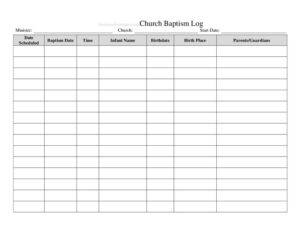
Church Baptism Log
Record every baptism accurately with our free Church Baptism Log template, available as a free download in PDF and DOCX with no signup required.
PDF
DOCX
5 downloads
0
likes
Download Files
- DOCX
A Church Baptism Log is a record-keeping document congregations use to document every baptism performed, capturing the candidate’s details, the date, the officiating minister, and witnesses in one organized register. The most common reason churches use it is to maintain a permanent, searchable history of sacramental events for both pastoral care and official certification. You can download this Church Baptism Log free in both PDF and DOCX formats, with no signup required.
What Is a Church Baptism Log?
A Church Baptism Log is an internal register maintained by a parish, congregation, or ministry to record the baptisms it administers over time. It is typically kept by the church secretary, parish clerk, or pastor and stored as part of the congregation’s permanent sacramental archive. The log documents who was baptized, when and where the rite took place, who officiated, and which sponsors or godparents participated. Unlike a single baptism certificate issued to one family, the log is a cumulative record covering many individuals across months or years. Churches rely on it to verify baptisms decades later, to confirm eligibility for confirmation or marriage, and to produce duplicate certificates when originals are lost.
When Do You Need a Church Baptism Log?
Almost any congregation that performs baptisms benefits from keeping an organized log. Common situations include:
- Routine record keeping — recording each baptism as it happens so the church has a continuous sacramental history.
- Issuing certificates — when a member requests a baptism certificate or a replacement, the log provides the verified source details.
- Confirmation or membership preparation — confirming a candidate was previously baptized before they advance to another rite.
- Marriage preparation — many churches require proof of baptism, which the log can substantiate.
- Transfers between churches — supplying baptism details when a member moves to a new congregation or denomination.
- Historical and genealogical research — descendants or archivists often consult old church logs to trace family history.
What a Church Baptism Log Should Have
A complete and useful baptism log gathers consistent information for each entry so records remain easy to search and verify years later. Strong logs include a unique entry or sequence number, the full legal name of the person baptized, their date of birth, the date and location of the baptism, the names of parents or guardians, the names of sponsors or godparents, and the name and signature of the officiating minister. Many churches also add a column for remarks, such as the type or mode of baptism, conditional baptisms, or cross-references to the certificate number. Keeping the format uniform across every entry is what makes the log dependable as an official source over the long term.
How to Fill Out a Church Baptism Log
Complete one row or entry for each baptism, working through these steps:
- Assign an entry number. Give each baptism a sequential reference number for easy cross-referencing to certificates and indexes.
- Enter the date of baptism. Record the exact day the rite was performed, not the registration date.
- Record the full name of the baptized. Use the person’s complete legal name, spelled carefully and consistently.
- Add the date and place of birth. Note the birth date and, where relevant, the birthplace to distinguish individuals with similar names.
- List parents or guardians. Include the names of the father, mother, or legal guardians as appropriate.
- Name the sponsors or godparents. Record those who stood as witnesses or sponsors during the ceremony.
- Identify the officiant. Write the name and title of the minister, priest, or pastor who performed the baptism, with their signature.
- Note the location and any remarks. Record the church or site and add notes such as the baptism mode or certificate number issued.
Keeping the Log Accurate and Secure
Because a baptism log can be relied upon decades after an entry is made, accuracy and preservation matter as much as completeness. Write in permanent ink if you keep a paper register, and avoid erasing mistakes — instead, draw a single line through an error and add a dated correction so the original remains visible. If you maintain the log digitally using the DOCX version, back it up regularly and restrict editing access to authorized staff. Many congregations keep both a bound physical book and a digital index so that one serves as a safeguard for the other. Store paper logs in a fire-resistant, climate-controlled location, since older records are irreplaceable once damaged.
How a Log Differs From a Baptism Certificate
It is easy to confuse the two documents, but they serve different roles. A baptism certificate is a single, often decorative document handed to the individual or family as their personal proof of the sacrament. The Church Baptism Log, by contrast, is the master register the church retains, holding many entries together as the authoritative source. When someone requests a duplicate certificate years later, the church looks up the relevant entry in the log and reproduces a certificate from those verified details. For that reason, the log is generally considered the primary record and the certificate the derivative one.
Common Mistakes to Avoid
- Inconsistent name spellings — varying spellings across entries make later verification difficult and certificates unreliable.
- Leaving fields blank — missing officiant names, dates, or sponsors weaken the record’s value as proof.
- Recording entries out of order — skipping the sequence numbering makes the log harder to audit and index.
- Erasing or overwriting errors — corrections should be visible and dated, never hidden.
- Failing to back up digital copies — relying on a single file risks losing years of records to one hardware failure.
- Storing the log in unsafe conditions — humidity, light, and fire can destroy decades of irreplaceable history.
Frequently Asked Questions
What is a Church Baptism Log used for? It is the church’s permanent register of every baptism performed, documenting the person baptized, the date, the officiant, and the sponsors. Churches use it to verify baptisms, issue or reissue certificates, and confirm eligibility for later rites such as confirmation and marriage.
Who is responsible for keeping the log? Typically the church secretary, parish clerk, or pastor maintains the log as part of the congregation’s official records. Some larger churches assign a dedicated records keeper, while smaller congregations may have the officiating minister record entries directly.
Does a baptism log need to be notarized or witnessed? A baptism log generally does not require notarization. It is an internal church record, and its credibility comes from the officiant’s signature and the consistency of the entries rather than from a notary, though sponsors effectively serve as witnesses to each baptism.
Is a Church Baptism Log a legally binding document? While it is primarily a religious record, baptism logs are often accepted as supporting evidence of identity, age, or family relationships in genealogical and certain administrative contexts. Their acceptance varies by jurisdiction and institution, so confirm local requirements before relying on one for official purposes.
How long should we keep the log? Baptism records are generally retained permanently, since requests for verification can arise many years or even generations later. Most denominations treat these registers as part of their lasting archive and never discard them.
How much does this template cost? Nothing — this Church Baptism Log template is completely free to download from Business Forms Pro in both PDF and DOCX formats, with no signup or payment required. You can print the PDF for a bound register or edit the DOCX to match your congregation’s preferred columns.
This Church Baptism Log template is provided as a general example for informational purposes only and does not constitute legal, religious, or administrative advice. Record-keeping requirements and the acceptance of church records vary by denomination and jurisdiction, so consult your governing church authority or a qualified professional for guidance specific to your situation.
Related Forms
- Ordination Anniversary Card 3 (2 per page)
- My Baptism Holy Card (2 per page)
- Church Funeral Log
- Ordination Anniversary Card (2 per page)
- St Francis Funeral Card (2 per page)
- Prayer To The Sacred Heart Funeral (4 per page)
Browse more in Church.