
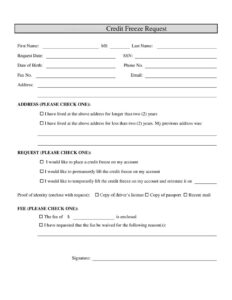
Credit Freeze Request
Use our free Credit Freeze Request form to lock your credit reports against fraud and identity theft, with an easy free download in PDF and DOCX.
PDF
DOCX
0
likes
Download Files
- DOCX
A Credit Freeze Request is a written notice you send to a credit reporting agency asking it to restrict access to your credit file, which is the single most common way consumers stop identity thieves from opening new accounts in their name. It is free to download here in both PDF and DOCX formats with no signup required, so you can fill it in by hand or on your computer in minutes.
What Is a Credit Freeze Request?
A Credit Freeze Request is a formal document submitted to a credit bureau that instructs the agency to place a security freeze on your consumer credit report. When a freeze is in place, most lenders and creditors cannot pull your file, which means new credit accounts generally cannot be opened in your name until you lift the freeze. The request identifies you, confirms your identity with supporting documentation, and authorizes the bureau to act. People typically use it after a data breach, suspected fraud, or simply as a proactive precaution. The form does not affect your credit score and does not stop existing creditors from managing your current accounts.
When Do You Need a Credit Freeze Request?
This form is useful any time you want to add a strong layer of protection to your credit file. Common situations include:
- You received a data-breach notification and want to prevent fraudsters from using your stolen information.
- You discovered unauthorized accounts or hard inquiries on your credit report.
- Your wallet, Social Security card, or important mail was lost or stolen.
- You are not planning to apply for new credit and want to lock your file as a precaution.
- You are protecting an elderly relative, a child, or a deceased family member from identity theft.
- You want to freeze your report with each of the major bureaus and need a consistent written request for each one.
What a Credit Freeze Request Should Have
A complete request gives the bureau everything it needs to verify you and act without delay. At minimum it should include your full legal name, your Social Security number, date of birth, and current mailing address so the agency can match the request to your file. It should clearly state the type of action you want — placing a freeze, lifting it temporarily, or removing it entirely. It must reference the proof of identity you are enclosing, note any applicable fee, and carry your dated signature. Accurate contact details, including a phone number and email, allow the bureau to reach you if anything is missing.
How to Fill Out a Credit Freeze Request
- First name, middle initial, last name: Enter your full legal name exactly as it appears on your credit file and government ID.
- Request date: Write the date you are completing and sending the form.
- SSN: Provide your full Social Security number so the bureau can locate your report.
- Date of birth: Enter your birth date to help confirm your identity.
- Phone number and fax number: Add a daytime phone number and a fax number if you have one for follow-up.
- Email: Supply a reliable email address where the bureau can send confirmation.
- Address and time at address: List your current mailing address and how long you have lived there; you may need to add prior addresses if you moved recently.
- Type of request: Indicate whether you want to place, temporarily lift, or permanently remove the freeze.
- Proof of identity: Note the documents enclosed, such as a copy of your ID and a utility bill.
- Fee: Record any fee, though freezes are typically free.
- Signature: Sign and date the form to authorize the request.
Sending the Request to the Credit Bureaus
To fully protect yourself, you generally need to submit a freeze request to each of the three major nationwide credit bureaus, because a freeze with one bureau does not affect the others. Many people complete one copy of this form for each agency and mail them together with the required identity documents. Mailing by certified mail or with delivery tracking gives you a record that the request was received. Keep a copy of every form you send, along with any confirmation number or PIN the bureau provides — you will need that information later if you want to lift or remove the freeze.
Freezing, Lifting, and Removing Explained
The type of request field matters because a credit freeze is not all-or-nothing. Placing a freeze locks your file. A temporary lift, sometimes called a thaw, reopens access for a set window or for a specific creditor so you can apply for a loan, credit card, or rental without removing protection permanently. A full removal ends the freeze entirely. Choosing the correct option on this form prevents confusion and ensures the bureau takes exactly the action you intend, so review this section carefully before signing.
Common Mistakes to Avoid
- Sending the form to only one bureau and assuming all three are covered.
- Omitting required proof of identity, which causes the bureau to reject or delay the request.
- Writing a name or address that does not match your credit file, making it hard to match the request.
- Forgetting to sign and date the form before mailing it.
- Failing to keep a copy of the request and any PIN or confirmation number you receive.
- Selecting the wrong type of request — for example, removing the freeze when you only meant to lift it temporarily.
Frequently Asked Questions
What is a Credit Freeze Request used for? It is used to ask a credit bureau to restrict access to your credit report so new accounts cannot be opened in your name. People most often use it after a data breach or suspected identity theft, or simply as a precaution. It is one of the strongest free tools for protecting your credit.
How do I fill out a Credit Freeze Request? Enter your full legal name, Social Security number, date of birth, current address, and contact details, then indicate the type of request and the proof of identity you are enclosing. Sign and date the form, and send a copy to each major bureau. Keep a copy for your records.
Does a credit freeze cost anything? Placing, lifting, and removing a credit freeze is generally free for consumers under federal law. This template is also completely free to download here in PDF and DOCX. The fee field is provided in case a particular service or situation requires one.
Does freezing my credit hurt my credit score? No. A credit freeze does not affect your credit score and does not appear as a negative item on your report. It simply limits who can access your file. Your existing accounts and their payment history remain unchanged.
Do I need to freeze my credit with all three bureaus? Yes, for full protection you should submit a request to each of the major nationwide bureaus, since a freeze with one does not apply to the others. You can use a separate copy of this form for each agency. Many people mail all three at the same time.
Is a Credit Freeze Request legally binding? A properly completed and signed request, sent with valid proof of identity, obligates the bureau to act according to applicable consumer protection law. Keep your confirmation details so you can lift or remove the freeze later. Always follow each bureau’s stated procedures.
This template is a general example provided for informational purposes only and is not legal, financial, or tax advice. Rules and procedures for credit freezes vary by jurisdiction and by credit reporting agency. Consult a qualified professional or contact the bureaus directly for guidance specific to your situation.
Official resource: for the rules that apply to your situation, see the Consumer Financial Protection Bureau.
Related Forms
- Weekly Sales Commission Tracker
- Consumer Equity Form
- Accounts Receivable Ledger
- Gas Cash Envelope
- Payment Calculator per $10000
- Savings Passbook
Browse more in Money.