
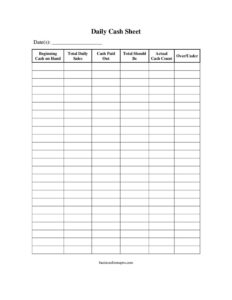
Daily Cash Sheet
Reconcile your register with this free Daily Cash Sheet template, tracking sales, payouts, and over/under amounts. Free PDF and DOCX download.
PDF
DOCX
21 downloads
1
likes
Download Files
- DOCX
A Daily Cash Sheet is a simple reconciliation form that lets a business compare the cash it expected to have in the drawer at the end of the day against the cash actually counted. The most common reason people use it is to catch register discrepancies early and keep an accurate daily record of sales and payouts. You can download it free in PDF and DOCX formats, with no signup required.
What Is a Daily Cash Sheet?
A Daily Cash Sheet is a one-page worksheet used by retail stores, restaurants, cafes, salons, and any cash-handling business to balance a register or cash drawer at the close of business. It is typically completed by a cashier, shift lead, or manager and documents the starting cash, the total sales taken in, any money paid out of the drawer, and the final counted cash. By calculating what the drawer should contain and comparing it to the actual count, the sheet produces an over/under figure. That number is the heart of the form: it flags miscounts, missing receipts, theft, or simple cashier errors so they can be investigated while the day is still fresh.
When Do You Need a Daily Cash Sheet?
Almost any operation that handles physical currency benefits from balancing the drawer every shift. Common situations include:
- Closing a retail register at the end of a sales day to confirm the cash matches recorded transactions.
- Restaurant and bar shift changes, where one server or bartender hands the drawer to the next and both want a clean count.
- Salons, barbershops, and service businesses that take cash tips and walk-in payments and need a daily tally.
- Pop-up shops, market stalls, and food trucks that start with a fixed float and reconcile takings at the end of the event.
- Small offices or nonprofits managing a petty cash box that pays out small expenses throughout the day.
- Franchise or multi-location managers who collect a standardized daily sheet from each store to roll up into weekly or monthly reports.
What a Daily Cash Sheet Should Have
A complete and useful Daily Cash Sheet captures every movement of cash so the math is traceable. At minimum it should record the beginning cash on hand (the opening float), total daily sales rung up, any cash paid out of the drawer for refunds or supplies, the expected total the drawer should hold, the actual physical cash counted, and the resulting over/under amount. It is also good practice to include the business name, the date, the shift or register number, and a line for the person who counted and the person who verified. Those identifiers turn a loose worksheet into an auditable record you can file and reference later.
How to Fill Out a Daily Cash Sheet
- Beginning cash on hand: Enter the opening float — the amount placed in the drawer at the start of the shift before any sales. This is your baseline.
- Total daily sales: Record the cash sales taken in during the day, usually pulled from the register report or sales log. Use cash sales only, since card and check totals do not affect the drawer count.
- Cash paid out: List any money removed from the drawer for legitimate reasons — refunds, vendor payments, petty purchases, or change runs. Keep the receipts to back up each payout.
- Total should be: Calculate the expected drawer total: beginning cash plus total daily sales, minus cash paid out. This is the figure your physical count must match.
- Actual cash count: Count the drawer carefully, tallying bills and coins, and enter the real amount on hand at close.
- Over/under: Subtract the “total should be” from the “actual cash count.” A positive number means the drawer is over; a negative number means it is short. Note any explanation, sign, and file the sheet.
Understanding the Over/Under Figure
The over/under line is where most of a manager’s attention belongs. A small variance of a few cents to a dollar is usually rounding or change-making error and is generally tolerable. A larger or repeating shortage may point to skipped transactions, missing payout receipts, or a counting mistake — and occasionally to theft. Many businesses set a threshold (for example, anything beyond a couple of dollars) that triggers a recount and a written note. Tracking over/under day after day reveals patterns: one register that is consistently short, or a particular shift that never balances, becomes obvious quickly when the numbers sit side by side on file.
Tips for Accurate Daily Reconciliation
Count the drawer in a quiet spot away from customers, and have a second person verify large variances before you sign off. Always count the float back to the same starting amount for the next shift, and pull that float aside before tallying sales so the math stays clean. Staple payout receipts to the sheet so every “cash paid out” entry is documented. If you use a point-of-sale system, reconcile the sheet against the POS report rather than guessing at sales. Finally, store completed sheets in date order — they support your bookkeeping, tax records, and any future audit.
Common Mistakes to Avoid
- Mixing in card and check sales: Only cash affects the drawer, so including non-cash totals throws off the over/under.
- Forgetting to subtract payouts: Refunds and supply purchases must come out of the expected total or the drawer will appear short.
- Skipping the float: Leaving out or miscounting the beginning cash on hand corrupts every figure below it.
- Not recounting on a big variance: Large discrepancies are often just miscounts — always count twice before concluding the drawer is off.
- Losing payout receipts: Without backup, you cannot explain why cash left the drawer.
- Leaving the sheet unsigned or undated: An anonymous, undated sheet has little value during a review or audit.
Frequently Asked Questions
What is a Daily Cash Sheet used for? It is used to reconcile a cash drawer or register at the end of a shift or business day. By comparing the expected cash total to the actual count, it identifies any over or short amount so errors can be caught and corrected promptly.
How do I calculate the “total should be” amount? Add your beginning cash on hand to your total daily cash sales, then subtract any cash paid out. The result is the amount the drawer should contain, which you then compare against your actual physical count.
What does over/under mean on a cash sheet? Over/under is the difference between the actual cash counted and the amount the drawer should hold. A positive figure means you have more cash than expected (over), while a negative figure means you are short.
Is a small over/under amount a problem? A variance of a few cents to a dollar is usually normal rounding or change-making error and is generally acceptable. Larger or recurring discrepancies should be recounted and investigated, as they may signal missing receipts or other issues.
Do I need special software to use this form? No. This Daily Cash Sheet is a straightforward template you can print as a PDF or edit in DOCX. It works well alongside a point-of-sale system but does not require one.
How much does this Daily Cash Sheet template cost? It is completely free to download here in both PDF and DOCX formats, with no signup or payment required. You can use it as-is or customize it with your business name and register numbers.
This Daily Cash Sheet template is provided as a general example for informational purposes only and does not constitute accounting, financial, or tax advice. Bookkeeping practices and record-keeping requirements vary by business and jurisdiction, so consult a qualified accountant or professional for guidance specific to your situation.
Official resource: for the rules that apply to your situation, see the Consumer Financial Protection Bureau.
Related Forms
- Profit And Loss Statement
- Large-Print Bill Tracker
- Roommate Expense Tracker
- Savings Breakdown
- Accounts Receivable Ledger
- Overdue Account History
Browse more in Money.