
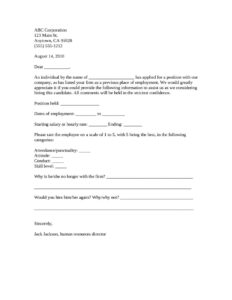
Employee Reference Request
Download a free Employee Reference Request letter template to verify a candidate's past employment, dates, and performance — free PDF and DOCX download.
DOCX
1 downloads
0
likes
Download Files
- DOCX
An Employee Reference Request is a formal letter an employer sends to a job applicant’s former employer to verify work history and gather feedback before making a hiring decision. It’s the most common way HR confirms that a candidate’s claims about a past job are accurate. This template is free to download in PDF and DOCX, with no signup required.
What Is an Employee Reference Request?
An Employee Reference Request is a written inquiry sent from a prospective employer to a candidate’s previous workplace, asking the former employer to confirm details and rate the applicant’s performance. It is typically issued by a human resources representative or hiring manager during the screening stage of recruitment. The letter documents the position held, dates of employment, compensation range, and a short assessment of attendance, attitude, conduct, and skill. Because the responses can influence a hiring outcome, the request usually promises that all comments will be held in strict confidence. It serves as a paper trail showing the employer performed reasonable diligence before extending an offer.
When Do You Need an Employee Reference Request?
This letter comes into play whenever an organization wants verified, third-party information about an applicant. Common situations include:
- Finalizing a hiring decision — confirming a top candidate’s background before sending an offer letter.
- Verifying employment history — checking that listed dates, titles, and salary on a resume match the former employer’s records.
- Assessing job performance — gathering ratings on attendance, attitude, conduct, and skill from someone who managed the candidate directly.
- Understanding a departure — learning why the applicant left a prior role and whether the separation was voluntary.
- Screening for trust-sensitive roles — positions involving finances, vulnerable populations, or safety where rehire eligibility matters.
- Standardizing the process — using the same letter for every applicant so each is evaluated consistently and fairly.
What an Employee Reference Request Should Have
A complete reference request reads professionally and asks only relevant, lawful questions. Key elements include the requesting company’s letterhead with name, address, and phone number; the date; a salutation addressed to the former employer or supervisor; and a clear statement naming the applicant and the firm they listed. It should request factual data — position held, dates of employment, and starting and ending pay — followed by a brief rating scale for performance categories. Open-ended questions about the reason for leaving and whether the company would rehire add useful context. A confidentiality assurance and a signature block from the HR contact complete the letter, making it polished and easy for the recipient to answer.
How to Fill Out an Employee Reference Request
- Add your company details at the top: company name (e.g., ABC Corporation), street address, city, state, ZIP, and a contact phone number.
- Enter the date the letter is sent.
- Complete the salutation — “Dear ____” — with the former supervisor’s or HR contact’s name if known.
- Insert the applicant’s full name in the sentence stating that the individual applied and listed the recipient’s firm as a past employer.
- Leave the factual fields blank for the former employer to complete: Position held, Dates of employment (from/to), and Starting salary or hourly rate and Ending rate.
- Present the 1-to-5 rating scale for Attendance/punctuality, Attitude, Conduct, and Skill level, with 5 as the highest.
- Include the open questions: Why is he/she no longer with the firm? and Would you hire him/her again? Why/why not?
- Sign off with your closing, the HR director’s name, and title (e.g., Jack Jackson, Human Resources Director).
Getting a Useful Response
Many former employers limit what they disclose to dates of employment and title to avoid disputes, so make your letter easy to answer. Attach a signed authorization from the applicant consenting to the reference check — this reassures the former employer that the inquiry is legitimate and protects everyone involved. Offer a clear return method, such as email or fax, and consider including a self-addressed envelope for mailed responses. A friendly, concise tone and a stated deadline improve your response rate. If you receive no reply within a week, a brief follow-up phone call to the HR department often resolves the gap faster than a second letter.
Reference Request vs. Background Check
A reference request gathers opinion and performance feedback from people who worked with the candidate, while a formal background check verifies records such as criminal history, credit, or licensing through a screening agency. The two serve different purposes and are often used together. A reference request is informal and relationship-based; background checks are governed by stricter consent and disclosure rules in many regions. Keep questions on this form focused on job performance and employment facts, and avoid asking about protected characteristics like age, religion, health, or family status.
Common Mistakes to Avoid
- Skipping applicant consent — always obtain written permission before contacting a former employer.
- Asking improper questions — steer clear of topics related to protected classes or anything unrelated to job performance.
- Leaving the company letterhead blank — recipients are far less likely to respond to an unidentified sender.
- Forgetting to name the applicant — the former employer can’t help if the candidate isn’t clearly identified.
- Omitting the confidentiality assurance — this line encourages honest, candid feedback.
- Not providing a return method or deadline — vague instructions stall the process and delay hiring.
Frequently Asked Questions
What is an Employee Reference Request used for? It is used to verify a job applicant’s previous employment and gather a former employer’s assessment of their performance. Hiring managers and HR teams send it during the final stages of recruitment to confirm resume details and inform their decision. The form covers dates, pay, performance ratings, and the reason the person left.
Do I need the applicant’s permission to send one? It is strongly recommended and often legally advisable to obtain written consent before contacting a former employer. A signed authorization protects you and the responding company and makes them more comfortable sharing details. Many candidates expect reference checks and provide consent as part of the application.
Is a former employer required to respond? No. Responding to a reference request is voluntary, and many companies limit replies to confirming dates of employment and job title as a matter of internal policy. Including a confidentiality statement and an applicant authorization can encourage a fuller, more candid response.
What questions can I legally ask? Focus on job-related facts and performance, such as position, dates, pay range, attendance, conduct, skill, and rehire eligibility. Avoid questions about protected characteristics like age, race, religion, disability, or family status. Laws vary by jurisdiction, so review your local employment regulations before finalizing your form.
Is the rating scale legally binding? No. The 1-to-5 ratings for attendance, attitude, conduct, and skill are subjective feedback from the former employer, not a binding or official record. They are one input among many in your overall hiring evaluation and should be weighed alongside interviews and other checks.
How much does this template cost? Nothing — this Employee Reference Request template is completely free to download in PDF and DOCX with no signup required. You can edit the company name, contact details, and signature block to match your organization and reuse it for every candidate you screen.
This template is provided as a general example for informational purposes only and does not constitute legal, HR, or professional advice. Employment and privacy requirements vary by jurisdiction. Consult a qualified employment law professional to ensure your reference-checking practices comply with applicable laws.
Official resource: for the rules that apply to your situation, see the U.S. Department of Labor.
Related Forms
- Employee Referral Form
- Employee Self Evaluation
- Shift Change Request
- Job Application Form
- Paycheck Authorization Form
- Employee Turnover Rate
Browse more in Employment.