
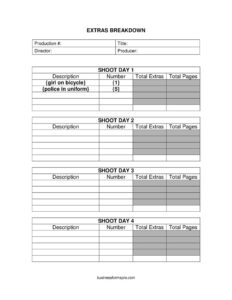
Extras Breakdown
Plan background talent fast with our free Extras Breakdown template, listing scene needs, headcounts, and totals — free download in PDF and DOCX.
PDF
DOCX
2 downloads
0
likes
Download Files
- DOCX
An Extras Breakdown is a film production document used to count and organize all the background performers a production needs across its scenes and shoot days. The most common reason people use it is to translate a script’s crowd requirements into a clear headcount the assistant director and casting team can hire against. It’s free to download here in both PDF and DOCX, with no signup required.
What Is an Extras Breakdown?
An Extras Breakdown is a planning sheet, usually prepared by the assistant director or production coordinator, that itemizes every scene requiring background actors and how many are needed in each. While a script breakdown captures all production elements, the Extras Breakdown narrows the focus to background talent — the diners, pedestrians, party guests, and office workers who fill a scene without speaking lines. It documents the production identity, the scene or shoot-day context, a short description of each crowd requirement, and the running totals of extras and pages. Casting directors, accountants, and ADs all reference it to budget, schedule, and staff each shooting day accurately.
When Do You Need an Extras Breakdown?
This form earns its place at almost every stage of physical production planning. Common situations include:
- Pre-production budgeting — when the line producer needs an accurate background actor count to estimate casting and wardrobe costs.
- Booking background talent — when the casting agency needs to know exactly how many extras to supply for each scene and day.
- Daily call sheet prep — when the AD team converts crowd numbers into call times, holding areas, and catering counts.
- Comparing script revisions — when a new draft changes crowd sizes and you need to track the difference against page totals.
- Coordinating wardrobe and makeup — when departments need a per-scene headcount to prepare enough fittings and stations.
- Reconciling actuals — when accounting compares the number of extras planned against those actually hired and paid.
What an Extras Breakdown Should Have
A complete Extras Breakdown ties background needs to the production it serves. It should clearly identify the project at the top — production number, title, director, and producer — so the sheet is never separated from its source. Each line should describe the crowd requirement in plain terms (“restaurant patrons,” “protest marchers”), state the number needed, and tie to a shoot day. Finally, it should carry totals: the cumulative number of extras and the page count covered. Together these elements let anyone reading the sheet understand not just the numbers but the scenes and schedule they belong to.
How to Fill Out an Extras Breakdown
Work top to bottom, starting with the production identifiers and then itemizing the background needs:
- Production #: Enter the internal production number so this sheet matches your other paperwork and budget codes.
- Title: Write the project’s working or final title.
- Director: List the director responsible for the creative vision driving these crowd needs.
- Producer: Add the producer or line producer overseeing budget and logistics.
- Shoot Day: Note the shooting day this breakdown covers (for example, Day 4) so it aligns with the schedule.
- Description: For each entry, describe the background requirement clearly — who the extras are and the scene setting.
- Number: Enter the count of extras needed for that specific description or scene.
- Total Extras: Sum the individual numbers to show the full background count for the day or project.
- Total Pages: Record how many script pages the breakdown spans, which helps gauge scope.
Update the sheet whenever a script revision or schedule change alters the numbers, and circulate it to casting, wardrobe, and accounting.
Types of Extras and Why the Count Matters
Not all background performers carry the same cost or scheduling weight, which is why the description column matters as much as the number. General background fills out a scene and is typically the largest group. Special ability extras — dancers, swimmers, skilled drivers, athletes — may require advance booking and a higher rate. Photo doubles and stand-ins serve specific principals. Atmosphere with props, like cars or pets, adds logistics. Calling out these distinctions in your descriptions helps casting source the right people and helps accounting forecast costs more precisely. A vague “50 extras” line tells the team how many bodies are needed but nothing about whether they need to swim, dance, or simply walk past camera.
Using the Breakdown Across Departments
The Extras Breakdown is rarely a solo document. Once the numbers are set, the assistant director uses them to build call sheets and stagger arrival times so crowds aren’t sitting idle. Wardrobe pulls and sizes enough costumes for the per-scene counts, while hair and makeup plan their stations accordingly. Catering and craft services use the totals to order meals. Accounting ties the count to the budget and later compares it against vouchers to confirm what was actually paid. Because so many teams depend on it, accuracy and version control are essential — always note the shoot day and keep the production number consistent so the right people are working from the right sheet.
Common Mistakes to Avoid
- Vague descriptions — “crowd” tells casting nothing; specify the setting and type of background needed.
- Forgetting to update after revisions — a new script draft can change crowd sizes, so re-check totals every time.
- Mismatched production numbers — an inconsistent production # makes it hard to tie the sheet to budgets and other paperwork.
- Math errors in totals — double-check that the total extras figure actually sums the individual numbers.
- Omitting the shoot day — without it, the AD can’t align background needs with the daily schedule.
- Ignoring special ability needs — failing to flag dancers, drivers, or stunt-adjacent extras leads to scrambling on the day.
Frequently Asked Questions
What is an Extras Breakdown used for? It’s used to count and organize all the background performers a film or video production needs, scene by scene and day by day. The assistant director, casting team, and accounting all rely on it to hire, schedule, and budget for extras accurately.
Who fills out the Extras Breakdown? It’s typically prepared by the assistant director or production coordinator during pre-production, drawing directly from the script breakdown. Casting directors and line producers often review and refine it before background talent is booked.
How is this different from a full script breakdown? A script breakdown captures every production element — cast, props, vehicles, special effects, and more — across the whole script. The Extras Breakdown isolates just the background performers, giving a focused count that’s easier to staff and budget against.
How do I calculate the total extras? Add up the number entered for each individual description or scene line to get the cumulative figure for the day or project. Recheck this total whenever you add, remove, or revise an entry so your budget and call sheets stay accurate.
Does this form need to be signed or notarized? No. The Extras Breakdown is an internal planning document, not a contract, so it requires no signatures or notarization. It is simply circulated among the production departments that depend on the counts.
Is this Extras Breakdown template really free? Yes. You can download it free in PDF or DOCX with no signup, then customize the fields for your production. Use the editable DOCX version to adjust columns or add rows as your scene list grows.
This Extras Breakdown template is provided as a general example for informational purposes only and does not constitute legal, financial, or production management advice. Production practices, labor rules, and background talent requirements vary by region, union agreement, and production — consult a qualified production professional or your applicable guild guidelines before relying on this document.
Related Forms
- Video Production Contract
- Actor Pay Form
- Video Production Rates
- Actor Release Form
- Production Assistant Breakdown
- Camera Shooting Log
Browse more in Film Production Forms.