
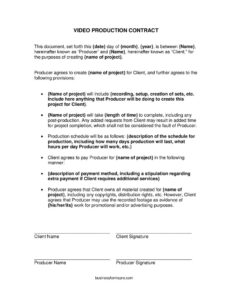
Video Production Contract
Download a free Video Production Contract template in PDF and DOCX to define scope, deliverables, and payment between a producer and client with no signup.
PDF
DOCX
3 downloads
0
likes
Download Files
- DOCX
A Video Production Contract is a written agreement between a video producer and a client that sets out exactly what video project will be created, the terms governing the work, and the signatures binding both parties to the arrangement. Most people use it to put clear expectations in writing before a shoot begins so there are no disputes over scope, payment, or deliverables. You can download this Video Production Contract free in both PDF and DOCX formats, with no signup required.
What Is a Video Production Contract?
A Video Production Contract is a legal document issued between two parties — the Producer, who agrees to create the video, and the Client, who commissions it. It documents the identity of both parties, the name of the project being produced, the date the agreement is formed, and any provisions the producer agrees to follow in delivering the work. The contract is signed and dated by both the client and the producer to confirm mutual consent. It is commonly used by freelance videographers, production studios, marketing agencies, event filmmakers, and corporate communications teams to formalize a working relationship and protect both sides if questions arise later about what was promised.
When Do You Need a Video Production Contract?
Any time money and creative deliverables are exchanged, a written agreement protects everyone. Common situations include:
- Commissioned brand or promotional videos — when a business hires a producer to create a commercial, product demo, or social media clip.
- Wedding or event videography — to lock in a producer for a specific date and define what footage and edits the client receives.
- Corporate or training content — internal videos, onboarding materials, or recruitment films produced for a company.
- Documentary or short-film collaborations — where multiple creative parties need clarity on roles and ownership.
- Music videos and creator content — when an artist or influencer hires a crew for a defined production.
- Recurring client work — agencies that produce ongoing video series benefit from a contract establishing baseline terms for each project.
In each of these cases, putting the project name, parties, and provisions in writing prevents misunderstandings before the camera ever rolls.
What a Video Production Contract Should Have
A complete Video Production Contract identifies the key parties and the work to be performed. At minimum, it should clearly state the effective date, the full legal names of both the producer and the client, and the specific name or description of the project being created. Beyond those essentials, a strong contract addresses the agreed provisions — the obligations the producer accepts and any conditions the client agrees to. While this template provides the core framework of parties, project, and signatures, well-drafted production agreements typically also spell out deliverables, timeline, payment, revisions, and usage rights. The signature block for both parties is what transforms the document from a draft into a binding, enforceable agreement.
How to Fill Out a Video Production Contract
- Enter the effective date. Fill in the day, month, and year the contract is being set forth so both parties have a clear start reference.
- Name the Producer. In the first Name field, enter the full legal name (or business name) of the producer who will create the video; this party is referred to as “Producer” throughout.
- Name the Client. In the second Name field, enter the full legal name of the individual or company commissioning the work, referred to as “Client.”
- Describe the project. Complete the name of project field with the specific title or description of the video being produced — be precise so it is clear what is and isn’t included.
- Add the provisions. In the space following the introductory clause, list the terms the producer agrees to: deliverables, schedule, payment, and any other conditions.
- Sign and print names. Have the client print their name and sign on the Client Name and Client Signature lines, and the producer do the same on the Producer Name and Producer Signature lines.
Adding Provisions That Protect Both Sides
Because this template centers on the parties, project name, and signatures, the “provisions” section is where you give the agreement real substance. Consider spelling out the scope of work (number of shoot days, locations, and final video length), the delivery format and deadline, the total fee and payment schedule, the number of included revisions, and who owns the final footage and raw files. Clarifying intellectual property and usage rights is especially important — clients and producers often have different assumptions about whether the producer may use the footage in a portfolio or whether the client receives exclusive rights. Adding a cancellation or rescheduling clause also protects both parties if circumstances change before the production date.
Signing, Copies, and Next Steps
Once both parties have reviewed the terms, each should sign and print their name in the appropriate block. Keep a fully signed copy for your records and provide one to the other party; a contract is only useful if both sides can refer back to it. Many producers send the agreement electronically and accept digital signatures, which are widely accepted for commercial contracts. After signing, confirm the production schedule and any deposit due so the project can move forward smoothly. Storing the signed contract alongside invoices and shot lists keeps your project documentation organized.
Common Mistakes to Avoid
- Leaving the project name vague. A generic description invites disputes — name the specific video and what it covers.
- Skipping payment terms. Failing to state the fee, deposit, and due dates is the most frequent source of conflict.
- Ignoring usage and ownership rights. Clarify who can use the final video and the raw footage, and where.
- Not defining revisions. Unlimited edits can erode a producer’s margin; cap the number of included rounds.
- Forgetting to date the agreement. The effective date anchors deadlines and obligations.
- Signing without both names printed. Printed names plus signatures avoid ambiguity about who agreed to what.
Frequently Asked Questions
What is a Video Production Contract used for? It is used to formalize an agreement between a video producer and a client, documenting who the parties are, what project will be created, and the terms governing the work. It protects both sides by putting expectations in writing before production begins.
Is a Video Production Contract legally binding? Yes — once both the client and producer sign and the contract reflects a genuine exchange of services for payment, it generally forms a binding agreement. Enforceability depends on the terms being clear and lawful, so define the project and provisions carefully.
Does a Video Production Contract need to be notarized? Notarization is typically not required for a standard service contract like this one; the signatures of both parties are usually sufficient. Some parties choose to have witnesses or notarization for higher-value projects, but it is generally optional.
How much does this template cost? Nothing — this Video Production Contract template is completely free to download in PDF and DOCX formats, with no signup or account required.
Can I edit the contract to add my own terms? Yes. The DOCX version is fully editable, so you can add provisions covering deliverables, payment, deadlines, revisions, and usage rights to fit your specific project.
Who keeps the rights to the finished video? That depends on what you write into the provisions. Spell out clearly whether the client receives full ownership, a license to use the video, or whether the producer retains rights to raw footage and portfolio use.
This Video Production Contract template is a general example provided for informational purposes only and does not constitute legal, financial, or tax advice. Contract requirements and enforceability vary by jurisdiction, so consult a qualified attorney before relying on this document for any specific project.
Related Forms
- Script Supervisor Notes
- Actor Pay Form
- Appearance Release Form
- Production Assistant Breakdown
- Camera Shooting Log
- Extras Release Form
Browse more in Film Production Forms.