
Field History Sheet
Track crop rotations, inputs, and yields with our free Field History Sheet template — record your farm's field data and download it free in PDF or DOCX.
PDF
DOC
5 downloads
0
likes
Download Files
- DOC
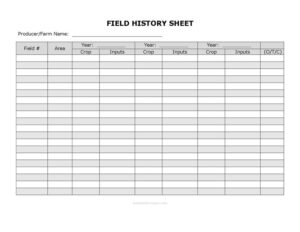
A Field History Sheet is a record-keeping form farmers and producers use to document what was planted, applied, and harvested on a specific field over time. The most common reason people use it is to maintain a clear, year-by-year record of crop rotations and inputs for planning, compliance, and certification. You can download this Field History Sheet free in both PDF and DOCX formats, with no signup required.
What Is a Field History Sheet?
A Field History Sheet is a simple agricultural log that captures the cropping history of an individual field or management zone. It is typically maintained by the producer, farm manager, or agronomist and documents details such as the crop grown, the field’s acreage, and the inputs applied during a given year. Over multiple seasons, these sheets build a continuous record that supports rotation planning, soil health management, organic or sustainability certification, and regulatory reporting. Because it ties information to a specific field number and producer or farm name, the sheet keeps records organized across an operation that may include dozens of separate parcels with different histories and needs.
When Do You Need a Field History Sheet?
A Field History Sheet is useful any time you need a verifiable account of what has happened on a piece of ground. Common situations include:
- Crop rotation planning — reviewing prior crops to avoid back-to-back planting of the same family and to manage pests, disease, and nutrient demand.
- Organic or sustainability certification — many programs require documented field history showing inputs and prohibited-substance-free periods.
- Input tracking and compliance — recording fertilizers, pesticides, herbicides, and amendments applied to satisfy recordkeeping rules and restricted-use reporting.
- Leasing or buying land — providing or requesting a field’s recent cropping and input history before a transaction.
- Yield and performance analysis — comparing inputs and crops across years to identify what drives results on a given field.
- Insurance and program enrollment — supporting crop insurance claims or government program applications that ask for prior planting records.
What a Field History Sheet Should Have
A complete Field History Sheet identifies the operation, the specific field, and the cropping details for each season. At minimum it should capture the producer or farm name so the record is attributable, a unique field number or identifier, the acreage or area being described, and the year the entry covers. It should also document the crop planted and the inputs applied. The strongest sheets allow multiple year rows per field so a single document tells the full story of that ground over time, and they leave room for notes on planting dates, varieties, or observed problems that add context to the raw data.
How to Fill Out a Field History Sheet
Work through the form one field entry at a time using the fields provided:
- Producer/Farm Name: Enter the legal or operating name of the farm or producer responsible for the field so the record is clearly attributable.
- Field #: Write the unique identifier you use for this field or management zone. Use consistent numbering across all your sheets so records match your maps and other documents.
- Area: Record the size of the field, typically in acres or hectares. Note whether you mean total acreage or only the planted portion if they differ.
- Year: Enter the crop year the entry describes. Create a new row or line for each season so the history accumulates over time.
- Crop: List the crop grown that year, including the variety or hybrid if you track it. Note cover crops separately if applicable.
- Inputs: Document the fertilizers, lime, manure, pesticides, herbicides, and other amendments applied, with rates and dates where you can. This is the most detail-heavy field and the most valuable for compliance.
Tips for Keeping Useful Field Records
The value of a Field History Sheet grows with consistency. Update it as soon as an operation is completed rather than reconstructing it from memory at season’s end, when application rates and dates are easy to forget. Keep field numbering identical to the labels on your farm map, GPS layers, and spray records so anyone reviewing the documents can cross-reference them quickly. For the inputs column, record the product name, the rate per acre, and the application date; this level of detail is exactly what certifiers, crop advisors, and insurance adjusters look for. Store completed sheets in a binder or digital folder organized by field number, and back up digital copies. Many producers keep several years on one sheet per field so rotation patterns are visible at a glance.
Field History Sheet vs. Spray or Application Records
A Field History Sheet is broader than a pesticide application log. While a spray record focuses narrowly on chemical applications—product, rate, weather, applicator, and re-entry intervals—the history sheet summarizes the whole season for a field: the crop, the acreage, and a general account of inputs. The two complement each other. Use detailed application records to satisfy specific restricted-use pesticide reporting, and use the Field History Sheet as the higher-level summary that ties multiple years together for rotation and certification purposes. Keeping both ensures you have the granular proof regulators may want and the long-term overview that supports planning decisions.
Common Mistakes to Avoid
- Inconsistent field numbers — changing how fields are labeled between years makes the history hard to follow and breaks cross-references.
- Vague input entries — writing only “fertilizer” without product, rate, or date undermines the sheet’s usefulness for compliance.
- Filling it out from memory — delaying entries until harvest leads to forgotten applications and wrong dates.
- Mixing planted and total acreage — be clear which area figure you are recording to keep rate calculations accurate.
- Skipping fallow or cover-crop years — leaving gaps creates confusion; record those seasons too.
- Keeping only one copy — losing the sheet means losing years of irreplaceable history, so back it up.
Frequently Asked Questions
What is a Field History Sheet used for? It is used to record the cropping and input history of a specific field over one or more years. Producers rely on it for rotation planning, input tracking, certification, and providing records when leasing, selling, or insuring farmland.
How do I fill out a Field History Sheet? Start by entering your producer or farm name and the field number, then record the field’s area and the year. For each year, list the crop grown and the inputs applied, ideally with rates and dates. Add a new row for each season so the history builds over time.
Is a Field History Sheet required for organic certification? Many organic and sustainability programs require documented field history showing crops and inputs over a set number of years. While exact requirements vary by program and region, a well-kept Field History Sheet helps demonstrate compliance—check with your specific certifying body for their rules.
How many years should I keep on one sheet? Keeping several consecutive years on a single sheet per field makes rotation patterns and input trends easy to see. Many producers keep three to five years per field, while certification or insurance programs may specify a minimum retention period you should follow.
What counts as an “input” on the form? Inputs include fertilizers, lime, manure, pesticides, herbicides, fungicides, soil amendments, and any other product applied to the field. Record the product name, application rate, and date whenever possible for the most useful and defensible record.
Is this Field History Sheet free to download? Yes. You can download this Field History Sheet template free in PDF and DOCX formats with no signup required. Use the editable DOCX to customize columns for your operation, or print the PDF for field and office use.
This Field History Sheet template is provided as a general example for informational purposes only and does not constitute legal, regulatory, agronomic, or certification advice. Recordkeeping requirements vary by jurisdiction and by program. Consult your certifying agency, crop advisor, or a qualified professional to ensure your records meet applicable requirements.
Related Forms
- Monthly Farm Expenses Form
- Sheep Birthing Records
- Field Productivity Record
- Farm Equipment Record
- Farmers Market Sales Record
- Detailed Egg Production Record
Browse more in Agriculture.