
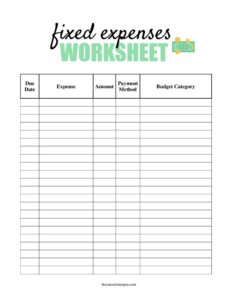
Fixed Expenses Worksheet
Track recurring monthly bills with this free Fixed Expenses Worksheet template, available as a free download in PDF and DOCX to organize your budget.
PDF
DOCX
6 downloads
0
likes
Download Files
- DOCX
A Fixed Expenses Worksheet is a simple budgeting tool used to list and total the regular, recurring costs you pay every month — things like rent, insurance, loan payments, and subscriptions. People most often use it to get a clear picture of their unavoidable monthly obligations before planning the rest of their budget. You can download this Fixed Expenses Worksheet for free in both PDF and DOCX formats, with no signup required.
What Is a Fixed Expenses Worksheet?
A Fixed Expenses Worksheet is a single-page document that organizes the costs that stay roughly the same from month to month and must be paid regardless of how much you spend on discretionary items. Unlike variable expenses such as groceries or entertainment, fixed expenses are predictable and contractual — a mortgage payment, a car loan, a streaming subscription, or an insurance premium. Individuals, families, and small business owners all use this worksheet to capture those steady obligations in one place. By listing each expense, its amount, and its due date, the worksheet reveals exactly how much money is committed before any flexible spending begins, making it the foundation of a realistic monthly budget.
When Do You Need a Fixed Expenses Worksheet?
This worksheet is useful any time you need to understand your baseline financial commitments. Common situations include:
- Building a monthly budget — you need to know your committed costs before allocating money to savings or discretionary spending.
- Moving or renting a new home — you want to confirm that rent plus utilities and insurance fit comfortably within your income.
- Applying for a loan or mortgage — lenders often ask for a clear breakdown of recurring obligations.
- Cutting costs or paying down debt — listing everything helps you spot subscriptions or services you can cancel.
- Managing a household after a change in income — a job loss, retirement, or new baby makes knowing fixed costs essential.
- Running a small business or side hustle — separating fixed overhead like rent, software, and insurance from variable costs clarifies break-even points.
Fixed vs. Variable Expenses
Understanding the difference is key to using this worksheet correctly. Fixed expenses are amounts you are committed to paying on a regular schedule and that change little, if at all, from one period to the next — rent, loan installments, insurance premiums, property taxes, and many subscriptions. Variable expenses fluctuate based on usage or choice, such as dining out, fuel, clothing, and entertainment. Some bills sit in a gray area: a utility bill may vary seasonally but still arrive every month. For budgeting purposes, list anything you consider a non-negotiable monthly commitment here, and track the truly flexible items separately. Keeping the two categories distinct helps you see how much room you actually have to adjust your spending.
What a Fixed Expenses Worksheet Should Have
A complete worksheet gives you enough detail to act on the numbers rather than just see them. The essential elements include:
- A clear label or category for each expense (housing, transportation, insurance, debt, subscriptions).
- The exact dollar amount of each recurring payment.
- The due date or billing cycle for each item.
- The payment method or account each bill is drawn from.
- A column to note whether the expense is paid automatically or manually.
- A running total of all fixed expenses for the month.
- Optional space to compare the total against monthly income.
How to Fill Out a Fixed Expenses Worksheet
Work through the worksheet one row at a time so nothing slips through the cracks:
- Set the time period. At the top, note the month or budgeting period the worksheet covers so you can compare it later.
- List each expense by name. In the first column, write the name of each fixed cost — for example “Rent,” “Car Loan,” or “Health Insurance.”
- Group by category. Where the worksheet allows, sort expenses under headings like housing, transportation, insurance, and subscriptions for easier review.
- Enter the amount. Record the exact recurring payment for each line in the amount column.
- Add the due date. Note when each payment is due so you can plan around your pay cycle and avoid late fees.
- Mark the payment method. Indicate whether the bill is autopay, bank draft, or paid manually.
- Total everything. Add all amounts to find your monthly fixed-expense total.
- Compare to income. If your worksheet has a summary line, subtract the total from your monthly income to see what remains.
Tips for Getting Accurate Numbers
Pull the figures from real statements rather than estimating from memory. Review the last two or three months of bank and credit card activity to catch every recurring charge, including annual subscriptions divided into a monthly figure. Watch for “hidden” fixed costs like cloud storage, gym memberships, or app subscriptions that auto-renew quietly. If a bill varies slightly each month — such as a utility — use an average of recent months so your total stays realistic. Update the worksheet whenever a payment changes, a contract ends, or you add a new obligation, and keep a fresh copy each month so you can track trends over time.
Common Mistakes to Avoid
- Forgetting annual or quarterly bills — divide them into a monthly amount so they don’t surprise you later.
- Mixing in variable spending — keeping groceries or entertainment here distorts your true fixed baseline.
- Skipping small subscriptions — several low-cost services add up to a meaningful monthly figure.
- Using rounded guesses — small errors across many lines can throw off your total significantly.
- Not updating after changes — an outdated worksheet leads to budgeting decisions based on old numbers.
- Ignoring due dates — knowing when bills hit helps you avoid overdrafts and late fees.
Frequently Asked Questions
What counts as a fixed expense? A fixed expense is a recurring cost that stays roughly the same each period and that you are committed to paying, such as rent, mortgage payments, car loans, insurance premiums, and subscriptions. These differ from variable expenses like groceries and dining out, which change based on your choices and usage.
How do I fill out the Fixed Expenses Worksheet? List each recurring expense by name, record its exact amount and due date, note the payment method, and then total all the amounts at the bottom. Pulling figures from recent bank and credit card statements ensures the worksheet reflects your real obligations.
Is this worksheet only for personal budgets? No. While individuals and households use it most often, small business owners and freelancers can use the same worksheet to track fixed overhead like rent, software subscriptions, and insurance. The structure works for any situation where you want a clear view of recurring commitments.
How often should I update it? Review and update the worksheet at least once a month, and any time a payment amount changes, a subscription ends, or you take on a new obligation. Keeping a fresh copy each month also lets you spot spending trends over time.
Should utilities go on this worksheet? Utilities often vary slightly with the season, but because they arrive every month and are largely unavoidable, many people include them here using a monthly average. If you prefer, you can track strongly fluctuating bills separately as variable costs.
How much does this Fixed Expenses Worksheet cost? It is completely free to download from Business Forms Pro in both PDF and DOCX formats, with no signup or payment required. You can fill it out digitally in the DOCX version or print the PDF and complete it by hand.
This Fixed Expenses Worksheet template is a general example provided for informational purposes only and does not constitute financial, tax, or accounting advice. Budgeting needs and best practices vary by individual circumstances — consult a qualified financial professional for guidance tailored to your situation.
Official resource: for the rules that apply to your situation, see the Consumer Financial Protection Bureau.
Related Forms
- Payment Calculator per $100000
- Pets Cash Envelope
- Debt Repayment Plan
- Daily Sales Commission Tracker
- Daily Cash Sheet
- Investment Record
Browse more in Money.