
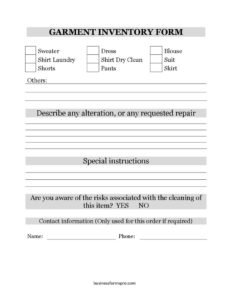
Garment Inventory Form
Download a free Garment Inventory Form template to log dry cleaning and laundry items, alterations, and special instructions in PDF or DOCX.
PDF
DOCX
1 downloads
0
likes
Download Files
- DOCX
A Garment Inventory Form is a simple intake document used by dry cleaners, laundries, tailors, and alteration shops to record every garment a customer drops off, along with the requested service and any special handling notes. The most common reason people use it is to create a clear, signed record of what was received so nothing gets lost or mixed up between customers. You can download this Garment Inventory Form for free in both PDF and DOCX formats, with no signup required.
What Is a Garment Inventory Form?
A Garment Inventory Form is a tracking sheet that documents the clothing items a customer brings in for cleaning, laundering, or repair. It is typically issued by a dry cleaning or alteration business at the moment of drop-off, and it captures the customer’s contact details, an itemized list of garments by type, the service requested for each, and any special instructions or alteration requests. The form also acknowledges that certain cleaning methods carry risks for delicate fabrics. In short, it serves as both a receipt and an internal inventory record, helping staff match garments to the right ticket and giving the customer confidence that their items were logged accurately.
When Do You Need a Garment Inventory Form?
This form is useful any time clothing changes hands for a service. Common scenarios include:
- A customer drops off several items at a dry cleaner and you need to itemize each shirt, suit, dress, or sweater on one ticket.
- A tailor accepts pants or a skirt for hemming and must record the exact alteration requested.
- A laundry service processes a bulk load and wants a count of blouses, shirts, and shorts to verify against the returned order.
- A garment requires special handling, such as a delicate fabric or a beaded dress, and the customer must acknowledge the cleaning risks involved.
- A business needs a paper trail in case a customer later disputes whether an item was received or returned.
- A bridal or formalwear shop logs a suit and accompanying pieces for cleaning ahead of an event with specific deadline instructions.
What a Garment Inventory Form Should Have
A complete Garment Inventory Form should clearly identify the customer, itemize each garment, and specify the service for every item. It needs a contact section so staff can reach the customer about delays or issues, a checklist or count of garment types, a field for alterations and repairs, and space for special instructions. Just as importantly, it should include a risk acknowledgment so the customer understands that certain fabrics, dyes, or embellishments may not survive a given cleaning process. Together these elements turn the form into a reliable record that protects both the business and the customer.
How to Fill Out a Garment Inventory Form
- Enter the customer’s Name at the top so the ticket is tied to the right person.
- Record the Contact information and Phone number so staff can call about pickup, delays, or concerns.
- Go through the garment list and tally each item type: Blouse, Dress, Pants, Shorts, Skirt, Suit, and Sweater. Note the quantity beside each.
- For shirts, distinguish between Shirt Dry Clean and Shirt Laundry, since these require different processes and pricing.
- Use the Others field for any garment not listed, such as a coat, tie, or linens, with a short description.
- In the Describe any alteration, or any requested repair field, write specifics like “hem pants 2 inches” or “replace zipper on skirt.”
- Add any Special instructions, such as starch level, fold versus hang, or a needed-by date.
- Confirm the customer acknowledges the question Are you aware of the risks associated with the cleaning of this item? before processing delicate goods.
Garment Types and Service Notes
Because the form separates garments by type, it helps staff apply the correct treatment. Wool sweaters and structured suits often call for dry cleaning, while everyday shirts may go through laundry pressing. Pants, shorts, and skirts can be sorted by fabric and finish, and blouses or dresses with delicate detailing may need hand attention. By marking the difference between Shirt Dry Clean and Shirt Laundry, the form prevents the common mix-up of laundering a garment that should have been dry cleaned. The Others line keeps the inventory flexible for unusual items so nothing is processed without being recorded first.
The Risk Acknowledgment Matters
The line asking whether the customer is aware of the cleaning risks is more than a formality. Some fabrics shrink, bleed dye, lose embellishments, or weaken under certain solvents or heat. By having the customer acknowledge these risks at drop-off, the business sets clear expectations and reduces disputes if a fragile item does not survive a standard process. When a garment is high-risk, note the specific concern in the Special instructions field so the staff member handling it knows to proceed with caution or recommend an alternative treatment.
Common Mistakes to Avoid
- Leaving the garment count blank or vague, which makes it impossible to verify the order at pickup.
- Skipping the risk acknowledgment on delicate or embellished items, exposing the business to disputes.
- Recording a phone number incorrectly, so the customer can’t be reached about delays.
- Failing to separate Shirt Dry Clean from Shirt Laundry, leading to the wrong process.
- Writing alterations too generally, such as “fix pants,” instead of exact measurements or instructions.
- Not giving the customer a copy of the completed form, leaving them without a receipt.
Frequently Asked Questions
What is a Garment Inventory Form used for? It is used to log every clothing item a customer brings in for cleaning, laundering, or alteration. It records the garment types, the service requested, and any special instructions, serving as both a receipt and an internal tracking record. This helps prevent lost or mismatched items.
How do I fill out a Garment Inventory Form? Start with the customer’s name, contact information, and phone number, then tally each garment type and note the service for each. Describe any alterations or repairs, add special instructions, and confirm the customer acknowledges the cleaning risks. Give the customer a copy as their receipt.
Does this form need to be signed or witnessed? A signature is not legally required, but having the customer acknowledge the risk question and sign the form is good practice. It documents that they understood the handling involved and confirms the items listed. No witness or notarization is needed for an everyday intake record.
Is a Garment Inventory Form legally binding? On its own it is primarily a record of what was received and what service was agreed upon, not a formal contract. However, it can support both parties if a dispute arises about items, services, or condition. For binding service terms, businesses may combine it with their posted policies.
How much does this form cost? This Garment Inventory Form template is completely free to download here in PDF and DOCX formats, with no signup or payment required. You can use it as-is or customize the garment list and instructions to match your shop. There are no hidden fees.
Can I customize the form for my business? Yes. The DOCX version lets you add your shop name, logo, pricing, and any garment types specific to your services, such as coats, drapes, or uniforms. You can also adjust the special instructions and risk acknowledgment wording to fit your policies.
This Garment Inventory Form template is a general example provided for informational purposes only and does not constitute legal, financial, or business advice. Service obligations, liability terms, and recordkeeping requirements vary by jurisdiction and by business — consult a qualified professional to ensure your forms and policies meet your needs.
Related Forms
- Password Record
- Donations Log
- Cleaning Log By Room
- Work Search Log
- Employee Covid Attestation Log
- Conference Room Schedule
Browse more in Log and Inventory.