
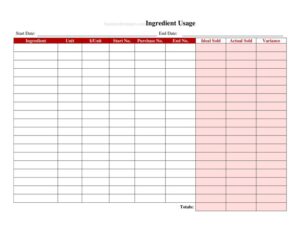
Ingredient Usage Report
Track kitchen ingredient consumption with this free Ingredient Usage Report template, available as a free download in PDF and DOCX for restaurants.
PDF
DOCX
4 downloads
0
likes
Download Files
- DOCX
An Ingredient Usage Report is a kitchen tracking document that records how much of each ingredient was used over a given shift, day, or period. Restaurants use it most often to compare expected ingredient consumption against actual usage so they can spot waste, theft, over-portioning, and inventory shortfalls. You can download this Ingredient Usage Report free in both PDF and DOCX formats, with no signup required.
What Is an Ingredient Usage Report?
An Ingredient Usage Report is a structured form completed by kitchen managers, chefs, or inventory staff to document the quantity of raw ingredients consumed during a specific timeframe. It typically captures starting stock, deliveries received, ending stock, and the calculated amount used for each item. The report serves as a bridge between purchasing, inventory, and recipe costing, giving operators a clear picture of where their food dollars go. Whether issued daily for high-volume items or weekly for a full pantry audit, it documents real consumption against expected usage. This makes it an essential tool for controlling food cost percentages and keeping a kitchen running profitably.
When Do You Need an Ingredient Usage Report?
This report becomes valuable any time a kitchen needs to understand the gap between what should have been used and what actually disappeared from the shelves. Common situations include:
- Daily food cost control — tracking high-value proteins, oils, and specialty ingredients to catch over-portioning before it eats into margins.
- Monthly or quarterly inventory reconciliation — comparing physical counts to usage figures to identify shrinkage.
- Menu engineering — measuring how much of each ingredient a dish actually consumes to refine recipe costing.
- Investigating waste or loss — pinpointing whether spoilage, theft, or incorrect prep is driving up consumption.
- Seasonal or promotional planning — forecasting how a limited-time offer will draw down specific stock.
- Supplier and ordering decisions — using documented usage trends to set par levels and reduce emergency orders.
What an Ingredient Usage Report Should Have
A complete and useful report goes beyond a simple list of items. It should clearly identify the reporting period and the location or station, then itemize each ingredient with units of measure that match how you purchase and count them. For every ingredient, the form should capture the opening quantity, any additions received during the period, the closing quantity, and the resulting amount used. Strong reports also include space for expected or theoretical usage so a variance can be calculated, plus a notes column to explain anomalies. Finally, the document should record who prepared it and the date, along with a sign-off line for a supervisor or manager to review and approve the figures.
How to Fill Out an Ingredient Usage Report
- Enter the header details. Write the restaurant or location name, the reporting period (date or date range), the kitchen station if applicable, and the name of the person preparing the report.
- List each ingredient. In the ingredient column, record every item you are tracking, using consistent naming so the same product is always logged the same way.
- Specify the unit of measure. Note whether each item is counted in pounds, kilograms, liters, cases, or each, matching your inventory system.
- Record the opening quantity. Enter the amount on hand at the start of the period from your last count.
- Add quantities received. Log any deliveries or transfers in during the period so the math reflects all available stock.
- Record the closing quantity. Enter the physical count taken at the end of the period.
- Calculate the amount used. Subtract the closing quantity from the sum of opening plus received to get actual usage.
- Compare to expected usage and note variances. Where the form allows, record theoretical usage and explain any large gaps in the notes column.
- Sign and submit. The preparer signs and dates the report, and a manager reviews and approves it.
Turning Usage Data Into Action
The report is only as valuable as the decisions it drives. Once usage is documented, calculate a variance percentage for each ingredient by comparing actual usage to the theoretical amount your recipes predict. A consistent overage on a costly protein might signal heavy portioning, untrained prep cooks, or stock walking out the back door. A persistent shortfall could mean miscounts, unrecorded deliveries, or spoilage. Review the largest dollar-value variances first, since those move your food cost percentage the most. Over several reporting cycles, the data also helps you set accurate par levels, time your orders to demand, and negotiate better with suppliers based on documented volume.
How It Differs From a Standard Inventory Count
An inventory count is a snapshot of what you have on hand at a single moment, while an Ingredient Usage Report measures the flow of ingredients between two counts. The usage report depends on accurate inventory counts as its bookends, but it adds the dimension of consumption and variance. In practice, the two work together: a careful physical count feeds the opening and closing figures, and the usage report turns those numbers into actionable cost insight. Many kitchens run both, using inventory counts for valuation and usage reports for control.
Common Mistakes to Avoid
- Inconsistent units — mixing pounds and cases for the same item makes usage math unreliable.
- Forgetting mid-period deliveries — leaving out received stock inflates apparent usage and distorts variances.
- Skipping the physical count — estimating closing quantities instead of counting them defeats the report’s purpose.
- No notes on anomalies — unexplained spikes lose meaning weeks later when no one remembers the cause.
- Tracking too many items at once — start with high-cost, high-volume ingredients rather than trying to log every spice.
- Not reviewing the report — data collected but never analyzed delivers no cost savings.
Frequently Asked Questions
What is an Ingredient Usage Report used for? It is used to track how much of each ingredient a kitchen consumes over a set period and to compare that against expected usage. This helps operators control food costs, reduce waste, and catch over-portioning or shrinkage early. It is a core tool in restaurant inventory and cost management.
How do I fill out an Ingredient Usage Report? Start by entering the period and location, then list each ingredient with its unit of measure. Record the opening quantity, any deliveries received, and the closing count, then subtract to find the amount used. Add notes on any unusual variances and have a manager review and sign the completed report.
How often should I complete this report? The frequency depends on your operation and which items you track. Many kitchens run daily reports on high-value proteins and oils, while completing a fuller pantry usage report weekly or monthly. Higher-volume and higher-cost ingredients generally justify more frequent tracking.
Is this Ingredient Usage Report free to download? Yes. You can download this template free in both PDF and DOCX formats with no signup or payment required. The DOCX version is fully editable so you can add your own ingredient lists, units, and columns.
Does the report need to be signed or approved? It is good practice to have the preparer sign and date the report and a manager review and approve it. This adds accountability, confirms the counts were verified, and creates a record you can refer back to during audits or cost reviews.
How do I calculate ingredient variance from the report? Compare the actual amount used, calculated from your counts, against the theoretical usage your recipes predict for the volume of dishes sold. The difference, expressed as a percentage or dollar value, is your variance. Focus on the largest variances first since they have the biggest impact on your food cost.
This Ingredient Usage Report template is provided as a general example for informational purposes only and does not constitute legal, financial, tax, or food-safety advice. Inventory practices, recordkeeping requirements, and food-handling regulations vary by jurisdiction and operation — consult a qualified professional or your local authority before relying on this document.
Related Forms
- Shift Change Form
- Sandwich Menu
- Line Starts Here Sign
- Dinner Menu Fancy
- Food Order Form
- Specials Menu
Browse more in Restaurant.