
Landlord Make Repairs
Download a free Landlord Make Repairs letter template to formally request and document repairs from your landlord, available as a free PDF and DOCX download.
DOCX
1 downloads
0
likes
Download Files
- DOCX
A Landlord Make Repairs letter is a written notice a tenant sends to a landlord or property management company formally requesting that specific repairs be made to a rental unit. People most often use it to create a dated, documented record that they asked for fixes — from a leaking faucet to a broken heater — under the terms of their lease. You can download this template free in PDF and DOCX formats, with no signup required.
What Is a Landlord Make Repairs Letter?
A Landlord Make Repairs letter is a tenant-issued demand that puts a maintenance request in writing. It is typically sent by a renter to a landlord, property manager, or leasing office, and it documents what needs to be repaired, where, and on what date the request was made. Unlike a quick text or phone call, this letter references your legally binding lease and creates a paper trail you can rely on later. It is commonly used when verbal requests have gone unanswered or when a tenant wants formal proof that the landlord was notified. The goal is simple: clearly communicate the problem and request prompt action while protecting your rights as a tenant.
When Do You Need a Landlord Make Repairs Letter?
This letter is useful any time a repair affects the safety, habitability, or comfort of your rental. Common situations include:
- A plumbing problem such as a persistent leak, clogged drain, or no hot water that the landlord has not addressed.
- A broken heating or cooling system that affects livability, especially in extreme weather.
- Electrical issues like faulty outlets, flickering lights, or a tripping breaker that pose a safety risk.
- Structural or weatherproofing problems such as a leaking roof, broken window, or damaged door lock.
- Pest infestations, mold, or other habitability concerns that need professional remediation.
- Following up in writing after a phone or in-person request was ignored, so you have documented proof of notice.
Sending a written letter is especially important when local law requires the landlord to be given notice and a reasonable time to fix a problem before a tenant can pursue other remedies.
What a Landlord Make Repairs Letter Should Have
A complete and effective letter includes a few essential elements. It should clearly identify you and your unit, name the recipient (landlord or management company), and state the date so the timeline is unmistakable. The heart of the letter is a specific, itemized description of each repair needed — vague language weakens your request. It should reference your lease to establish that the request is made under a binding agreement, and it should request prompt action. A polite but firm closing and your signature complete the document. Keeping a copy for your records, and noting how it was sent, rounds out a well-documented request.
How to Fill Out a Landlord Make Repairs Letter
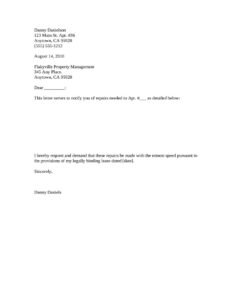
- Add your name and address. At the top, enter your full name and complete rental address, including the apartment or unit number (for example, replacing the sample “Danny Danielson, 123 Main St. Apt. #36, Anytown, CA 95928”).
- Include your phone number. Provide a contact number so the landlord can reach you to schedule access or follow up.
- Enter the date. Write the current date the letter is being sent — this anchors the legal timeline of your notice.
- Fill in the recipient. Replace the sample “Flakyville Property Management” with your landlord’s or management company’s name and address.
- Complete the salutation. After “Dear ____,” insert the name of the specific landlord, manager, or department.
- Specify the apartment number. In the line referencing “Apt. #___,” enter your unit identifier.
- List the repairs. In the detailed section, describe each needed repair clearly and specifically — what is wrong, where it is located, and any safety concerns.
- Reference your lease date. Where the template notes “my legally binding lease dated [date],” insert the date your lease was signed.
- Sign the letter. Add your handwritten signature and printed name at the bottom.
How to Send and Document Your Request
How you deliver the letter can matter as much as what it says. Many tenants send the letter using a method that provides proof of delivery, such as certified mail with a return receipt, or email with a read receipt, so there is no dispute about whether the landlord received it. Always keep a dated copy for your own files. If you spoke with the landlord by phone first, note the date and substance of that conversation in your records as well. Photographs or short videos of the problem can strengthen your documentation, especially for issues like leaks, mold, or broken fixtures. Together, these steps build a clear timeline showing you gave proper notice.
What Happens After You Send It
After delivery, give the landlord a reasonable amount of time to respond and complete the work — what counts as reasonable often depends on the urgency of the issue and local rules. Emergency repairs affecting safety usually warrant faster action than minor cosmetic ones. If the landlord schedules the repair, keep notes on the date and outcome. If the request is ignored, your documented letter becomes the foundation for any further steps you may consider, such as a follow-up notice. Because tenant remedies for unaddressed repairs vary widely by location, it is wise to review your local landlord-tenant rules before taking action beyond the written request.
Common Mistakes to Avoid
- Being vague. Listing “things are broken” instead of itemizing each specific repair makes your request easy to dismiss.
- Forgetting the date. Without a clear date, you lose the ability to prove when notice was given.
- Sending it informally only. Relying solely on a text or verbal request leaves you without a documented record.
- Omitting your unit number. Leaving the apartment number blank can cause confusion in larger properties.
- Using an aggressive tone. A firm but professional letter is more effective and preserves a workable relationship.
- Not keeping a copy. Failing to retain a copy of the signed, dated letter undermines your paper trail.
Frequently Asked Questions
What is a Landlord Make Repairs letter? It is a written notice a tenant sends to a landlord or property manager formally requesting that specific repairs be completed in the rental unit. It documents the problem, the date of the request, and references the tenant’s lease so there is a clear record of notice.
How do I fill out the letter? Enter your name, address, phone number, and the current date at the top, then add the landlord or management company’s details and the salutation. Specify your apartment number, list each needed repair clearly, reference your lease date, and sign at the bottom.
Does this letter need to be notarized? No, a repair request letter generally does not require notarization or witnesses. What matters most is that it is dated, specific, and delivered in a way you can document, such as certified mail or email with a delivery record.
Is the letter legally binding? The letter itself is a notice rather than a contract, but it can carry legal weight as proof that you notified your landlord of needed repairs. Many jurisdictions require tenants to give written notice and reasonable time before pursuing other remedies, so documentation is valuable.
How much does this template cost? It is completely free to download here in both PDF and DOCX formats, with no signup or payment required. You can edit the DOCX version to fit your unit, repairs, and lease details.
How long should I give my landlord to make repairs? A reasonable time depends on the severity of the issue and your local landlord-tenant rules, with safety-related emergencies generally requiring faster action than minor problems. Check your lease and local regulations to understand the expected timeframes.
This template is a general example provided for informational purposes only and is not legal advice. Landlord-tenant laws and repair-notice requirements vary by jurisdiction, so consult a qualified attorney or your local housing authority for guidance specific to your situation.
Official resource: for the rules that apply to your situation, see HUD.
Related Forms
- Property Management Agreement
- Covid Tenant Relief Request
- Home Utility Provider List
- Rental Agreement
- Complaint Letter Against Tenant
- Lease Extension Approval
Browse more in Rental and Real Estate.