
Lease Extension Approval
Download a free Lease Extension Approval letter template to confirm a tenant's new check-out date, prorated rent, and inspection time — free PDF and DOCX.
PDF
DOCX
2 downloads
0
likes
Download Files
- DOCX
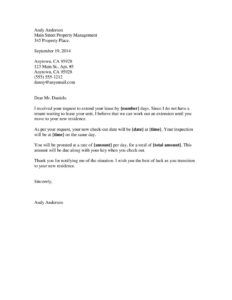
A Lease Extension Approval is a letter a landlord or property manager sends to confirm that a tenant’s request to stay beyond the original lease end date has been granted. It is most commonly used when a tenant needs a few extra days before moving to a new residence, and it spells out the new check-out date, the prorated daily rate, and the inspection time. You can download this Lease Extension Approval template free in PDF and DOCX, with no signup required.
What Is a Lease Extension Approval?
A Lease Extension Approval is a written response from a landlord or property management company that formally agrees to extend a tenant’s lease for a defined number of additional days. It confirms the key terms in writing so both parties share the same expectations. Rather than rewriting the entire lease, this letter acknowledges the tenant’s request, sets a revised check-out date and time, schedules a move-out inspection, and states how the extra days will be charged through prorated rent. It is a short, friendly, but binding piece of correspondence that documents a mutual agreement and prevents disputes about when the unit must be vacated and what is owed.
When Do You Need a Lease Extension Approval?
Property managers and landlords use this letter whenever a short-term extension is requested and granted. Common situations include:
- A tenant’s new home or apartment is not ready by the original move-out date and they need a few buffer days.
- A closing on a home purchase is delayed and the tenant needs to bridge the gap.
- A job relocation timeline shifts and the tenant requires extra time to coordinate movers.
- The unit has no incoming tenant waiting, so the landlord can comfortably offer flexibility.
- A tenant wants confirmation in writing of a verbal agreement to stay longer.
- A student or seasonal renter needs a short overlap before transitioning to a new lease.
What a Lease Extension Approval Should Have
To be clear and enforceable, the approval letter should include several core elements. It should identify the landlord or property management company and the tenant by name, reference the rental unit address, and state that the letter is a response to the tenant’s extension request. It must specify the number of extra days granted, the exact new check-out date and time, and the scheduled inspection time. Crucially, it should set out the prorated daily rate and the total amount due, along with when and how payment is expected — in this template, along with the key at check-out. A courteous closing and the landlord’s signature complete the document.
How to Fill Out a Lease Extension Approval
Follow these steps to complete the template using the fields provided:
- Enter the sender details at the top — the property manager’s name (for example, Andy Anderson), company name, and the management office address.
- Add the date you are writing the letter.
- List the tenant’s mailing address, including the apartment or unit number and city, state, and ZIP code.
- Include the office phone number and email so the tenant can reach you with questions.
- Open with a salutation addressed to the tenant by name (for example, “Dear Mr. Daniels”).
- In the {number} field, enter how many days the lease is being extended.
- Fill the {date} and {time} fields with the new check-out date and time.
- Enter the inspection {time}, which occurs on the same day as check-out.
- State the prorated {amount} charged per day and the {total amount} due for the full extension.
- Confirm that payment is due with the key at check-out, then sign as the landlord or manager.
Understanding the Prorated Rate
The most financially important part of this letter is the proration. A prorated rate divides the rent into a per-day charge so the tenant pays only for the additional days they actually occupy the unit. To calculate it, take the monthly rent and divide it by the number of days in the month, then multiply by the number of extra days granted. For example, if monthly rent is $1,500 and the month has 30 days, the daily rate is $50; a five-day extension would total $250. Always show both the daily rate and the total in the letter so there is no confusion. Stating that the balance is due along with the key at check-out ties payment to the handover and keeps the timeline simple for both sides.
How This Differs From a Lease Renewal
It is easy to confuse a lease extension with a lease renewal, but they serve different purposes. A renewal typically continues the tenancy for another full term — often another six or twelve months — under a new or updated lease agreement. An extension, as documented here, is a short, defined add-on of days to an existing lease, usually to accommodate a move-out transition. Because the extension is brief and tied to a specific check-out date, a full new lease is generally unnecessary; this confirmation letter is enough to record the agreed terms. If the tenant intends to stay for another long term, use a renewal or new lease instead.
Common Mistakes to Avoid
- Leaving the number of days, new check-out date, or time blank, which creates ambiguity about when the unit must be vacated.
- Forgetting to state the prorated daily rate and total, so the tenant is surprised by the bill.
- Not scheduling the inspection time, which can delay the return of the security deposit.
- Failing to confirm the agreement in writing and relying only on a verbal arrangement.
- Omitting contact details, leaving the tenant unsure how to ask questions or coordinate.
- Not keeping a signed copy of the letter for your own records.
Frequently Asked Questions
What is a Lease Extension Approval letter? It is a written confirmation from a landlord or property manager that a tenant’s request to stay beyond the original lease end date has been granted. It documents the new check-out date and time, the inspection time, and the prorated amount owed for the extra days. The letter helps both parties avoid misunderstandings about the move-out.
How do I fill out the Lease Extension Approval? Add the landlord and tenant contact information, the date, and the number of extra days requested. Then fill in the new check-out date and time, the inspection time, the prorated daily rate, and the total amount due. Sign the letter and provide a copy to the tenant.
Does a lease extension need to be notarized? A short extension confirmation like this usually does not require notarization to be valid between a cooperative landlord and tenant. A signed, dated letter that both parties keep is generally sufficient. Requirements vary by jurisdiction and by what your original lease specifies, so check your local rules.
How is the prorated daily rate calculated? Divide the monthly rent by the number of days in the month to get the daily rate, then multiply by the number of extension days for the total. For example, $1,500 monthly rent in a 30-day month is $50 per day. Always state both figures in the letter so the tenant knows exactly what is owed.
Is a Lease Extension Approval legally binding? When both parties agree to the terms and the letter clearly states the dates and amounts, it can serve as an enforceable record of the arrangement. Pairing it with a signature from each side strengthens its standing. For complex situations, you may want to amend the original lease formally.
Is this template really free? Yes. You can download this Lease Extension Approval template completely free in PDF and DOCX formats from Business Forms Pro, with no signup or payment required. Edit the fields to match your own property, tenant, and terms.
This Lease Extension Approval template is a general example provided for informational purposes only and is not legal, financial, or tax advice. Landlord-tenant requirements vary by state and locality, so consult a qualified attorney or property professional before relying on this document.
Official resource: for the rules that apply to your situation, see HUD.
Related Forms
- Apartment Hunting Checklist
- Covid Tenant Relief Request
- Property Management Agreement
- Rental Agreement
- Closed Sales Tracker
- Lawn Care Form
Browse more in Rental and Real Estate.