
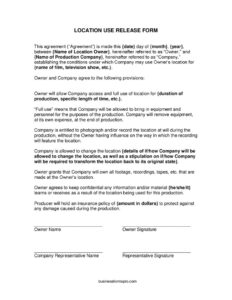
Location Use Release Form
Download a free Location Use Release Form template in PDF and DOCX to secure permission to film on private property, with editable fields and free download.
PDF
DOCX
4 downloads
0
likes
Download Files
- DOCX
A Location Use Release Form is a short agreement that gives a production company legal permission to film, photograph, and record at a property owner’s location. Productions use it most often to lock down a shooting location before cast and crew arrive, protecting both the owner’s property and the company’s right to use the resulting footage. You can download this Location Use Release Form free in both PDF and DOCX formats, with no signup required.
What Is a Location Use Release Form?
A Location Use Release Form is a contract between a property owner (the “Owner”) and a film, television, or media production company (the “Company”) that sets the terms under which the Company may use the Owner’s premises for a production. It documents who the parties are, the project name, how long the location is needed, what the Company may do on site, and who owns the footage captured there. It also commonly addresses property changes, restoration, confidentiality, and insurance. By signing, the Owner grants access and recording rights while the Company accepts responsibility for its equipment and any agreed-upon obligations. This single page prevents disputes over access, ownership, and liability.
When Do You Need a Location Use Release Form?
Any time a production films somewhere it does not own or control, a written release protects everyone involved. Common situations include:
- Shooting a feature film, short film, or web series at a private home, business, or storefront.
- Recording a television show, documentary, or reality program on someone else’s property.
- Filming a commercial or branded video at a restaurant, warehouse, farm, or studio space.
- Capturing a music video or photo shoot at a distinctive interior or exterior location.
- Using a property where the Company needs to bring in lighting, sets, vehicles, or large crews.
- Securing footage that will be distributed publicly, where clear ownership of the recordings matters for licensing and broadcast.
Even informal or low-budget projects benefit from a signed release. Insurers, distributors, broadcasters, and streaming platforms frequently require proof that every filming location was properly cleared before they will license or air the finished work.
What a Location Use Release Form Should Have
A complete release leaves no ambiguity about access, rights, and responsibilities. Strong versions include the date of the agreement, the full legal names of the Owner and the Company, and the title of the production. They define the duration of use and what “full use” means, including the right to bring in equipment and personnel and to remove it afterward at the Company’s expense. They confirm the Company’s right to photograph and record freely, spell out whether and how the location may be altered and restored, and state that the Company owns all resulting footage. Finally, they address confidentiality and the insurance amount the producer will carry to cover any damage.
How to Fill Out a Location Use Release Form
- Enter the date, month, and year the agreement is being made at the top of the form.
- Fill in the Name of Location Owner, who will be referred to as “Owner” throughout, and the Name of Production Company, referred to as “Company.”
- Write the name of the film, television show, or other production the location will be used for.
- Specify the duration of production — the dates or length of time the Company may access the location.
- Complete the change to the location clause, describing if and how the Company may alter the space and whether it must restore the location to its original state afterward.
- Enter the insurance policy amount in dollars the producer will hold to cover potential damage during production.
- Have the Owner print and sign their name, and have the Company Representative print their name and sign as well.
Review every blank before signing, and give each party a copy for their records.
Understanding Footage Ownership and Confidentiality
Two clauses in this form carry significant weight. The ownership provision grants the Company all footage, recordings, and tapes made at the location, and confirms the Owner has no influence over how the property is depicted on screen. This protects the Company’s ability to edit, distribute, and license the production without later objections. The confidentiality clause requires the Owner to keep private any information or material learned because the location was used — useful when a production involves unreleased scripts, scenes, or proprietary details. Make sure both parties understand these terms before signing, since they meaningfully limit the Owner’s control once production wraps.
Insurance and Property Protection
The insurance figure is more than a formality. Productions can involve heavy equipment, set construction, vehicle traffic, and large crews, all of which create real risk to a property. By naming a dollar amount the producer will carry, the form gives the Owner assurance that damage will be covered and gives the Company a clear obligation. Owners often ask to be named as an additional insured on the production’s certificate of insurance; discuss this before filming so the paperwork can be issued in time. Document the location’s condition with photos before and after the shoot to make any damage claim straightforward.
Common Mistakes to Avoid
- Leaving the duration blank or vague — always state specific dates or a defined length of time for access.
- Skipping the location-change clause, which leads to disputes over alterations and who pays for restoration.
- Forgetting to fill in the insurance amount or failing to actually obtain the policy before filming.
- Using a nickname or incomplete entity name instead of the full legal name of the Owner or Company.
- Not providing a signed copy to both parties after execution.
- Assuming a verbal handshake covers footage ownership — get the rights and confidentiality terms in writing.
Frequently Asked Questions
What is a Location Use Release Form used for? It is used to grant a production company permission to film, photograph, and record at a property owner’s location. The form documents the terms of access, the production duration, footage ownership, and insurance coverage. It protects both the Owner’s property and the Company’s right to use the resulting recordings.
Does a Location Use Release Form need to be notarized? Notarization is generally not required for a location release to be valid, since it is a contract between the Owner and the Company. The signatures of both parties are usually sufficient. Requirements can vary, so check your local rules if your project or insurer has specific documentation standards.
Who owns the footage filmed at the location? Under this form, the Company owns all footage, recordings, and tapes made at the Owner’s location. The Owner also agrees they will not have influence over how the location is portrayed in the production. This allows the Company to edit, distribute, and license the material freely.
Is a Location Use Release Form legally binding? Yes, once both the Owner and Company representative sign it, the form becomes a binding agreement between the parties. It should clearly state the terms, dates, and obligations to be enforceable. For high-value or complex productions, having an attorney review the agreement is advisable.
What insurance amount should be listed? The amount should reflect the potential risk of the production and the value of the property, and it is often guided by what the Owner, the Company, or distributors require. Many productions carry general liability coverage and name the Owner as an additional insured. Confirm the figure with your insurer before filming begins.
How much does this Location Use Release Form cost? This template is completely free to download from Business Forms Pro in both PDF and DOCX formats, with no signup required. You can edit the DOCX version to fit your specific production details. Print or save it once both parties have signed.
This Location Use Release Form template is a general example provided for informational purposes only and is not legal, financial, or tax advice. Laws and requirements vary by jurisdiction, and individual productions differ. Consult a qualified attorney before relying on this document for your project.
Related Forms
- Production Assistant Breakdown
- Daily Film Production Report
- Student Film Actor Release Form
- Actor Pay Form
- Extras Breakdown
- Shooting Notice
Browse more in Film Production Forms.