
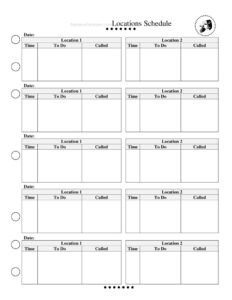
Multiple Location Schedule
Use a free Multiple Location Schedule template to coordinate dates, venues, call times, and tasks across multiple sites — free download in PDF and DOCX.
PDF
DOCX
5 downloads
0
likes
Download Files
- DOCX
A Multiple Location Schedule is a planning document used to coordinate dates, times, tasks, and call times across two or more venues at once. Theater companies, touring productions, and event teams rely on it most often to keep a cast and crew aligned when work happens in more than one place on the same day. You can download this template free in PDF and DOCX with no signup required.
What Is a Multiple Location Schedule?
A Multiple Location Schedule is a single sheet that lays out where people need to be, when, and what they should accomplish across several sites. Stage managers, production coordinators, and tour managers typically issue it so that everyone — performers, technicians, designers, and drivers — works from one source of truth. Instead of juggling separate call sheets for a rehearsal hall, a load-in venue, and a performance space, this form consolidates them. It documents the date, the locations involved, the relevant times, the to-do items for each spot, and who is called. In theater, it becomes especially valuable during transfers, split rehearsals, and multi-venue festivals where confusion about location can cost an entire day of work.
When Do You Need a Multiple Location Schedule?
Any time a production splits its activity between sites, a clear schedule prevents missed calls and wasted hours. Common scenarios include:
- Touring runs: A show plays one theater in the evening while the crew preps the next venue for load-in the following morning.
- Split rehearsals: The acting company rehearses at a studio while the build team constructs scenery in the scene shop.
- Festival programming: A company performs at two or more festival stages within the same day and needs everyone routed correctly.
- Tech transfers: Lighting and sound load into the main house while costume fittings continue at a separate workroom.
- Outdoor and site-specific work: Scenes are staged at multiple real-world locations that each require their own call time and task list.
- Workshop and performance overlap: A developmental reading happens at one venue while strike or setup occurs at another.
What a Multiple Location Schedule Should Have
A complete schedule leaves no room for guesswork. It should clearly state the date being covered so it cannot be confused with another day’s plan. It must name each location precisely — addresses or recognizable venue names rather than vague labels. It needs specific times tied to each activity, a column or section describing the tasks to be accomplished, and a clear indication of who is called to each site. The best versions are easy to scan at a glance, distribute the same morning to everyone involved, and avoid abbreviations that newcomers won’t recognize. Including a contact or distribution note also helps people reach the coordinator with questions.
How to Fill Out a Multiple Location Schedule
- Date: Enter the calendar date this schedule covers. Use a full format such as the month, day, and year so an old sheet is never mistaken for today’s plan.
- Location 1: Write the first venue or site — for example, the main theater or rehearsal studio. Include a recognizable name and, where helpful, the address or room.
- Location 2: Enter the second venue or site, such as the scene shop, a secondary stage, or a fitting room. Add as many location lines as your day requires.
- Time: List the times tied to activity at each location. Be specific about start and stop times so call times and breaks are unambiguous.
- To Do: Describe the tasks for each time and place — load-in, blocking Act One, spacing rehearsal, costume fittings, focus session, or strike.
- Called: Note exactly who is called to each location and time. List departments or named individuals so no one wonders whether they are needed.
Once complete, review the sheet for conflicts — no one should be called to two places at the same moment — then distribute it to the full company.
Tips for Coordinating Across Venues
The biggest risk in multi-location days is overlap. Before you publish the schedule, trace each person or department through the day to confirm they can physically travel between sites in the time allotted. Build in realistic transit and break time rather than scheduling back-to-back calls at distant venues. Use consistent venue names across every document so “the studio” always means the same place. If equipment or scenery moves between locations, note it explicitly on the to-do line so the crew knows what travels and when. Finally, identify a single coordinator on the sheet who owns the day and can answer questions when plans shift.
How It Differs From a Standard Call Sheet
A standard call sheet usually assumes one location and focuses on call times for a single space. A Multiple Location Schedule is built for the days a single sheet can’t cover — when activity is happening simultaneously at two or more sites. It pairs each location with its own times, tasks, and called personnel, making it the better tool whenever your day is geographically split. Many productions use both: a master Multiple Location Schedule for the overall day and detailed call sheets within each venue.
Common Mistakes to Avoid
- Vague location names like “Stage B” that newcomers and guest artists cannot find without an address.
- Scheduling conflicts where the same person is called to two venues at the same time.
- Ignoring travel time between sites, leaving people late or stranded.
- Leaving the Called column blank, so people are unsure whether they need to attend a given site.
- Forgetting the date, which causes an outdated schedule to circulate as if it were current.
- Failing to redistribute after a change, so half the company works from an old version.
Frequently Asked Questions
What is a Multiple Location Schedule used for? It is used to coordinate work happening at two or more venues on the same day. Productions and event teams use it to show the date, each location, the times, the tasks, and who is called to each site so everyone stays aligned.
How do I fill out a Multiple Location Schedule? Start with the date, then name each location clearly. Add the times for each site, describe the to-do tasks, and list who is called to each place and time. Review for conflicts before sharing it with the company.
Who creates the Multiple Location Schedule? In theater it is usually the stage manager, production coordinator, or tour manager. Whoever owns the day’s logistics drafts the schedule and distributes it to cast, crew, and any guest artists involved.
Can I use this for more than two locations? Yes. The template includes Location 1 and Location 2 fields, but you can add additional location lines or duplicate sections to cover three or more sites in a single day.
Is this only for theater productions? No. While it is built with theater workflows in mind, the same format works for film shoots, corporate events, festivals, conferences, and any project with simultaneous activity at multiple venues.
How much does the template cost? Nothing — it is completely free to download here in both PDF and DOCX formats, with no signup required. You can edit the DOCX version to match your company’s column layout and terminology.
This template is provided as a general example for informational purposes only and does not constitute legal, financial, or professional production advice. Scheduling needs and venue requirements vary by organization and location — consult a qualified professional or your venue management when appropriate.
Related Forms
- Audition Checklist
- Performance Report
- Blocking Sheet
- Production Schedule
- Character Breakdown
- Daily Schedule
Browse more in Theater.