
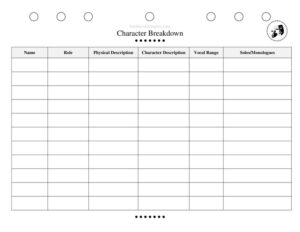
Character Breakdown
Build a complete Character Breakdown for any role with this free, easy-to-use theater template—download in PDF and DOCX with no signup required.
PDF
DOCX
3 downloads
0
likes
Download Files
- DOCX
A Character Breakdown is a structured worksheet actors, directors, and casting teams use to analyze a single role in detail, from objectives and relationships to physical traits and emotional arc. The most common reason people use one is to prepare for rehearsals or auditions by turning a script into a clear, actionable portrait of who a character really is. It’s free to download here in both PDF and DOCX formats with no signup required.
What Is a Character Breakdown?
A Character Breakdown is a working document that distills everything a performer or creative team needs to know about a role into one organized page. It’s used by actors building a part, directors clarifying their vision, casting directors writing audition notices, and playwrights checking that a character is fully developed. The breakdown captures the basics—name, age range, and physical description—alongside deeper layers like motivations, relationships, conflicts, and the emotional journey across the play. Rather than relying on scattered margin notes, the breakdown puts the character’s identity, function in the story, and key scenes in a single reference you can revisit throughout the production process. It bridges the gap between the written script and a living, embodied performance.
When Do You Need a Character Breakdown?
- Preparing for an audition: An actor analyzes the role to make bold, specific choices before walking into the room.
- Starting rehearsals: A director shares breakdowns so the whole cast understands each character’s function and relationships.
- Writing a casting notice: A casting director condenses age range, type, and key traits to attract the right submissions.
- Developing a new play: A playwright or dramaturg confirms each character has clear wants, obstacles, and growth.
- Teaching acting technique: Instructors use breakdowns to teach script analysis, objectives, and tactics.
- Doubling or understudy prep: A performer covering multiple roles keeps each character distinct with separate breakdowns.
Types of Character Breakdowns
Not every breakdown serves the same purpose, and the depth changes with the user. A casting breakdown is short and external—age range, physical type, vocal requirements, and a one-line description meant to attract submissions. An actor’s breakdown is internal and detailed, exploring backstory, objectives, secrets, and emotional beats that may never be stated in the script. A director’s breakdown sits between the two, focusing on how the character drives the plot and relates to others on stage. This template is flexible enough to support all three—fill in only the sections relevant to your role in the production, or complete every field for a full character study.
What a Character Breakdown Should Have
A complete breakdown moves from the surface to the core of the character. Surface elements include the character’s name, age or age range, and physical description—the information a costume or casting team needs first. The middle layer covers relationships, status, and the character’s function in the story. The deepest layer captures what truly drives performance: the character’s primary objective, the obstacles in the way, the tactics they use, their emotional arc, and key scenes or lines. A strong breakdown also notes vocal qualities, physical mannerisms, and any special skills the role demands, such as dialects, singing, or stage combat.
How to Fill Out a Character Breakdown
- Character name and play title: Write the character’s full name and the production they belong to so the breakdown is easy to file and reference.
- Age and physical description: Record the character’s age or age range, build, and any defining physical features drawn from the script or your interpretation.
- Status and occupation: Note their social standing, job, and economic situation, which shape posture, dress, and behavior.
- Relationships: List how the character connects to others—family, allies, rivals, romantic partners—and the nature of each bond.
- Objective and motivation: State what the character wants most across the play and why it matters to them.
- Obstacles and conflict: Identify who or what stands in the way of that objective.
- Tactics: Describe the strategies the character uses to pursue their goal.
- Emotional arc: Map how the character changes from first entrance to final scene.
- Key scenes and lines: Note pivotal moments and quotes that reveal who they are.
- Special skills: Record dialects, accents, singing, dancing, or other demands of the role.
Tips for a Stronger Breakdown
The most useful breakdowns are specific rather than vague. Instead of writing that a character is “angry,” note what they want and who frustrates them—anger is the result, not the choice. Pull evidence directly from the text: lines other characters say about them and lines they say about themselves often reveal more than stage directions. Phrase objectives as active verbs the character can play, such as “to win back” or “to escape,” because actable goals fuel performance far better than abstract states of mind. Revisit and revise the breakdown as rehearsals uncover new discoveries; a character study is a living document, not a one-time assignment.
Common Mistakes to Avoid
- Listing traits without function: Adjectives like “kind” or “clever” mean little unless tied to what the character does in the story.
- Ignoring the text: Inventing backstory that contradicts the script confuses choices and undermines the performance.
- Vague objectives: “To be happy” is not actable; specific, scene-by-scene goals are.
- Skipping relationships: Characters exist in relation to others—omitting key bonds flattens the role.
- Forgetting the arc: A character who ends exactly where they started usually signals a missed opportunity for change.
- Overloading a casting breakdown: For submissions, keep it concise; save deep analysis for your own actor’s notes.
Frequently Asked Questions
What is a character breakdown used for? It’s a worksheet that organizes everything you need to know about a single role, including objectives, relationships, physical traits, and emotional arc. Actors use it to prepare performances, directors use it to clarify vision, and casting teams use it to write audition notices. The goal is to turn a script into a clear, actionable understanding of a character.
How do I fill out a character breakdown? Start with the surface details—name, age, and physical description—then work toward the character’s objective, obstacles, tactics, and emotional arc. Draw your answers directly from the script wherever possible, and phrase objectives as active verbs the character can pursue. Complete only the sections relevant to your purpose, or fill in every field for a full study.
What’s the difference between a casting breakdown and an actor’s breakdown? A casting breakdown is short and external, listing age range, type, and key requirements to attract the right submissions. An actor’s breakdown is internal and detailed, exploring backstory, secrets, and emotional beats that may never appear in the script. This template supports both depending on which sections you complete.
Do I need to follow the script exactly? The factual details—relationships, events, and stated facts—should align with the text, since contradicting them creates confusion. Beyond the established facts, you’re free to invent backstory and inner life that justify your choices, as long as your additions support rather than override what the playwright wrote.
Can I reuse this template for multiple characters? Yes. Many productions require a separate breakdown for each role, and actors covering multiple parts or understudying keep one per character to stay distinct. Simply download a fresh copy for each character you analyze, and label each clearly with the character name and play title.
Is this character breakdown template free? Yes, it’s completely free to download in both PDF and DOCX formats with no signup required. The DOCX version is fully editable so you can adapt the fields to your production, classroom, or casting needs. Print it for rehearsal or fill it in digitally—whichever fits your workflow.
This Character Breakdown template is a general example provided for informational and educational purposes only. It is not professional, legal, or contractual advice, and production requirements and conventions vary by company, school, and project. Consult your director, instructor, or a qualified professional for guidance specific to your production.
Related Forms
- Rehearsal Schedule Month
- Stage Choreography Numbers Black
- Rehearsal Sign-In Sheet
- Audition Sheet Musical
- Costume Inventory
- Box Office Count
Browse more in Theater.