
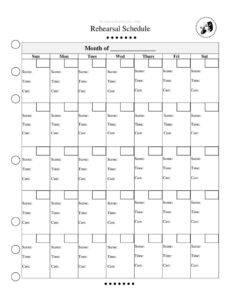
Rehearsal Schedule Month
Plan your entire production month with a free Rehearsal Schedule Month template — organize scenes, calls and cast availability. Free download in PDF and DOCX.
PDF
DOCX
5 downloads
0
likes
Download Files
- DOCX
A Rehearsal Schedule Month is a calendar-style planning document that maps out an entire month of rehearsals for a theatrical production, listing dates, times, locations, and which scenes or cast members are called. Stage managers and directors use it to keep an entire company on the same page across weeks of preparation. It’s free to download here in both PDF and DOCX formats, with no signup required.
What Is a Rehearsal Schedule Month?
A Rehearsal Schedule Month is a month-at-a-glance document that organizes every rehearsal session for a play, musical, dance piece, or opera within a single calendar month. It is typically created and maintained by the stage manager in collaboration with the director, then distributed to cast, crew, and creative team. The schedule documents what is being worked on each day, who needs to attend, how long each session runs, and where it takes place. Rather than juggling scattered emails and last-minute texts, the monthly schedule gives everyone a reliable reference for planning their lives around the production. It is one of the most important communication tools in any rehearsal process.
When Do You Need a Rehearsal Schedule Month?
Almost any organized production benefits from a monthly view of rehearsals. Common situations include:
- Launching a new production — when a director sets the overall arc from table read through tech week and needs to lay out the full month.
- Community and school theater — where cast members balance rehearsals with day jobs, classes, and family commitments and need plenty of advance notice.
- Musicals with multiple disciplines — coordinating separate music, choreography, and blocking calls that may run in different rooms simultaneously.
- Large ensemble shows — when only certain scenes are being rehearsed each day, so not everyone is called every night.
- Touring or repertory companies — managing overlapping rehearsals for more than one show across the same weeks.
- Booking shared spaces — when rehearsal rooms, studios, or the main stage must be reserved well in advance and conflicts avoided.
What a Rehearsal Schedule Should Have
A complete monthly rehearsal schedule should clearly identify the production and the month it covers, then break down each rehearsal day. Essential elements include the date and day of the week, the start and end times, the rehearsal location or room, the specific scenes, songs, or act being worked, and the cast or crew members called for that session. Many schedules also note the type of call (blocking, music, choreography, run-through, or tech), planned breaks, and any special requirements such as costume pieces, props, or accompanists. Including contact information for the stage manager and a note about how changes will be communicated rounds out a professional, dependable document.
How to Fill Out a Rehearsal Schedule Month
- Add the production title and month at the top so there is no confusion about which show and which calendar period the schedule covers.
- List each rehearsal date down the page or across a grid, including the day of the week to help cast members plan around weekends and weekdays.
- Enter the time block for each session, noting both the start time and the end time so people can arrange transportation and other commitments.
- Specify the location — the building, room number, or stage — especially when sessions move between spaces.
- Note what will be rehearsed that day: the scene numbers, act, song titles, or the phrase “full run” so participants arrive prepared.
- Mark who is called by listing character names, ensemble groups, or “full company” for each session.
- Flag special notes such as costume fittings, photo calls, or guest accompanists.
- Add stage manager contact details and distribute the finished schedule to everyone involved.
Tips for Building a Schedule That Actually Works
The best rehearsal schedules respect everyone’s time. Avoid calling actors who only appear briefly in a single scene to sit through three hours of unrelated blocking — group their scenes together when possible. Build in realistic breaks; performers who are rested and fed work better than those pushed to exhaustion. Leave a buffer toward the end of the month before tech week, because some scenes always need more polish than planned. Color-coding by call type (music, dance, blocking) makes a dense schedule far easier to read at a glance. Finally, post the schedule somewhere central and share a digital copy so no one can claim they missed it.
Communicating and Updating the Schedule
A rehearsal schedule is a living document. Productions evolve, actors fall ill, and rooms get double-booked, so changes are inevitable. Establish one clear method of communicating updates — a group message, a shared calendar, or a posted revision — and stick to it. Always include a version date or label revised schedules clearly so an old printout is never mistaken for the current plan. When you publish a change, highlight exactly what moved so people don’t have to compare the entire month line by line. Consistent, predictable communication keeps trust high and prevents the missed calls that derail momentum.
Common Mistakes to Avoid
- Calling people unnecessarily — scheduling actors who aren’t in the scenes being worked wastes their time and breeds resentment.
- Forgetting to label the month or version — leading to confusion between an outdated draft and the live schedule.
- Omitting end times — leaving cast unable to plan rides, childcare, or work shifts.
- Ignoring travel between rooms — back-to-back calls in different locations with no transition time.
- Overpacking tech week — failing to leave breathing room for the inevitable problems that surface late.
- Not distributing widely — relying on a single posted copy that absent members never see.
Frequently Asked Questions
What is a Rehearsal Schedule Month used for? It is used to plan and communicate an entire month of rehearsals for a production in one organized document. It tells cast and crew when, where, and what they are rehearsing, and who is called for each session. This prevents missed calls and scheduling conflicts.
Who creates the rehearsal schedule? In most productions the stage manager builds and maintains the schedule, working closely with the director and creative team. The director decides what needs to be rehearsed and in what order, while the stage manager translates that into concrete dates, times, and calls. Larger companies may involve a production manager as well.
How far in advance should I publish a monthly schedule? Ideally the full month is shared at least a week or two before it begins, so cast members can arrange work, school, and family commitments. Many companies publish the broad month early and confirm finer details week by week. Earlier notice almost always improves attendance.
How do I handle last-minute changes? Establish one consistent communication channel and use it for every update, then label revised schedules with a new date or version. Highlight exactly what changed so people aren’t forced to re-read the whole month. Clear, predictable updates keep the company informed and reduce confusion.
Can I edit this template for my own show? Yes. The DOCX version is fully editable, so you can add your production title, adjust the date grid, rename columns, and tailor it to a play, musical, or dance piece. The PDF is convenient for printing and posting once your plan is final.
Is this Rehearsal Schedule Month template free? Yes, it is completely free to download in both PDF and DOCX formats, with no signup or payment required. You can use it for school, community, or professional productions and reuse it for as many shows as you like.
This template is a general example provided for informational and organizational purposes only and does not constitute professional, contractual, or legal advice. Production needs, union rules, and venue requirements vary widely — consult your production team, venue, and any applicable agreements before finalizing your schedule.
Related Forms
- Rehearsal Report
- Character Breakdown
- Daily Schedule
- Weekly Rehearsal Schedule
- Comp Ticket Tracker
- Line Notes Breakdown
Browse more in Theater.