
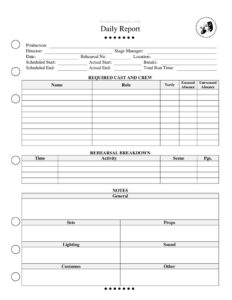
Rehearsal Report
Download a free Rehearsal Report template in PDF and DOCX to log each theater rehearsal, track notes for every department, and keep your production team aligned.
PDF
DOCX
8 downloads
0
likes
Download Files
- DOCX
A Rehearsal Report is the daily document that captures what happened during a theater rehearsal and communicates action items to every department on the production. Stage managers use it to keep directors, designers, technicians, and producers informed, and you can download it here free in PDF and DOCX with no signup required.
What Is a Rehearsal Report?
A Rehearsal Report is a standardized form, typically completed by the stage manager or assistant stage manager at the end of each rehearsal. It records who attended, what was worked, how long the session ran, and most importantly the notes and requests directed to each department — scenic, costumes, lighting, sound, props, and production management. The report becomes the official record of decisions, problems, and questions raised during rehearsal, ensuring that information flows from the rehearsal room to the people who can act on it. It also creates a paper trail that protects everyone by documenting what was discussed and when.
When Do You Need a Rehearsal Report?
Any production with multiple collaborators benefits from a consistent rehearsal report. Common situations include:
- A community theater staging a full-length play where the director needs a furniture change communicated to the scenic shop.
- A musical rehearsal where the music director requests a microphone adjustment that the sound department must address.
- A school or university production tracking attendance and rehearsal hours for academic records.
- A regional theater where the costume designer is not in the room and relies on written notes about a quick-change problem.
- A dance or opera company logging which numbers were run so the choreographer knows what still needs work.
- A touring show that needs a clear daily record to hand off between stage management teams in different cities.
What a Rehearsal Report Should Have
A complete rehearsal report is organized so every reader can quickly find the notes that concern them. Strong reports include the production name and date, the day’s start and end times along with any breaks, and an attendance summary noting lateness or absences. The body is divided into clearly labeled departmental sections so scenic, lighting, sound, costumes, and props notes are never confused with one another. A general or schedule section records what scenes were worked and what is planned next. Finally, the report identifies who wrote it and how to reach them with questions. Numbering each note makes follow-up conversations far easier.
How to Fill Out a Rehearsal Report
Work through the form in order at the end of each rehearsal while details are fresh:
- Enter the production title, the date, and the report number or day count.
- Record the start time, end time, and the length and number of any breaks taken.
- Complete the attendance section, noting who was present, late, or excused.
- Summarize what was accomplished in the rehearsal recap — which scenes, songs, or numbers were worked.
- Fill the scenic notes with any set, furniture, or rigging requests.
- Add costume notes covering fittings, repairs, or quick-change issues.
- List lighting and sound notes, including cue questions and equipment needs.
- Record props notes for items to add, replace, or modify.
- Use the general or production section for scheduling, building, and miscellaneous items.
- Sign with the stage manager’s name and contact information, then distribute.
How Rehearsal Reports Differ From Performance Reports
It is easy to confuse a rehearsal report with a performance report, but they serve different stages of a production. A rehearsal report covers the developmental period — it is full of creative decisions, blocking changes, and requests that shape the show before it opens. A performance report, by contrast, is generated after each public performance and focuses on running times, audience count, technical glitches, and maintenance issues during the live run. Many stage managers use a similar layout for both so the team reads them the same way, but the content and tone are distinct. During tech week you may produce both kinds of documents as rehearsals blend into runs, so labeling each clearly avoids confusion.
Tips for Writing Effective Rehearsal Reports
The best rehearsal reports are concise, specific, and timely. Distribute the report the same night or first thing the next morning so departments have lead time. Write notes as actionable requests rather than vague observations — “the kitchen table needs to be six inches shorter” is more useful than “the table is too big.” Avoid editorializing or assigning blame; the report is a working tool, not a place for opinions. Keep a numbered, dated archive of every report so you can reference earlier decisions, and copy the full production team on distribution even when a note targets one department, since context helps everyone plan.
Common Mistakes to Avoid
- Waiting too long to write the report, causing details and exact requests to be forgotten.
- Mixing department notes together so the lighting designer has to hunt for items that concern them.
- Writing vague notes that do not specify dimensions, colors, cue numbers, or deadlines.
- Forgetting to log accurate start, end, and break times, which production needs for budgeting and union compliance.
- Failing to record attendance, leaving no record of who missed key blocking.
- Sending the report to an incomplete distribution list so a key department never receives its notes.
Frequently Asked Questions
What is a rehearsal report used for? A rehearsal report documents everything that happened in a rehearsal and communicates requests and questions to each production department. It keeps designers, technicians, and producers informed even when they were not in the room, and it serves as the official record of decisions made that day.
Who writes the rehearsal report? The stage manager or an assistant stage manager almost always writes the report, since they observe the entire rehearsal and track every department’s needs. In small productions the director or a production assistant may take on the task, but consistency in who writes it helps the team trust the document.
How do I fill out a rehearsal report? Start with the production name, date, and times, then record attendance and a recap of what was worked. Add specific, numbered notes under each department heading — scenic, costumes, lighting, sound, and props — and finish by signing with your name and contact information before distributing.
When should the rehearsal report be sent out? Distribute the report as soon as possible after rehearsal ends, ideally the same night or early the next morning. Departments need time to source materials, build elements, and answer questions before the next rehearsal, so prompt delivery is essential.
Is a rehearsal report a legal document? It is generally an internal production document rather than a binding legal contract, though it can serve as evidence of what was communicated and when. On union productions it may also support compliance records for rehearsal hours and breaks, so accuracy matters.
Is this rehearsal report template free? Yes. You can download this rehearsal report template free in both PDF and DOCX formats with no signup required. Edit the DOCX version to match your production’s departments and house style before printing or emailing it.
This rehearsal report template is provided as a general example for informational purposes only and does not constitute legal, financial, or professional advice. Production practices and any applicable union or organizational requirements vary, so consult your producer, union representative, or another qualified professional for guidance specific to your situation.
Related Forms
- Box Office Count
- Prop Pre-Set Checklist
- Comp Ticket Tracker
- Costume Change Tracker
- Set Design
- Scene Changes
Browse more in Theater.