
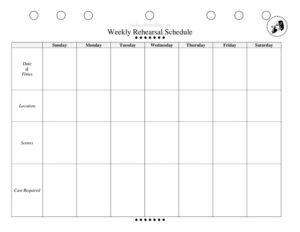
Weekly Rehearsal Schedule
Plan your production week with a free Weekly Rehearsal Schedule template that keeps cast and crew on track — free download in PDF and DOCX.
PDF
DOCX
3 downloads
0
likes
Download Files
- DOCX
A Weekly Rehearsal Schedule is a planning document that lays out which scenes, songs, or numbers a cast and crew will work on each day of the week, along with times, locations, and who is called. Theater companies, directors, and stage managers use it most often to keep everyone informed and rehearsals running on time. You can download it free in PDF and DOCX, with no signup required.
What Is a Weekly Rehearsal Schedule?
A Weekly Rehearsal Schedule is a day-by-day grid that organizes a production’s rehearsal time across a single week. It is typically issued by the stage manager or director and distributed to actors, musicians, choreographers, and technical staff. The document records what will be rehearsed (scenes, acts, dance numbers, or vocal sections), the start and end times, the rehearsal space, and which performers are required to attend. By putting all of this in one place, the schedule prevents wasted time, double-bookings, and confusion about who needs to be where. It serves as both a planning tool during pre-production and a daily reference once rehearsals begin.
When Do You Need a Weekly Rehearsal Schedule?
Almost any production with more than a handful of people benefits from a written weekly plan. Common situations include:
- Mounting a community or school play where volunteer actors juggle day jobs and classes and need advance notice of calls.
- Staging a musical that requires separate music, choreography, and blocking rehearsals coordinated across multiple rooms.
- Preparing for tech week, when long days and shifting priorities make a clear, posted plan essential.
- Running a youth theater program where parents need to know exactly when to drop off and pick up.
- Coordinating a touring or repertory company that rotates several shows in the same week.
- Managing a small ensemble or fringe production with limited venue access, where every available hour must be allocated carefully.
What a Weekly Rehearsal Schedule Should Have
A complete schedule does more than list dates. To be genuinely useful, it should include the production title and the week it covers, each rehearsal day with start and end times, the location or room, and a clear description of what is being worked on. Just as important is the call — the list of cast members or roles required at each session — so no one shows up unnecessarily or, worse, fails to appear when needed. Many schedules also note breaks, the stage manager’s contact information, and any reminders such as bringing scripts, off-book deadlines, or wearing rehearsal skirts and shoes. Clarity and consistency are what make a schedule trustworthy.
How to Fill Out a Weekly Rehearsal Schedule
Work through the template section by section so nothing is missed:
- Enter the production title and the week dates the schedule covers at the top so every distributed copy is unambiguous.
- For each day, fill in the date and day of the week (Monday through Sunday or only your active days).
- Add the start and end time for each rehearsal block, including any planned breaks.
- List the location or room so cast and crew know exactly where to go.
- Describe the scenes, songs, or numbers to be rehearsed in that block, referencing act and scene numbers or song titles.
- Record the cast called — the characters or performers required for each session.
- Note any special requirements, such as props, costumes, accompanist needs, or off-book expectations.
- Add the stage manager or contact name and phone number at the bottom, then date and distribute the finished schedule.
Tips for Building a Schedule That Actually Works
The best rehearsal schedules respect everyone’s time. Group scenes by which actors are needed so you can release performers who are done rather than holding them all evening. Build in realistic breaks — exhausted casts make slow progress — and pad transitions between blocks so a late-running scene doesn’t derail the rest of the night. Post the schedule in a consistent place, such as a backstage call board and a shared group chat, and color-code or bold the names of who is called each day. Always include a deadline reminder for being off-book and flag any rehearsals that will be combined music-and-staging sessions so the music director and choreographer can plan accordingly.
How It Differs From a Daily Call Sheet
A weekly schedule and a daily call sheet are related but not identical. The weekly schedule gives the big-picture overview of the entire week so people can plan their personal calendars and arrange time off in advance. A daily call sheet, by contrast, zooms in on a single day with precise arrival times for each person, a minute-by-minute breakdown, and last-minute notes. Many companies use both: the weekly schedule sets expectations, and the daily call sheet confirms and refines them. Keeping the two consistent — and issuing the call sheet from the weekly plan — avoids contradictory information that frustrates a busy cast.
Common Mistakes to Avoid
- Forgetting to specify who is called, leaving actors unsure whether they need to attend.
- Scheduling scenes without checking actor conflicts, then having to cancel or rework on the day.
- Omitting the location when rehearsals move between rooms or venues.
- Packing days so tightly that there is no room for breaks or scenes that run long.
- Distributing the schedule too late for performers to arrange their week.
- Failing to update and re-circulate the schedule when changes happen, so people work from stale copies.
Frequently Asked Questions
What is a Weekly Rehearsal Schedule used for? It is used to organize a production’s rehearsal time across one week, showing what will be rehearsed each day, when, where, and who is required. It keeps cast and crew informed and helps the stage manager use limited time efficiently. It also gives performers enough notice to plan around work, school, and personal commitments.
Who creates the rehearsal schedule? In most productions the stage manager prepares the schedule in close coordination with the director, music director, and choreographer. The director sets priorities for which scenes need attention, and the stage manager translates those priorities into a workable weekly plan. In smaller or amateur groups, the director may build it alone.
How far in advance should I publish it? A good rule of thumb is to distribute the upcoming week’s schedule several days ahead, ideally before the previous week ends. Early notice lets actors request time off, arrange childcare, and prepare their material. The further out you can plan reliably, the smoother attendance tends to be.
Can I edit this template for my production? Yes. The DOCX version is fully editable, so you can add or remove days, rename columns to match your show’s structure, and insert your company’s logo. The PDF is ready to print and post on a call board as-is. Adapt it to whatever rehearsal format your production uses.
Is a rehearsal schedule a binding contract? No, a rehearsal schedule is an organizational planning document, not a legal contract. Attendance expectations are usually governed by your cast agreement, union rules, or company policies rather than the schedule itself. Always follow any applicable union or contractual rules for rehearsal hours and breaks.
Is this template really free? Yes. You can download the Weekly Rehearsal Schedule template free in both PDF and DOCX formats with no signup or payment required. Use it for as many productions and weeks as you like.
This template is a general example provided for informational purposes only and does not constitute legal, contractual, or professional advice. Rehearsal hour limits, break requirements, and labor rules vary by jurisdiction and by union agreement — consult the relevant authority or a qualified professional for your specific situation.
Related Forms
- Line Notes
- Production Calendar
- Focus Chart
- Post-Show Checklist
- Performance Report
- Stage Choreography Numbers
Browse more in Theater.