
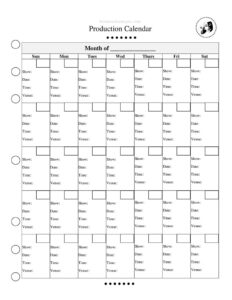
Production Calendar
Plan every rehearsal, build deadline, and performance with our free Production Calendar template for theater—free download in PDF and DOCX, no signup needed.
PDF
DOCX
1 downloads
0
likes
Download Files
- DOCX
A Production Calendar is the master schedule that maps every key date in a theatrical production, from the first read-through to closing night. Theater companies and stage managers use it most often to keep cast, crew, and creative teams aligned on what happens when. It’s free to download in PDF and DOCX, with no signup required.
What Is a Production Calendar?
A Production Calendar is a planning document that lists all the dates, deadlines, and milestones tied to mounting a stage production. It is typically created by the production stage manager or producer in collaboration with the director, designers, and technical director. The calendar documents when rehearsals occur, when sets and costumes must be finished, when technical and dress rehearsals happen, and when performances run. It serves as a single source of truth so everyone—from actors to the lighting designer to front-of-house staff—works backward from the same opening date. A well-built Production Calendar prevents scheduling conflicts and keeps a complex collaborative project moving toward a fixed deadline.
When Do You Need a Production Calendar?
Any time multiple departments must coordinate toward a shared performance date, a Production Calendar becomes essential. Common situations include:
- Launching a new production — once a show is selected and a venue booked, you need to schedule backward from opening night.
- Community or school theater — when volunteers and students have limited availability, a clear calendar protects rehearsal time around classes and jobs.
- Coordinating design deadlines — set, costume, lighting, and sound teams need firm dates for renderings, builds, and load-in.
- Planning tech week — sequencing cue-to-cue, technical, and dress rehearsals so nothing is rushed before previews.
- Managing a touring or repertory schedule — when several shows share a space, the calendar avoids overlaps in stage and rehearsal time.
- Reporting to a board or producer — a calendar communicates progress and budget timing to stakeholders at a glance.
Types of Dates a Production Calendar Tracks
Most theatrical calendars group dates into a few recognizable phases. Pre-production covers auditions, callbacks, casting decisions, and design meetings. The rehearsal phase includes the first read-through, blocking, music or choreography rehearsals, and run-throughs. The build phase tracks set construction, costume fittings, and prop fabrication deadlines. Technical phase entries include load-in, focus, paper tech, cue-to-cue, technical rehearsals, and dress rehearsals. Finally the performance phase lists previews, opening night, the full run, and strike. Understanding these phases helps you place every entry in the right sequence.
What a Production Calendar Should Have
A complete calendar is more than a list of dates. To be genuinely useful it should include:
- The production title, season, and venue.
- A clear opening night and closing date anchoring the schedule.
- Each rehearsal date with start and end times and the location.
- Design and build deadlines tied to named departments.
- Technical milestones such as load-in, tech, and dress rehearsals.
- Responsible parties or departments for each deadline.
- Notes on conflicts, dark days, and holidays.
How to Fill Out a Production Calendar
Follow these steps to build a complete, conflict-free schedule:
- Enter production details. At the top, record the show title, the producing organization or season, and the venue where rehearsals and performances take place.
- Fix your anchor dates. Write in opening night and closing performance first—every other deadline works backward from these.
- List the rehearsal period. Add the first read-through, then individual rehearsal dates with times and rooms, marking dark days when no rehearsal is scheduled.
- Add design and build deadlines. Note when renderings are due, when costume fittings happen, and when set construction must finish, assigning each to the relevant department.
- Schedule the technical phase. Enter load-in, focus, paper tech, cue-to-cue, technical rehearsals, and dress rehearsals in sequence before previews.
- List all performances. Record previews, opening, every show in the run, and strike.
- Assign responsibility and add notes. Mark who owns each milestone and flag any known conflicts, holidays, or shared-space bookings.
Tips for Keeping the Calendar Accurate
A Production Calendar is a living document. Distribute the first version early so cast and crew can flag conflicts before commitments are locked. Version your updates clearly—date each revision and announce changes in writing rather than verbally so nothing is missed. Build in buffer time before tech week; productions rarely run exactly on schedule, and a day of slack prevents a cascade of late nights. Coordinate with your venue’s master calendar to confirm you actually have the space booked on every listed date. Finally, keep a shared copy accessible to the whole team rather than relying on a single printed sheet that quickly goes stale.
How It Differs From a Rehearsal Schedule
People sometimes confuse a Production Calendar with a daily rehearsal schedule, but they serve different scopes. The Production Calendar is the big-picture roadmap covering the entire timeline from pre-production through strike, including build and design deadlines. A daily rehearsal schedule, by contrast, breaks a single day into hour-by-hour blocks—who is called, which scenes are worked, and when breaks fall. The calendar sets the framework; daily calls fill in the detail. Use both together for a smoothly run production.
Common Mistakes to Avoid
- Skipping the backward-planning step — failing to anchor to opening night leads to deadlines that arrive too late.
- Forgetting tech week buffer — cramming load-in, tech, and dress into too few days causes burnout and missed cues.
- Ignoring cast conflicts — not collecting availability before publishing creates rehearsals nobody can attend.
- Leaving deadlines unassigned — a build date with no responsible department tends to slip unnoticed.
- Not double-booking checks — listing dates the venue isn’t actually available wastes everyone’s time.
- Distributing only one version — circulating outdated copies after changes creates confusion on call.
Frequently Asked Questions
What is a Production Calendar used for? It is used to schedule and coordinate every milestone of a theatrical production, including rehearsals, design and build deadlines, technical rehearsals, and performances. It keeps the entire cast, crew, and creative team working toward the same dates so the show opens on time.
Who creates the Production Calendar? Usually the production stage manager or producer builds it, in close consultation with the director, designers, and technical director. In school and community theater, a director or volunteer coordinator may take on the task. Whoever creates it should share it widely and update it as plans change.
How far in advance should I make one? Build the calendar as soon as the show is selected and the venue and opening date are confirmed. Starting early gives departments enough lead time for casting, design, and construction. The longer the runway, the easier it is to resolve conflicts before they become problems.
Is a Production Calendar a legally binding document? No, it is an internal planning and communication tool, not a contract. Employment and rental obligations are governed by separate agreements with cast, crew, and venues. The calendar simply organizes the dates those agreements reference.
Can I edit this template for my own show? Yes. The template downloads in both PDF and DOCX, and the editable DOCX version lets you add your show title, adjust the phases, and insert your specific dates. Customize the departments and milestones to match the scale of your production.
How much does this Production Calendar template cost? It is completely free to download here, with no signup or payment required. You can grab the PDF for printing or the DOCX for editing and start scheduling your production right away.
This Production Calendar template is provided as a general example for informational purposes only and is not legal, financial, or professional advice. Scheduling practices and contractual obligations vary by organization and jurisdiction—consult the appropriate qualified professional or your producing organization’s guidelines before finalizing your production plan.
Related Forms
- Line Notes
- Page Blocking Breakdown
- Conflict Calendar
- Costume Changes
- Blocking Sheet
- Scene Breakdown Actors
Browse more in Theater.