
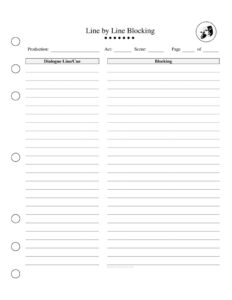
Page Blocking Breakdown
Download a free Page Blocking Breakdown template to record line-by-line blocking, cues, and movement for any production — free PDF and DOCX download.
PDF
DOC
7 downloads
0
likes
Download Files
- DOC
A Page Blocking Breakdown is a stage management worksheet that records the movement, positions, and cues for a single page of a script, line by line. Directors, stage managers, and actors use it most often to capture blocking exactly as it is set in rehearsal so it can be replicated, reviewed, and communicated to the whole company. It’s free to download here in both PDF and DOCX formats — no signup required.
What Is a Page Blocking Breakdown?
A Page Blocking Breakdown is a structured form that pairs each line of dialogue or cue with the staging instructions tied to it. Rather than scribbling arrows in a margin, this sheet gives you dedicated columns for the production title, the act and scene, the page number, the specific dialogue line or cue, and the blocking action. It’s typically maintained by the stage manager in the prompt book and shared with the director and cast. The result is a clean, readable record of who moves where and when — invaluable for re-rehearsing scenes, training understudies, and keeping a production consistent from the first run-through to closing night.
When Do You Need a Page Blocking Breakdown?
Any production with movement benefits from a written record of its staging. This form is especially useful in these situations:
- Setting blocking in rehearsal — capturing the director’s choices in real time as a scene is staged page by page.
- Building the prompt book — assembling a master reference the stage manager calls the show from.
- Bringing in understudies or swings — teaching a replacement exactly where and when to move without re-blocking the scene.
- Reviving a production — reconstructing staging for a remount months or years later.
- Coordinating with technical cues — aligning entrances, crosses, and exits with light and sound cues during tech week.
- Giving actors notes — referencing a precise line and its blocking when a movement drifts during the run.
What a Page Blocking Breakdown Should Have
A complete blocking breakdown ties every instruction to a specific moment in the text so there’s no ambiguity about timing. The essential elements are the production name, the act and scene location, the page reference within the script, the dialogue line or cue that triggers the action, and a clear description of the blocking itself. Good blocking notation uses consistent abbreviations — for example USL (upstage left), DSR (downstage right), X (cross), and character initials — so the sheet stays compact and quick to read. Including a “page x of y” reference keeps multi-page scenes in order and prevents loose sheets from being misfiled in the prompt book.
How to Fill Out a Page Blocking Breakdown
- Production: Enter the title of the show at the top so the sheet is identifiable when filed with other paperwork.
- Act: Record the act number for the page you’re documenting.
- Scene: Note the scene number or designation, matching how the script labels it.
- Page x of y: Write the current page number and the total number of blocking pages for the scene or script, so the breakdown stays in sequence.
- Dialogue Line/Cue: For each entry, copy the line of dialogue, a short quoted phrase, or the cue (such as a sound or light cue) that triggers the movement. Anchoring the blocking to a precise textual moment is what makes the sheet reliable.
- Blocking: Describe the action in the same row — who moves, where they go, and any business such as sitting, picking up a prop, or turning to address another character. Use consistent abbreviations and character initials, and add the timing relative to the line (“on,” “before,” or “after”).
Work line by line down the page, completing one row before moving to the next, and start a fresh sheet when you reach the next page of script.
Blocking Notation Tips
The value of this form comes from being readable at a glance during a fast-moving rehearsal or live performance. Establish a legend of abbreviations at the start of the prompt book and use it consistently across every page: stage areas (US, DS, SL, SR, C), movement (X for cross, ENT for enter, EX for exit), and a fixed set of initials for each character. Keep blocking descriptions short and verb-driven — “JANE X DSC, sits sofa” reads faster than a full sentence. When blocking changes in a later rehearsal, update the row rather than crossing it out illegibly; a clean prompt book is far easier to call from. Many stage managers use pencil for early rehearsals and ink for locked blocking.
Keeping the Prompt Book Organized
Because blocking is recorded one page at a time, organization matters as much as accuracy. File breakdown sheets in script order, behind or facing the corresponding script page, so a caller can find any moment instantly. The “page x of y” field helps you confirm nothing is missing before tech. If your production runs in repertory or tours, keep a master copy and distribute photocopies for rehearsal use, preserving the original. Revisit the breakdowns after each major rehearsal milestone — first stumble-through, runs, and tech — to keep them current, since blocking inevitably evolves as scenes are refined.
Common Mistakes to Avoid
- Vague descriptions — “moves left” is ambiguous; specify the stage area and the destination.
- Missing the cue line — blocking without an anchor line leaves the timing unclear.
- Inconsistent abbreviations — mixing notation styles makes the sheet hard for others to read.
- Skipping the page reference — without “page x of y,” loose sheets fall out of order.
- Not updating after changes — outdated blocking creates confusion during tech and runs.
- Overcrowding a row — cramming several actions into one cell defeats the line-by-line clarity the form is built for.
Frequently Asked Questions
What is a Page Blocking Breakdown used for? It is used to record the staging of a production line by line, pairing each piece of dialogue or cue with the movement that goes with it. Stage managers keep it in the prompt book so blocking can be replicated, taught to understudies, and called accurately during performances.
Who fills out this form? The stage manager or assistant stage manager usually maintains the breakdown, recording the director’s choices as they are set in rehearsal. Directors and actors may also reference or annotate copies for their own notes.
What does “page x of y” mean on the form? It indicates the current blocking page number and the total number of pages for that scene or script. This keeps multi-page scenes in the correct sequence and helps you confirm the prompt book is complete before tech week.
How detailed should the blocking column be? Detailed enough to reproduce the movement exactly, but concise enough to read quickly. Use standard stage abbreviations and character initials, name the destination on stage, and note the timing relative to the cue line.
Can I edit this template to fit my production? Yes. The DOCX version is fully editable, so you can add columns for props, light or sound cues, or notes, and adjust the headings to match how your script labels acts and scenes.
Is the Page Blocking Breakdown template free to download? Yes, it is completely free in both PDF and DOCX formats with no signup required. Download it, print copies for your prompt book, or customize the editable file for your show.
This template is a general example provided for informational purposes only and is not professional production, legal, or contractual advice. Theatrical conventions and notation standards vary by company and region — adapt this form to your production’s needs and your organization’s established practices.
Related Forms
- Scene Changes
- Audition Sheet Musical
- Comp Ticket Request Form
- Production Meeting Notes
- Costume Information Sheet
- Line Notes
Browse more in Theater.