
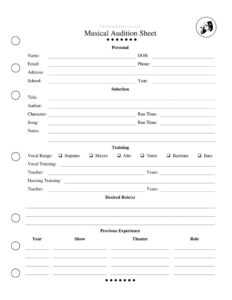
Audition Sheet Musical
Download a free Audition Sheet Musical template in PDF and DOCX to organize singers, dancers, and actors auditioning for your musical production.
PDF
DOCX
22 downloads
0
likes
Download Files
- DOCX
An Audition Sheet Musical is a one-page form that captures everything a casting team needs to know about each performer trying out for a musical, from contact details to vocal range and audition song. It’s most commonly used by directors, music directors, and stage managers to keep auditions organized and to compare candidates fairly during callbacks. You can download it free in both PDF and DOCX formats, with no signup required.
What Is an Audition Sheet Musical?
An Audition Sheet Musical is a structured intake and scoring form used during the tryout process for a stage musical. It is typically issued by the production team — a director, casting director, or music director — and filled out partly by the performer and partly by the panel. The form documents who auditioned, what material they prepared, their vocal and dance qualifications, scheduling conflicts, and the panel’s notes and ratings. Because musicals demand singing, acting, and movement together, this sheet gathers far more detail than a straight-play audition form. It serves as the official record that helps a team review dozens of hopefuls, narrow the field for callbacks, and ultimately assign roles with confidence and consistency.
When Do You Need an Audition Sheet Musical?
Any production that holds open or invited tryouts benefits from a standardized sheet. Common situations include:
- Community theater season auditions — when a volunteer cast turns out and you need a quick, uniform way to log each performer.
- School and college musicals — drama teachers and directors comparing students for lead, ensemble, and chorus roles.
- Professional and regional productions — where Equity and non-Equity performers audition across multiple days and panels need shared notes.
- Children’s or youth theater — capturing parent contact information, conflicts, and age-appropriate casting details.
- Callback rounds — pairing performers, testing harmonies, and recording which combinations work for chemistry reads.
- Touring or summer-stock casting — when availability, travel, and rehearsal conflicts directly affect who can be cast.
In each case, the sheet creates a paper trail you can revisit weeks later when memories of individual performances have blurred together.
What an Audition Sheet Musical Should Have
A complete musical audition sheet balances performer-supplied information with panel evaluation space. Strong versions of the form include the performer’s name and contact details, the role or roles they are seeking, their vocal range or voice type, prior experience, the title of the song and the show it’s from, accompaniment needs, dance or movement experience, scheduling conflicts, and a willingness to accept any role. On the panel side, it should provide room for scoring categories — vocals, acting, movement, and overall impression — along with a notes field and a clear callback yes/no marker. An audition number or slot helps match the sheet to a recording or headshot.
How to Fill Out an Audition Sheet Musical
- Performer name and audition number: Write the full name and assign a sequential number that matches your sign-in list and any video.
- Contact information: Record phone and email so you can deliver callback or cast notifications quickly.
- Role(s) desired: Note the specific part the performer is reading for, plus whether they’ll accept ensemble or any role.
- Voice type / vocal range: Enter soprano, alto, tenor, bass, or a measured range; this is critical for matching to the score.
- Audition song and show: Log the song title and the musical it comes from, noting key and accompaniment needs.
- Experience: Summarize relevant credits, training, or dance background to gauge readiness.
- Conflicts and availability: Capture rehearsal or performance date conflicts that affect casting.
- Panel scores and notes: Have evaluators rate vocals, acting, and movement, then add comments.
- Callback decision: Mark yes or no and list any roles to recall the performer for.
Tips for Running Smoother Musical Auditions
Hand each performer a partial sheet to complete while they wait, so the panel time stays focused on the actual performance rather than paperwork. Pre-print sheets with your show title, audition date, and the list of available roles to keep the team aligned. Staple or clip a headshot and resume to the matching sheet immediately to avoid mix-ups. Agree as a panel on what your numeric ratings mean before the first singer enters — a shared scale prevents one judge’s “4” from meaning something different than another’s. Finally, jot impressions immediately after each audition; waiting until a break almost always leads to forgotten details.
How It Differs From a Straight-Play Audition Form
A musical audition sheet adds three categories a dramatic-play form usually omits: vocal range or voice type, the prepared song and its source, and dance or movement evaluation. Musicals often require a triple-threat assessment, so the scoring grid weights singing and movement alongside acting. Accompaniment and key information also matter because a pianist or track must support the singer. If you also produce plays, keep both versions on hand and reach for this one only when the production includes a musical score.
Common Mistakes to Avoid
- Skipping audition numbers — without them, sheets, headshots, and video recordings drift apart and become impossible to match.
- Vague vocal notes — “good voice” tells you nothing; record range, tone, and pitch accuracy instead.
- Ignoring conflicts — casting a lead who can’t attend tech week creates a crisis you could have foreseen.
- Inconsistent scoring — letting each panelist use a private scale makes comparison meaningless.
- Forgetting contact details — a brilliant audition is wasted if you can’t reach the performer for a callback.
- Writing notes late — relying on memory after 30 auditions blends performances together and erodes fairness.
Frequently Asked Questions
What is an Audition Sheet Musical used for? It is used to record and evaluate each performer who auditions for a stage musical. The form captures contact details, vocal range, the prepared song, experience, and conflicts, then gives the panel space to score and decide on callbacks. It keeps a busy audition day organized and your casting decisions consistent.
Who fills out the audition sheet? Responsibility is usually split. The performer completes the top portion — name, contact information, role desired, song, and conflicts — often while waiting, and the casting panel fills in the scoring, notes, and callback decision during and after the performance.
What should performers list as their vocal range? Performers should give their voice type, such as soprano, mezzo, alto, tenor, baritone, or bass, and a specific range if they know it. This information helps the music director match singers to the demands of particular songs and roles in the score.
Is this audition sheet legally binding? No. An audition sheet is an internal organizational and evaluation document, not a contract. Casting commitments, pay, and rehearsal obligations are handled separately through cast agreements or, in union productions, formal contracts.
How much does the template cost? Nothing. You can download the Audition Sheet Musical here for free in both PDF and DOCX formats, with no signup required. Use the editable DOCX to add your show title, role list, and custom scoring categories.
Can I customize the form for my production? Yes. Open the DOCX version and adjust the fields to fit your needs — add dance call ratings, harmony test boxes, parent contact lines for youth theater, or your own logo and show artwork before printing copies for the panel.
This Audition Sheet Musical template is provided as a general example for informational purposes only and does not constitute legal, employment, or professional casting advice. Production and labor requirements vary by jurisdiction and by union agreement — consult a qualified professional or your producing organization for guidance specific to your situation.
Related Forms
- Entrance Exit Tracker
- Sound Inventory Sheet
- Production Calendar
- Blocking Key
- Multiple Location Schedule
- Storage Contents Tracker
Browse more in Theater.