
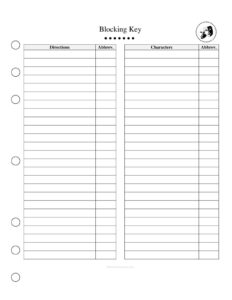
Blocking Key
Download a free Blocking Key template for theater stage managers to record actor movement and notation symbols, available as a free PDF and DOCX download.
PDF
DOC
5 downloads
0
likes
Download Files
- DOC
A Blocking Key is a reference sheet used in theater to define the abbreviations and symbols a stage manager or director uses to record actor movement, positioning, and stage directions in a prompt book. Its most common purpose is to keep blocking notation consistent and readable so anyone reading the script can reconstruct exactly where actors stand and move. You can download it free here in PDF and DOCX, with no signup required.
What Is a Blocking Key?
A Blocking Key is a legend that explains the shorthand a production team uses to notate staging in the prompt book. Stage managers, assistant stage managers, and directors create it at the start of rehearsals so that every blocking note written into the script margins or on dedicated blocking pages can be understood at a glance. It typically defines stage area abbreviations (such as DS for downstage or USL for upstage left), character symbols, and movement notation like crosses, exits, and entrances. Because productions move fast and personnel can change, a clear key turns cryptic pencil marks into a record that any team member can follow weeks or months later.
When Do You Need a Blocking Key?
A Blocking Key is useful any time staging needs to be documented clearly and consistently. Common situations include:
- Starting rehearsals for a new play or musical and setting up the prompt book before blocking begins.
- Training an assistant stage manager or replacement who must read and update existing blocking notes.
- Running understudy or swing rehearsals where actors must learn precise positions quickly from written notation.
- Remounting or touring a production months later and needing to reconstruct the original staging accurately.
- Handing off a show between stage managers mid-run so the new SM can interpret notes immediately.
- Teaching stage management students a standardized notation system in an academic or community theater setting.
Types of Notation a Blocking Key Covers
While every production adapts its own conventions, most Blocking Keys organize notation into a few categories. Stage areas divide the playing space into a grid using terms like downstage, upstage, center, and the left and right sides from the actor’s point of view. Character symbols assign each role a short initial or icon so movement can be plotted without writing full names. Movement and action symbols capture crosses, turns, sits, rises, kneels, exits, and entrances. Many keys also include symbols for props handled, sightline notes, and timing cues. Defining all of these in one place prevents confusion when several people annotate the same script.
What a Blocking Key Should Have
A complete Blocking Key should include the production title and the name of the person maintaining the prompt book, so the document is tied to a specific show. It should list each stage area abbreviation with its meaning, a roster of character symbols matched to cast names or roles, and a glossary of movement symbols with plain-language definitions. Leaving space to add custom symbols partway through the process is valuable, because staging vocabulary often grows during rehearsals. A dated revision line helps the team know which version of the key is current.
How to Fill Out a Blocking Key
Because a Blocking Key is a flexible reference template, fill it in to match your production and your team’s habits:
- Enter the production title and your name or role at the top so the key is clearly attributed.
- Add the date you created or last revised the key, since notation often evolves through rehearsals.
- List your stage area abbreviations, such as DS, US, C, SL, SR, DSL, and USR, each with a short definition.
- Create a character symbol column, assigning each role a unique initial or shape and noting the actor’s name beside it.
- Define your movement symbols, such as an arrow for a cross, an X for a mark, or abbreviations for sit, rise, enter, and exit.
- Add any special symbols for props, lighting cues, or sightlines that your prompt book will reference.
- Leave blank rows so you can record new notation as it comes up during the process.
- Photocopy or share the completed key so every member of the stage management team works from the same legend.
Tips for Keeping Blocking Notation Consistent
The value of a Blocking Key comes from discipline in using it. Decide early whether stage directions are written from the actor’s perspective, which is the standard, and apply that consistently. Use pencil for blocking notes so changes are easy to make as the director adjusts staging. Keep the key on a single visible page at the front of the prompt book, and update the revision date whenever you add a symbol. If multiple people annotate the script, hold a short meeting to agree on shared conventions before rehearsals begin. Consistency matters more than cleverness — a simple, well-explained system beats an elaborate one no one else can read.
Common Mistakes to Avoid
- Using symbols you never define, leaving future readers guessing what a mark means.
- Mixing actor-perspective and audience-perspective directions, which causes left-right confusion.
- Writing blocking in ink, making it hard to update when staging changes during rehearsals.
- Forgetting to date revisions, so the team cannot tell which version of the key is current.
- Assigning the same symbol to two characters or two actions, creating ambiguity in the notes.
- Keeping the key only in your head instead of writing it down, which fails the moment someone else needs the book.
Frequently Asked Questions
What is a Blocking Key used for? It is a legend that defines the abbreviations and symbols a stage manager or director uses to record actor movement and staging in a prompt book. It ensures that blocking notes remain consistent and readable so any team member can reconstruct the staging. It is especially helpful for understudies, replacements, and remounts.
How do I fill out a Blocking Key? Add your production title and name, then list your stage area abbreviations, character symbols, and movement symbols with clear definitions. Leave space to add new notation as rehearsals progress, and share the completed key with your whole team. Update the date whenever you revise it.
Is there a standard blocking notation system? There are widely used conventions, such as stage area abbreviations like DS and USL written from the actor’s point of view, but there is no single mandatory standard. Many stage managers develop personal systems based on their training and the needs of a show. The key is to define your symbols clearly so others can follow them.
Who creates the Blocking Key? Usually the stage manager or assistant stage manager who maintains the prompt book creates it, often in coordination with the director. In academic settings, a stage management student or instructor may set it up as part of learning the craft. Whoever creates it should share it with everyone who will read or update the book.
Should blocking be written in pencil? Yes, most stage managers record blocking in pencil because staging frequently changes during rehearsals. Pencil makes it easy to erase and update notes without rewriting pages. Your Blocking Key itself can be printed, but the script annotations should stay flexible.
Is this Blocking Key template free? Yes, you can download this Blocking Key template free here in both PDF and DOCX formats, with no signup required. You can edit the DOCX version to match your production’s notation conventions. Print copies for every member of your stage management team.
This Blocking Key template is provided as a general example for informational purposes only. Theater notation conventions vary by production, company, and training tradition, so adapt the key to suit your team and the standards of your organization.
Related Forms
- Comp Ticket Tracker
- Stage Choreography Numbers
- Stage Choreography Numbers Black
- Pre-Show Checklist
- Box Office Count
- Costume Measurement Form
Browse more in Theater.