
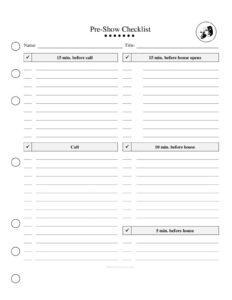
Pre-Show Checklist
Download a free Pre-Show Checklist template in PDF and DOCX to organize cast, crew, props, and tech before curtain — keep every performance running smoothly.
PDF
DOC
4 downloads
0
likes
Download Files
- DOC
A Pre-Show Checklist is a structured run-down of every task a theater company must complete before the house opens and the curtain rises. It is most commonly used by stage managers and crew to guarantee that nothing — from props placement to sound levels — is overlooked in the rush before a performance. You can download this Pre-Show Checklist free in both PDF and DOCX formats, with no signup required.
What Is a Pre-Show Checklist?
A Pre-Show Checklist is a standardized document used by stage managers, technical directors, and crew members to verify that a production is fully ready before an audience is admitted. It documents the sequence of setup tasks across departments — set, props, lighting, sound, costumes, and front of house — so that each performance starts under identical, reliable conditions. Rather than relying on memory during a high-pressure window, the team works through the list item by item, initialing or checking off each task as it is completed. The result is a repeatable routine that reduces last-minute scrambling, protects performer safety, and ensures consistency from opening night through the final show.
When Do You Need a Pre-Show Checklist?
Almost any live performance benefits from a documented pre-show routine. Common situations include:
- Opening a new production when the team is still learning the running order and needs a written reference for every department.
- Long runs and repertory schedules where the same setup must be repeated identically across dozens of performances.
- Touring productions that load into unfamiliar venues and must confirm every element works before doors open.
- School, community, and amateur theater where volunteer crews rotate and consistency depends on a shared list.
- Shows with complex tech — flying scenery, pyrotechnics, quick changes, or live music — where a missed safety step has real consequences.
- Training new stage managers or crew who need a teaching tool to learn the full pre-show sequence.
What a Pre-Show Checklist Should Have
A complete Pre-Show Checklist captures every department and assigns clear accountability. The strongest versions include the production name and performance date, a call-time reference, and grouped task sections so each crew member can quickly find their responsibilities. Look for areas covering the set and stage deck, props presets, lighting and sound checks, costume and wardrobe readiness, performer call-ins, front-of-house coordination, and safety walkthroughs. Each line should have a checkbox or initial space and, ideally, a column noting who is responsible and the time the task must be completed. A signature line for the stage manager confirming the production is “ready to go” gives the document its final authority.
How to Fill Out a Pre-Show Checklist
Work through the form in performance order so it mirrors how the evening unfolds:
- Header information: Enter the production title, the performance date and time, and the venue or stage name at the top so the completed sheet can be filed and referenced later.
- Call times: Record the crew call, cast call, and house-open times to anchor the rest of the schedule.
- Stage and set: Confirm the deck is swept and clear, scenery is in its starting position, and any locks or brakes are engaged.
- Props preset: Check that every prop is on its preset table or onstage spike mark, and that consumables are restocked.
- Lighting and sound: Note completion of the light check, sound check, microphone battery swaps, and headset/comms test.
- Costumes and wardrobe: Verify quick-change stations are set and costumes are placed for the correct entrances.
- Cast check-in: Mark each performer present as they sign in.
- Front of house: Coordinate with the house manager and confirm clearance to open the house.
- Final sign-off: The stage manager initials or signs to confirm the show is ready before giving the call.
Organizing the Checklist by Department
Most productions run smoothest when the checklist is divided into clear departmental blocks rather than one long undifferentiated list. Group tasks under headings such as Stage/Set, Props, Lighting, Sound, Wardrobe, and Front of House, and let each department head own their block. This structure allows several crew members to work in parallel — the lighting board operator runs the light check while props are being preset and the deck crew sweeps the stage — without anyone duplicating effort or waiting on another team. It also makes the document a useful diagnostic tool: if something goes wrong during the performance, the stage manager can trace back to which checklist item should have caught it and tighten the routine for the next show.
Tips for a Reliable Pre-Show Routine
Treat the checklist as a living document. After early performances, add items the team discovered were missing and remove steps that proved redundant. Build in a realistic time buffer so the list can be completed calmly rather than at a sprint, and post a copy at the stage manager’s station and backstage so everyone shares the same reference. Establish a clear verbal call sequence — “places,” “house open” — that follows naturally from the completed list. Finally, designate a single person to give the final sign-off, so accountability is never ambiguous.
Common Mistakes to Avoid
- Skipping the safety walk — checking spike marks, clearing tripping hazards, and confirming flying scenery is a non-negotiable step.
- No named responsibility — tasks without an assigned owner are the ones that get missed.
- Forgetting battery and comms checks — dead mic packs and broken headsets surface at the worst possible moment.
- Treating the list as optional once the run is established — complacency in week three causes the errors opening night avoided.
- Not updating the checklist after changes — new props, blocking, or cues should be reflected immediately.
- Opening the house before final sign-off — admitting the audience prematurely removes the buffer needed to fix late problems.
Frequently Asked Questions
What is a Pre-Show Checklist used for? It is used to verify that every department of a theater production is ready before the audience is admitted and the show begins. By walking through each task in sequence, the stage management team ensures consistency and safety from one performance to the next. It turns a chaotic pre-curtain window into a repeatable routine.
Who is responsible for completing the Pre-Show Checklist? The stage manager typically owns the overall checklist and gives the final sign-off, but individual sections are usually delegated to department heads. The lighting operator handles the light check, the props crew confirms presets, and wardrobe verifies costume stations. Shared ownership with one final authority works best.
How do I customize this checklist for my production? Open the DOCX version and add, remove, or rename items so the list matches your specific set, props, cues, and crew structure. Most productions tailor the document during tech week and refine it over the first few performances. The template is a starting framework, not a fixed form.
Is a Pre-Show Checklist only for professional theaters? Not at all. School, community, and amateur productions arguably benefit even more because volunteer crews rotate and rely on a shared written reference. A clear checklist helps inexperienced team members learn the routine quickly and perform consistently.
How much does this Pre-Show Checklist template cost? It is completely free to download in both PDF and DOCX formats, and no signup or account is required. You can print the PDF for backstage use or edit the DOCX to fit your show. Use it for as many productions as you like.
When should the checklist be completed before a show? Most teams finish the full checklist before the house opens, with a realistic time buffer built in so any problems can be fixed calmly. The exact timing depends on your call schedule and the complexity of your setup. Aim to have the stage manager’s final sign-off comfortably before doors.
This Pre-Show Checklist template is a general example provided for informational purposes only and is not professional, safety, or legal advice. Production requirements, venue rules, and safety regulations vary by location and by show — consult your venue’s technical staff and a qualified professional to ensure your procedures meet all applicable requirements.
Related Forms
- Blank Schedule Ongoing
- Sound Inventory Sheet
- Prop Pre-Set Checklist
- Focus Chart
- Conflict Calendar
- Contact Sheet Individual
Browse more in Theater.